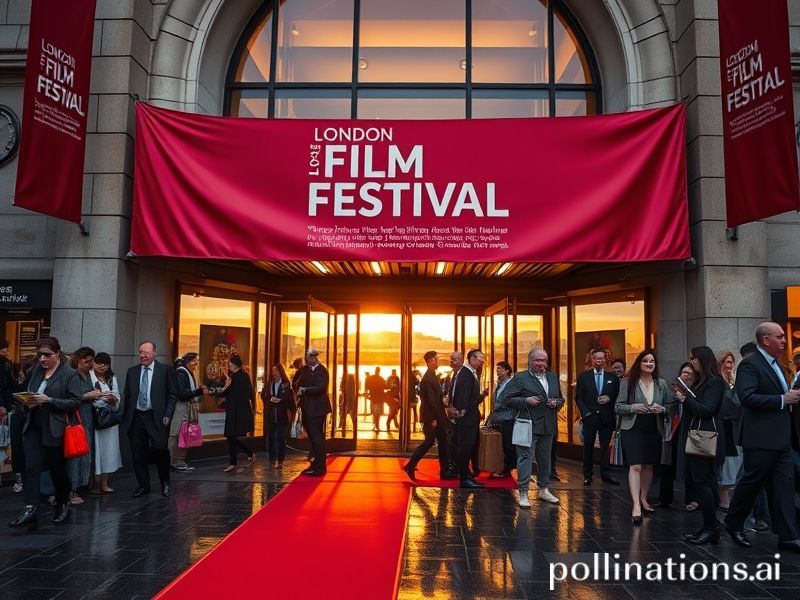
London, that damp and overpriced island capital, is once again pretending the planet orbits Leicester Square. The 67th BFI London Film Festival (or LFF to the acronym-obsessed) has rolled out its red carpet—this year woven from equal parts recycled polyester and Brexit anxiety—inviting the world to queue politely and pretend the weather is “atmospheric.” From October 4-15, 2023, the city that perfected passive-aggression has become a petri dish for global neuroses, all projected at 24 frames per second.
The festival’s 164-feature lineup hails from 67 countries, a statistic that looks heart-warmingly cosmopolitan until you remember the average delegate spends 90 % of their time in a five-tube-stop radius, clutching lanyards like diplomatic passports. Still, the program is a geopolitical mood ring: Ukrainian documentaries share the slate with Iranian defiance-cinema, while a Chinese arthouse epic sneaks in just ahead of another round of trade-war headlines. Each screening is a miniature UN session with popcorn; the only veto power belongs to whoever controls the subtitles.
Money, naturally, sloshes under every seat. Streaming giants—those cash-rich introverts—have bought whole wings of the program. Netflix parks its tank on the lawn with “Maestro,” Bradley Cooper’s Leonard Bernstein biopic, which will promptly vanish onto a thumbnail menu the size of Liechtenstein. Amazon, still wearing the expression of a kid who only got invited because he owns the ball, counters with “Saltburn,” a posh-Gothic psychosexual romp that will simultaneously scandalize the Daily Mail and boost Oxford tourism. Somewhere in the algorithmic gloom, Apple TV+ is lurking with “Napoleon,” presumably timed for the moment global audiences most need a two-and-a-half-hour reminder that megalomania ends badly on a small island.
Meanwhile, the British government—fresh from discovering that “creative industries” can be taxed—has announced a new 40 % rebate for VFX work. This fiscal flirtation means London may soon render more apocalypses than it suffers, an irony not lost on the climate-change doc section, whose filmmakers can now watch their flood sequences composited in the very city whose basements are beginning to resemble Venice without the charm.
The festival’s true currency, however, is reputation laundering. Saudi Arabia’s new Cultural Development Fund underwrote a “New Cinema” sidebar, offering Q&A sessions that politely avoid questions about bone saws. Qatar, still flush with World Cup afterglow, hosts nightly receptions on a terrace overlooking the Thames, serving dates and denials. Even the Russians have found a loophole: exile auteurs with impeccable anti-war credentials screen their state-disowned films, thereby allowing European programmers to applaud conscience without having to pronounce “Navalny” on stage.
For the global press corps, LFF is an annual exercise in cognitive whiplash. One moment you’re watching a Senegalese drama about migration; the next you’re interviewing a TikTok star whose film knowledge extends to “whatever’s trending.” Journalists file copy on the death of cinema while live-streaming reaction videos to their own reviews. Somewhere in the press lounge, a veteran critic from Le Monde is Googling “What is Letterboxd?” The answer, like most things here, is simultaneously trivial and existential.
And yet, for all the cynicism baked into soggy canapés, the festival still delivers moments that remind you why humans invented this absurd, communal dream machine. A 14-year-old from Lagos sees her first 35 mm print and forgets the exchange rate. An Iranian director, banned at home, receives a 10-minute ovation that drowns out the fire alarm. Even the security guards—outsourced, underpaid, and definitely not invited to the after-party—lean in to watch the credits roll.
When the closing-night gala ends and the carpet is rolled up for storage next to the national dignity, delegates will scatter back to their respective crises. The films will migrate to platforms, piracy sites, or oblivion. But for twelve days, London’s usual drizzle of disappointment was briefly back-lit by the collective flicker of a few hundred strangers sitting in the dark, agreeing—just for the runtime—to pretend the world isn’t ending. Which, in 2023, is about as international as hope gets.