Louise Minchin: How One Woman’s 3:40 a.m. Wake-Up Call Echoes from Kyiv to Caracas
By our correspondent, still jet-lagged in Terminal 2
In the grand geopolitical casino, where chips are measured in oil pipelines and rare-earth minerals, Louise Minchin’s decision to step off the BBC Breakfast sofa last autumn might look like spare change sliding down the side of the roulette wheel. Yet her departure has been felt—quietly, absurdly—far beyond the M25: from Ukrainian breakfast hosts wondering how to fill the dead air before the next missile alert, to Brazilian insomniacs who discovered that the BBC’s pre-dawn chirpiness translated surprisingly well into Portuguese subtitles.
Let’s not kid ourselves: Minchin never negotiated a ceasefire or chaired the WTO. What she did, for twenty years, was manufacture five hours of coherent English at an hour when most sentient mammals are still bargaining with their snooze button. That ritual—half pep talk, half group therapy for a nation convinced its kettle is the moral center of the universe—turned out to be a soft-power export Britain managed not to screw up. When she signed off with a wry “See you later—well, someone will,” diplomats in time zones from Islamabad to Idaho noted the tremor. One Canadian trade attaché confessed he’d calibrated his circadian rhythm to her weather forecast; something about the way she said “scattered showers” made NAFTA negotiations feel survivable.
Globally, the implications are deliciously trivial in exactly the way modern life excels at. South Korean streaming services instantly slapped together “Breakfast Like Minchin” compilation packs, proving that algorithmic grief is the sincerest form of flattery. Meanwhile, the Nicaraguan state broadcaster—never knowingly under-paranoid—ran a five-minute segment suggesting her exit was a MI6 psy-op designed to destabilize Latin American caffeine markets. Somewhere in the bowels of the Kremlin, a junior analyst filed a memo titled “UK Soft-Sofa Deterioration: Strategic Opportunity?” and was promptly told to go make the coffee, ideally before 3:40 a.m. GMT.
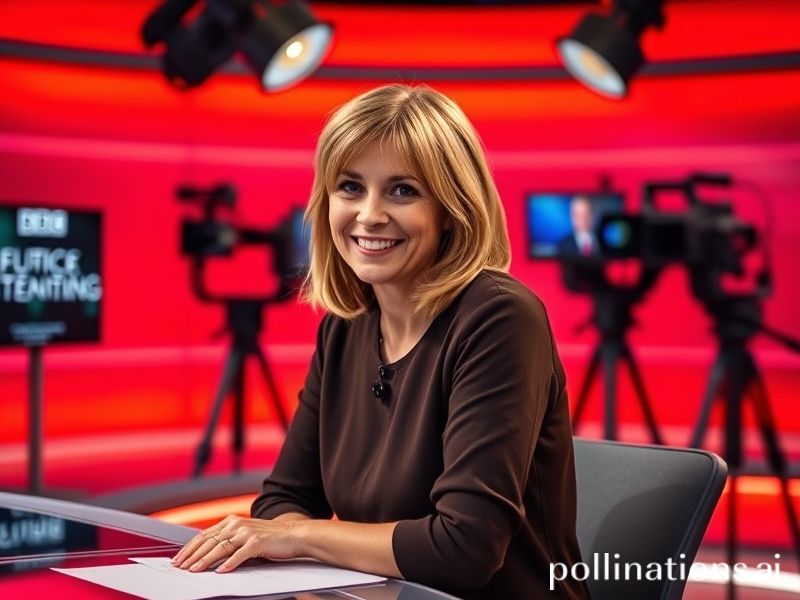
The broader significance, if we really must, lies in what Minchin represented: the illusion of stability. In a decade when the morning headlines might toggle between Brexit, plague, and the latest cryptocurrency named after a dog, she sat there in Studio C, flanked by a perspex map and Dan Walker’s teeth, and pretended the world still ran on polite curiosity. To viewers in places where breakfast television is interrupted by actual artillery, that composure looked almost indecently luxurious—like watching someone iron napkins during an earthquake. And yet they watched, hungrily. The BBC World News feed became an odd comfort blanket for expats in Dubai and refugees in Athens alike. One Syrian doctor in a German transit camp told aid workers the red sofa was “proof that somewhere, the kettle still worked.”
Of course, the universe enjoys a punchline. Within weeks of her exit, the UK’s energy regulator warned of winter blackouts that could silence kettles nationwide. The BBC replaced her with a rotating cast whose collective caffeine tolerance is still being stress-tested. Ratings have not collapsed—this is Britain, where viewers will endure almost anything except missing the weather—but the international comment threads have turned savage. A Kenyan satirist Photoshopped Minchin onto Mount Rushmore, subtitled “Last Known Example of British Reliability.” A Texan shock-jock demanded she be naturalized immediately and handed the 4 a.m. slot on CNN, because “if we’re going to collapse, let’s at least do it with diction.”
So here we are. Louise Minchin is currently off somewhere riding her bike across Patagonia for charity—an activity so wholesomely British it makes quinoa feel guilty. The planet keeps turning, missiles keep flying, and breakfast television staggers on like a hungover diplomat pretending to remember the names of everyone at the summit. Somewhere a new presenter is learning the hard way that “scattered showers” can sound like a death threat if you get the intonation wrong. And in the margins of a world that can’t decide whether to boil or freeze, a million displaced kettles still whistle in her honor.
We may not miss the news she read, but we miss the promise that someone calm would be there to read it. In 2023, that’s practically a superpower.