INEOS: How a Quiet Chemical Empire Became the World’s Loudest Sponsor of Everything
ZURICH — Somewhere between the Rhine and the Clyde, INEOS has managed to turn industrial solvents into soft-power superglue. The conglomerate—founded in 1998 by Sir Jim Ratcliffe, a man who reportedly keeps a Gulfstream G650 for weekdays and another for weekends—now sponsors the shirts of Manchester United’s women, the legs of the INEOS Grenadiers cycling team, and, should the wind be favorable, perhaps your nephew’s future wedding. In a world where nation-states struggle to keep the lights on, INEOS simply buys the grid, renames it “Project Lightbulb,” and hires a skywriter to spell the new moniker above Davos.
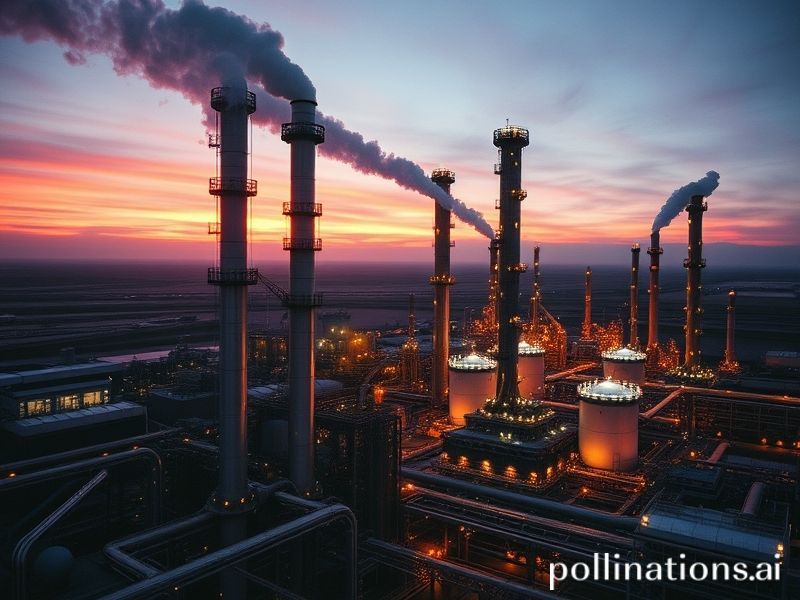
From Port Arthur to Port Neches, INEOS’s petrochemical plants exhale the perfume of late-stage capitalism. The company’s 194 sites in 29 countries refine, crack, and polymerize hydrocarbons with the casual efficiency of a blackjack dealer. One moment you’re looking at a bottle of Belgian spring water (also INEOS) and the next you’re holding the polypropylene that holds the bottle itself. It’s turtles all the way down, except the turtles are on fire and have emission permits.
The geopolitics are deliciously ironic. While governments bicker over carbon pledges, INEOS simply buys up North Sea gas fields, then announces a “net-zero roadmap” that looks suspiciously like a treasure map. The firm’s fingerprints are on the UK’s shale-gas fantasies, Norway’s plastic-recycling promises, and China’s ever-expanding appetite for “virgin” plastics—an oxymoron that would make Orwell blush. If soft power were measured in air-miles, Sir Jim’s fleet would qualify as a permanent member of the UN Security Council.
Then there’s sport. Nothing says “environmental stewardship” quite like slapping your logo on a carbon-fiber bicycle ridden at 60 km/h through the French Alps. The INEOS Grenadiers—formerly Team Sky, formerly British Cycling’s tax-efficient dream—now pedal under a banner that also adorns the side of a Grenadier 4×4, a vehicle whose fuel economy rivals a midsize coal plant. The messaging is so mixed it could be a cocktail: one part greenwash, two parts single-malt scotch (distilled, naturally, in a repurposed INEOS ethanol tank).
Meanwhile, the company’s $5 billion investment in Antwerp’s “Project One” cracker plant—so named, one assumes, because “Project Let’s Keep Burning Stuff” tested poorly with focus groups—promises to create 450 permanent jobs and 4.5 million tons of annual CO₂. That’s roughly one Belgium worth of emissions, give or take a waffle. Environmentalists have protested, but INEOS simply reminds them that the plastic kayaks they’re paddling were probably born in one of its reactors. Checkmate, hippies.
The broader significance? INEOS is the ghost in the machine of globalization: invisible yet omnipresent, profitable yet pleading poverty when regulators knock. It embodies the modern paradox of wanting to appear responsible while remaining essentially ungovernable. When the EU tightens emissions rules, INEOS threatens to relocate to the US Gulf Coast, where rules are written in crayon. When the US Congress flirts with windfall taxes, Sir Jim hints at a move to the UAE, where the desert air is thick with opportunity and lightly taxed condensate.
And so the merry-go-round spins. Governments promise green revolutions; INEOS sells them the plastic seats. Activists demand circular economies; INEOS circles the wagons. Consumers clutch reusable bottles made from, well, INEOS resin. Somewhere a cyclist in INEOS kit sips from an INEOS-branded bidon, unaware that the water inside has a higher carbon footprint than the Tour de France itself. The planet warms, the profits rise, and a discreet logo is embroidered on yet another jersey—proof that in the 21st century you don’t need to plant a flag to claim territory. You just have to put your name on the chest of someone faster than the news cycle.
In the end, INEOS teaches us the oldest lesson in empire: if you can’t beat them, sponsor them. Preferably in triplicate.