Qatar Airways: The World’s Nicest Way to Ignore Geopolitics at 35,000 Feet
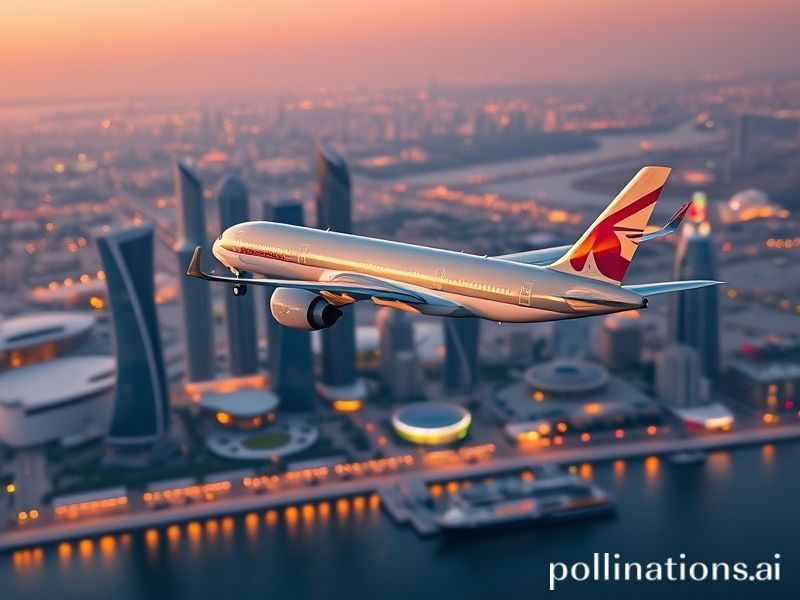
Doha—Somewhere above the Persian Gulf, the cabin lights dim to a shade called “midnight indigo” and a flight attendant glides down the aisle offering warm almonds as if they were tiny, salted apologies for the last half-century of regional turbulence. Qatar Airways, the state-owned carrier that launched in 1997 with a handful of leased jets, now flies to more than 170 destinations on every continent except Antarctica—penguins, apparently, can’t accrue Avios. Its rise is routinely described as meteoric, which is ironic given how rarely meteors land exactly where they’re told to by air-traffic control.
The airline’s story is less about aviation than about soft power delivered in a chilled glass of Krug. When Saudi Arabia, the UAE, Bahrain and Egypt blockaded Qatar in 2017—cutting land, sea and air links in a fit of diplomatic pique usually reserved for divorces—the carrier simply rerouted through Iranian airspace and kept flying. Detours added 45 minutes to some European flights, but Qatar Airways marketed the inconvenience as “scenic.” Passengers, ever eager to believe the brochure, Instagrammed the Zagros Mountains and mumbled that the embargo was “good for in-flight movies.”
Globally, the airline has become a floating Switzerland: neutral, polished, and rich enough to pretend neutrality is effortless. Its Al Mourjan lounge in Doha—marble floors polished to the point of existential crisis—offers sleeping suites and a spa where you can get a “hydrating caviar facial” while CNN loops footage of the same caviar’s natural habitat being bombed. The message is subtle: why choose sides when you can choose Dom Pérignon?
From Lagos to Los Angeles, the carrier’s growth sketches the darker outlines of globalization. Its route map is a connect-the-dots of places where hydrocarbons, desperation or debt create just enough demand to fill an A350. In Dhaka, migrant workers queue for flights to Doha clutching plastic-wrapped suitcases and dreams of exit visas. Over the Atlantic, hedge-fund managers recline in Qsuite business class, sipping lime-and-mint mocktails while reading pitch decks about “human capital optimization.” Same aluminum tube, two species.
Labor activists note that the airline’s glamour is underwritten by kafala, the sponsorship system that tethers foreign workers to their employers like carry-on luggage. Amnesty International calls it “systemic exploitation”; Qatar Airways prefers the phrase “five-star service culture.” Both statements fit on the same luggage tag. When FIFA awarded the 2022 World Cup to Qatar, the airline’s marketing team shot into hyperspeed, plastering Leo Messi’s face on every boarding pass like a papal indulgence. The message: yes, stadiums were built by men who can’t leave the country without an exit stamp, but look—free Wi-Fi!
Environmentalists, never invited to the caviar facial, point out that each long-haul flight emits more CO₂ per passenger than some small nations manage in a year. Qatar Airways counters by buying carbon offsets that fund tree-planting projects in countries passengers will never visit because, well, no direct flights. The trees, presumably, wave gratefully as contrails scar the sky above them.
Still, there is something perversely comforting in the airline’s insistence that civility can be microwaved and served at cruising altitude. While other carriers nickel-and-dime for legroom, Qatar Airways hands out pajamas stitched from organic cotton and denial. Somewhere between the warm towel and the cheese trolley, geopolitics shrinks to the size of an in-flight map icon: a tiny, glowing plane inching across a planet that looks suspiciously less on fire from 40,000 feet.
By the time the wheels touch down—whether in São Paulo or Seoul—passengers have been reminded that the world can still be orderly, perfumed, and disturbingly well-catered. They disembark refreshed, hydrated, and only mildly complicit. Outside, the same planet resumes its regularly scheduled chaos, but for the length of a transcontinental flight, humanity agreed to fasten its seatbelt and pretend the seatbelt sign wasn’t, in fact, permanently lit.