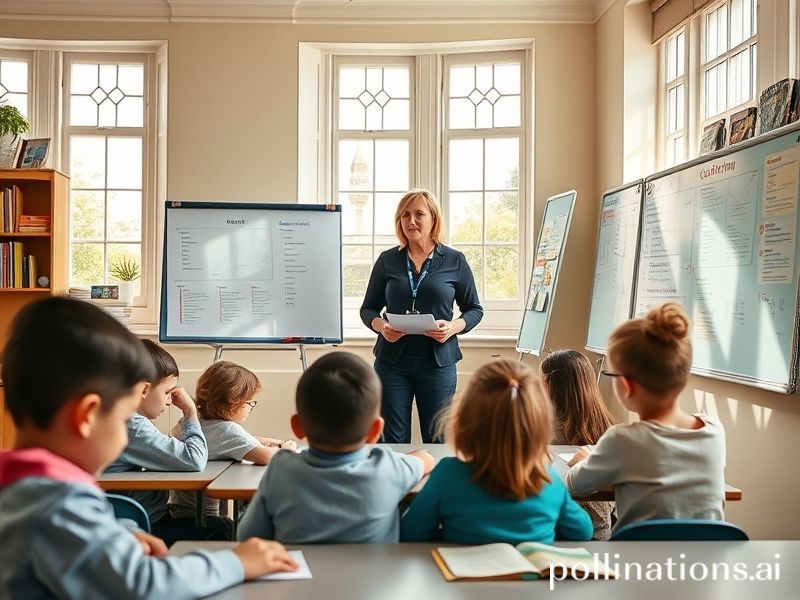
Ofsted Unleashes ‘New Framework’ – World Watches in Mild Panic
By Our Correspondent in an Undisclosed Café, Somewhere Between Heathrow and Existential Dread
LONDON—Yesterday, in a conference room scented faintly of instant coffee and impending judgment, Ofsted unveiled its latest inspection framework. Across the planet, education ministers from Seoul to São Paulo leaned forward like anxious parents at a school nativity, wondering if Britain had again discovered a fresh way to weaponise clipboards. Spoiler: it has.
The new four-point grading scale—Outstanding, Good, Requires Improvement, and the ever-popular Special Measures (a phrase that sounds like a Bond villain’s retirement plan)—now comes bundled with “myth-busting” guidance, lighter paperwork, and an insistence that inspectors will “talk more to pupils.” Internationally, this was greeted with the diplomatic equivalent of a raised eyebrow: after all, the last time a British civil servant promised to “listen to young people,” the youth responded by voting for Brexit and downloading TikTok.
Still, the ripple effects are already being charted on global risk-assessment spreadsheets. Singapore’s Ministry of Education immediately dispatched a fact-finding team, presumably to confirm that yes, Western nations still believe you can quantify curiosity with a rubric. Finland, meanwhile, issued a politely amused press release reminding everyone that its teachers already trust each other and therefore don’t require strangers with stopwatches to rate “behaviour and attitudes” like an Uber driver after a hen night.
In Washington, the Department of Education issued a statement praising “our British partners’ bold step,” which is Beltway code for “we’re stealing half of this and blaming you for the rest.” American charter-school networks have already begun A/B-testing the phrase “quality of education” in donor e-mails, while Chinese ed-tech giants are updating their AI proctoring software to detect “deep cultural capital” by analysing the angle at which a 12-year-old tilts their copy of Wuthering Heights.
Of course, the framework’s real genius lies in its portability. Inspectors will now spend less time on data-crunching and more on “professional dialogue”—a term that translates neatly into every UN language except, curiously, French. UNESCO observers note that the rubric’s emphasis on “personal development” could be photocopied straight into development aid programmes, allowing donor nations to rate Sudanese primary schools on “British values” without a trace of irony. Consultants in Dubai are already printing glossy brochures: “Get your Outstanding rating—only £299 per pupil, desert surcharge negotiable.”
Meanwhile, back in the sceptred isle, head teachers are perfecting the thousand-yard stare of someone asked to prove “intent, implementation and impact” while the boiler fails and the Year 9s discover vaping. One academy chain has reportedly started hiring former interrogators from Iraq—sorry, “experienced rapport-builders”—to coach staff on how to smile convincingly when describing their curriculum sequencing. If that sounds dystopian, remember we live in a world where PISA ranks teenagers like racehorses and the global ed-tech market is worth $340 billion. Compared to that, a friendly chat with an inspector is practically pastoral care.
And yet, cynicism only takes you so far. Beneath the gallows humour lies a universal truth: everyone wants the kids to be alright, even if we can’t agree on how to measure “alright.” Whether you’re in Lagos worrying about collapsed roofs or in Zurich obsessing over personalised learning dashboards, the basic transaction is the same—adults promising children a future that isn’t on fire. The new Ofsted framework is just Britain’s latest attempt to certify that promise, laminated and double-sided for ease of international franchising.
Will it work? Probably about as well as any other grand reform: some schools will game it, others will be crushed by it, and a heroic few will ignore it and continue the ancient art of actually teaching. The rest of the world will cherry-pick the bits that look good in a TED talk, then blame England when the PowerPoint slides don’t survive contact with reality.
And so the eternal carousel spins: standards rise, morale wobbles, ministers rotate, consultants cash in. Somewhere, a small child still wants to know why the sky is blue. If the new framework helps answer that question without reducing her to a data point, we might call it progress. Otherwise, we’ll simply schedule another framework in five years—same time, same instant coffee, same politely desperate optimism.
Conclusion: The planet will survive Ofsted’s fresh paint job, just as it survived the last one and the one before that. International observers will adapt, monetise, or ignore it as national mood dictates. And in draughty staffrooms from Cornwall to Kolkata, teachers will do what they always do—close the door, roll their eyes, and get on with the impossible. The framework is new; the comedy is timeless.