Dave’s Locker – International Desk
3 June 2024
Red Sox vs Athletics: A Microscopic Battle on a Planet That’s Already on Fire
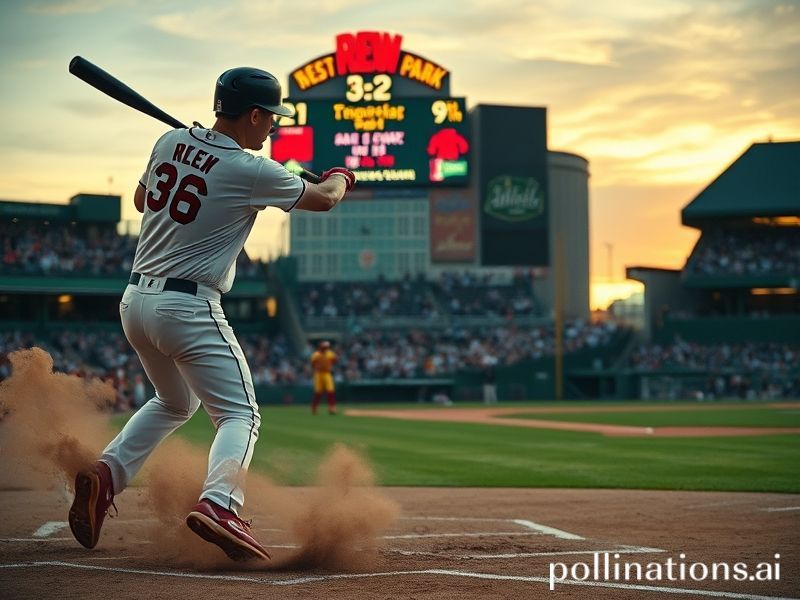
By the time the first pitch left Brayan Bello’s hand in Oakland, the Nikkei had slipped another 400 points, a cyclone was politely rearranging the coast of Bangladesh, and somewhere in Brussels a committee was drafting the 47th non-binding statement on AI safety. Yet 35,000 Americans—plus the statistically inevitable 247 clandestine Canadians—decided the most pressing drama on Earth was whether a small sphere of cowhide could evade a slab of maple wielded by a man who still calls his glove “Susan.”
From the International Space Station, the contest looked like two colonies of bacteria arguing over a petri dish. Down on the surface, however, the Red Sox and Athletics serve as a tidy allegory for late-stage capitalism’s favorite pastime: nostalgia wrapped in revenue sharing, garnished with geopolitical anxiety. Boston, a city that once dumped tea in protest and now dumps $17 on lukewarm lager, carries the burden of legacy. Oakland, meanwhile, can’t decide whether to build a new ballpark or simply FedEx its roster to Las Vegas and save on airfare.
Overseas audiences—those hardy insomniacs from Seoul to São Paulo who treat MLB.TV as an ASMR substitute—watch with the detached fascination usually reserved for American elections or Florida news. To them, the Red Sox are the empire striking back after a century of charming ineptitude, while the Athletics are the scrappy underdog that learned Moneyball, applied it successfully, and still got evicted for gentrification purposes. It’s like watching Greece debate austerity while Germany sells it beach towels.
The box score, of course, is merely the tip of a very expensive iceberg. Consider the supply chains: Dominican sugar plantations feeding the Red Sox clubhouse spread; Korean-made cleats on Oakland feet; Costa Rican-stitched baseballs rubbed with Mississippi mud, because nothing says global commerce like a regional dirt fetish. Every swing reverberates through stock prices of aluminum conglomerates and broadcast-rights holding companies domiciled in the Cayman Islands. When Rafael Devers launches a 112-mph line drive, somewhere a hedge-fund intern updates a spreadsheet labeled “Exit Velocity Arbitrage.”
And let us not ignore the soft-power implications. When Boston’s bullpen melts down in the eighth—again—European Union diplomats sigh with relief: at least their currency union never intentionally walked the tying run. Meanwhile, Chinese state media runs a 30-second clip of the A’s bleachers, noting that even a city with a homelessness crisis can fill plastic seats if beer is cheap enough. The lesson: democracy is messy, but it comes with garlic fries.
The game ended 5–4, because baseball abhors clean narratives. The Red Sox flew back east, burning jet fuel at a rate that would make a Saudi prince blush. The A’s stayed home, contemplating whether “home” will soon require a Nevada zip code. Somewhere in between, a betting syndicate in Manila yawned, closed its laptops, and reopened the cricket exchange: same algorithms, different colonial legacy.
Conclusion
So what, you ask, does a mid-season tilt between two .500-ish franchises matter to a planet busy rehearsing its own extinction event? Precisely this: it’s the last ritual we still perform together before the oceans reclaim the outfield. The Red Sox vs Athletics isn’t just baseball; it’s a quarterly earnings call disguised as pastoral theater. And while the final score fades from memory faster than a TikTok trend, the machinery behind it—merchandise, media rights, municipal extortion—grinds on like a perpetual-motion sneaker factory staffed by irony.
Enjoy the seventh-inning stretch. The glaciers aren’t getting any younger.