Stockholm Syndrome, Global Edition: Watching the World Argue Over a 20-Year-Old Who Still Can’t Legally Rent a Car in Most U.S. States
By Dave’s International Affairs Desk
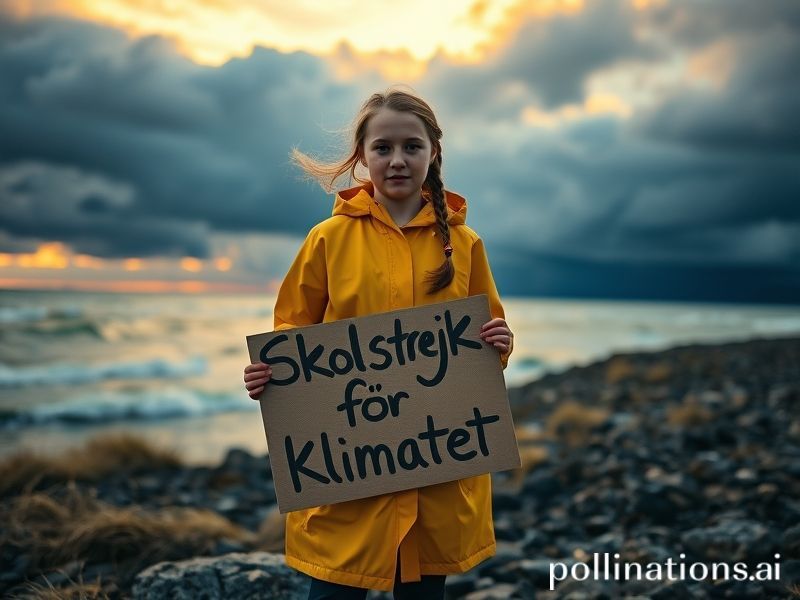
The planet’s most famous truant is at it again. Greta Thunberg, whose 2018 “Skolstrejk för klimatet” began as a solo cardboard protest outside the Swedish parliament, has now become a sort of geopolitical Rorschach test: step back and you see whatever neurosis your hemisphere specializes in. Americans see a pinko adolescent scolding them from the backseat of a Tesla; Europeans see a Nobel-in-waiting Joan of Arc in mom jeans; petrostates see an existential threat with better cheekbones than their PR departments can buy. Meanwhile, the climate itself keeps shrugging and setting new heat records like a bored bouncer outside an increasingly exclusive club called “Habitable Earth.”
From Davos to Delhi, Greta’s message—essentially “stop torching the only house with breathable air”—has been translated, subtitled, mistranslated, and meme-ified. In Beijing, state media calls her “a victim of Western eco-hysteria” between ads for coal-powered ski resorts. In Brazil, President Bolsonaro once dismissed her as a “pirralha” (brat) right before the Amazon reminded everyone who’s actually the boss by belching smoke visible from the ISS. The irony, of course, is that Greta’s carbon footprint is smaller than most delegates’ steak dinners at COP summits, yet she remains the lightning rod while the buffet keeps serving beef because, apparently, cognitive dissonance pairs well with pepper sauce.
The global economy has responded with its usual subtlety. European utilities rushed to rebrand natural gas as “transitional,” a euphemism so brazen it could only have been cooked up by the same minds that labeled cluster bombs “area denial devices.” Meanwhile, ESG funds slap solar-panel stock art on prospectuses stuffed with shares in companies whose supply chains run on diesel generators in provinces you can’t pronounce. Greta’s retort—calling out “blah blah blah” in Glasgow—was dismissed as childish by leaders whose own climate math still relies on unicorn-scale carbon capture by 2040. Somewhere, a lobbyist for Exxon’s algae-fuel division is Googling “how to photosynthesize sincerity.”
The geopolitical ripple effects are equally farcical. Russia spent years trolling Greta on state TV until its own permafrost started belching methane like an untaxed vodka distillery. Gulf monarchies invite her to “dialogue” while quietly lobbying to water down every IPCC comma, like arsonists offering fire-safety tips. Even the Global South, often portrayed as a monolithic victim in her speeches, is split: Kenya’s electric-bus startups cheer her on; Indonesia’s nickel miners mutter about neo-colonial hypocrisy while shipping ore for batteries that will soon be wrapped in “eco-friendly” marketing brochures. Everyone wants absolution without the inconvenience; Greta offers only the inconvenience.
What makes the circus fascinating is the meta-narrative: a single persistent voice has managed to expose how threadbare our planetary governance really is. The UNFCCC process resembles a group project where 195 students keep adding footnotes while the deadline burns. Greta’s superpower isn’t scientific revelation—IPCC reports already do that with footnotes nobody reads—it’s her knack for turning bureaucratic inertia into a livestreamed hostage crisis starring the biosphere. And we, the audience, keep refreshing the page, half horrified, half entertained, like doomscrolling Romans watching the Colosseum catch fire.
So here we are, five years after one Swedish teenager decided homework could wait. Emissions are still rising, but at least now the denial comes with PowerPoint decks. Greta, meanwhile, has graduated from school strikes to court cases, suing her own government for violating the Paris Agreement—a legal strategy as deliciously ironic as suing your landlord for arson while still paying rent. Whether she’s a prophet, a nuisance, or the world’s most effective unpaid lobbyist is beside the point; the planet’s fever doesn’t grade on charisma. The tragedy is that the adults in the room require a 20-year-old to remind them that physics doesn’t negotiate, it just wins.
In the end, the joke’s on us: we created a system so dysfunctional that a teenager with Asperger’s and a bullhorn became the closest thing we have to adult supervision. History may not remember which CEO pledged net-zero by 2050 and which one bought another yacht, but it will note that when the house was on fire, the kid who pointed it out was both celebrated and vilified—mostly by people still arguing over the color of the hydrant.