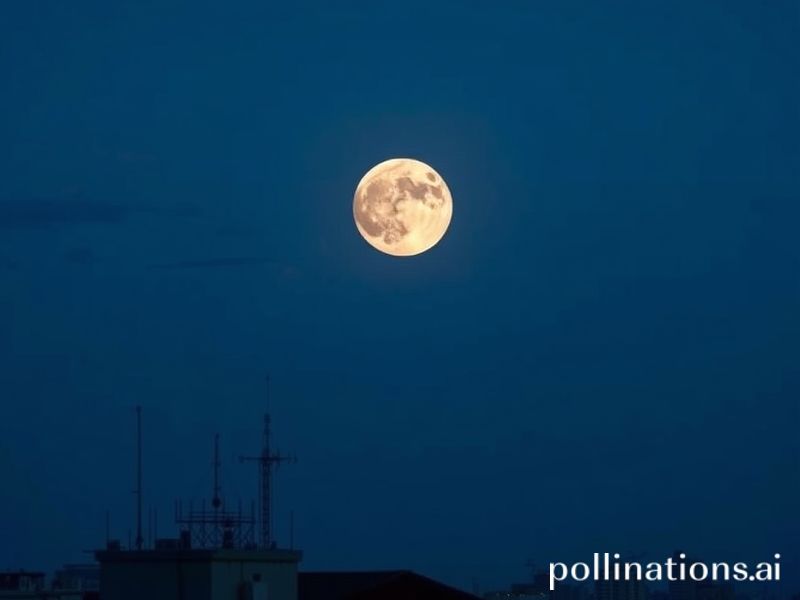
Moon Tonight: The World’s Oldest Reality Show Returns for Another Season
By Our Man in the Cold Empty Void
Dateline: Everywhere and Nowhere—Tonight, the moon will rise above Pyongyang and Paris, above the favelas of Rio and the gated compounds of Davos, above both the last polar bear and the newest refugee camp. Same orb, same chalky face, same indifferent distance of 384,400 kilometers. Yet every culture still insists on projecting its own neurotic plotlines onto the poor rock like a celestial Netflix Original that no one can cancel.
In Tokyo, salarymen glance up between subway ads promising “moon-viewing sake” and wonder if their overtime will ever end. In Tehran, rooftop telescopes dodge smog and morality patrols to glimpse the same cratered wasteland that American drones photograph with colder, better lenses. Meanwhile, Silicon Valley pitches a timeshare on the Sea of Tranquility—only $250 million per seat, oxygen not included, terms and conditions subject to Muskian whim. The brochure promises “life-changing perspective,” which is marketing speak for “you’ll still hate your father, but from farther away.”
Across the European Union, energy ministers hold emergency Zooms titled “Lunar Illumination vs. Gas Prices.” They conclude—after three hours of multilingual gridlock—that the moon is, regrettably, non-negotiable. In the United Kingdom, the BBC livestreams “Moon Watch 2024” with all the breathless solemnity of a royal funeral. Somewhere in the Midlands, a pensioner switches off the telly, muttering that the Queen never charged a subscription fee for existing.
Down in Lagos, generators cough diesel into the night so the neighborhood kids can see the moon without load-shedding interruptions. Their parents calculate: one hour of lunar appreciation equals two days of lost phone-charging. The kids decide the moon is worth the math. Up in the Arctic, a Norwegian research team records the moon’s reflection on melting ice and uploads the data to a server farm that consumes the annual output of a small coal plant. Progress, like irony, is carbon-intensive.
China’s Chang’e program, whose name translates roughly to “We’re Definitely Not Racing Anyone,” releases high-definition photos of the lunar far side, prompting conspiracy theorists worldwide to ask why the shadows still look “off.” NASA responds with a PowerPoint so polite it apologizes for existing. Elon Musk tweets a meme. The UN issues a strongly worded press release about “equitable lunar governance” that everyone files next to last year’s climate resolutions.
And still the moon performs its nightly shift without filing a single customs form. It illuminates Russian tanks rolling over Ukrainian fields, lights cartel caravans along the Sonoran trail, and gently silhouettes Korean border guards who mirror each other’s paranoia in 4K. It has watched every genocide, every moon landing, every awkward teenage kiss, every billionaire midlife crisis bought with a rocket ticket. It keeps impeccable records and offers no commentary—history’s most seasoned diplomat, armed only with dust.
Tonight, as the Earth tilts another notch toward ecological cliffhanger season, the moon will again demonstrate the universe’s most savage punchline: the only place humans have ever walked that isn’t actively trying to kill us is the one with no air, water, or Wi-Fi. We gaze up, sigh, and order another round of geopolitical self-harm. The bartender is a crater named after a dead astronomer who never saw a cent in royalties.
So, dear reader, whether you’re reading this on a cracked phone in Caracas or a platinum MacBook in Palo Alto, look up. That pale disk is the same one your Mesopotamian equivalent once blamed for crop failures. The only thing that’s changed is our ability to monetize the view. Drink it in while you can; subscriptions are going up with the tide.