Squirrel Hill Fire: Pittsburgh’s Little Inferno as a Global Mood Ring
By our jaded correspondent who keeps a passport in one pocket and a fire extinguisher in the other
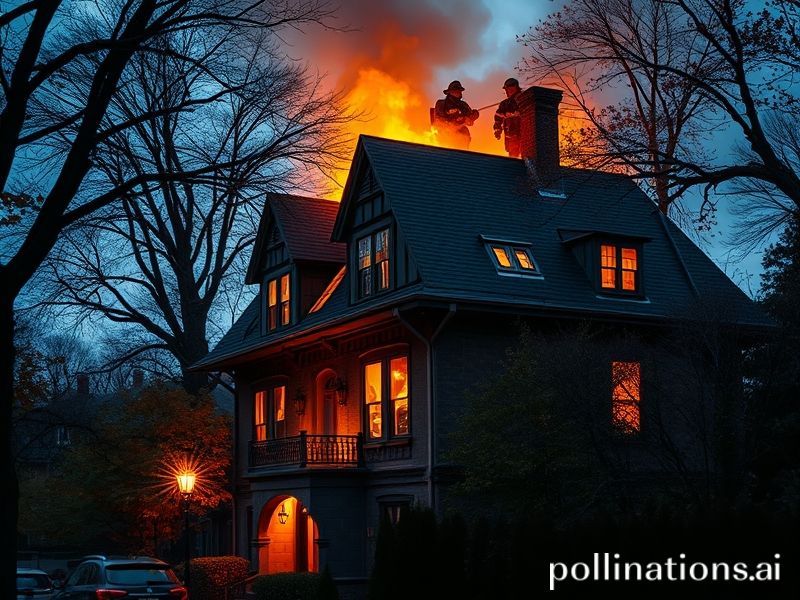
It takes a special kind of municipal embarrassment to make a neighborhood named after manic tree-rats combust on live television, yet here we are. In the early hours of yesterday—while much of Pittsburgh slept off another sports-related heartbreak—a four-alarm blaze tore through a century-old apartment block on Forbes Avenue in Squirrel Hill. Flames licked the sky with the theatrical enthusiasm of a Netflix arson documentary, and by sunrise the block resembled a charred layer cake nobody ordered. Two residents hospitalized, thirty displaced, one firefighter treated for “non-life-threatening optimism,” according to the city’s ever-upbeat PIO.
Cue the international news cycle, which treats every American fire like a campfire ghost story told over diplomatic brandy. French 24 ran B-roll of baguettes being buttered while solemnly noting “America’s crumbling infrastructure.” Al-Jazeera English framed the blaze as “another chapter in the Global North’s housing affordability inferno.” Meanwhile, the BBC dispatched a correspondent who pronounced “Squirrel Hill” the way one might say “Guantánamo,” lending the affair an imperial gravitas normally reserved for royal funerals or cricket scandals.
Of course, Squirrel Hill is no random zip code. It’s the kind of place where synagogues and Korean noodle shops coexist under the same soot-stained moon, and where the local Starbucks still spells your name wrong in three alphabets. That multicultural pedigree made the fire catnip for think-piece writers from Berlin to Bangkok, all eager to splice local tragedy into grander narratives. Housing crisis? Check. Climate change nudging century-old wiring past its expiration date? Double check. The slow-motion immolation of the American middle class, now available in 4K drone footage? Welcome to the buffet.
Across the Atlantic, EU urban planners took notes with the smugness of people whose buildings are held together by regulation rather than thoughts and prayers. German fire codes mandate sprinkler retrofits; America, meanwhile, treats them like an optional extra—right up there with dental insurance and a functioning democracy. In Seoul, city officials screened the footage for junior architects under the title “How Not to Do Mixed-Use Zoning, Part VII.” And in Lagos, where informal settlements combust with depressing regularity but rarely break into U.S. prime time, Twitter wits asked if the victims would now receive GoFundMe sympathy at Lagos prices ($1 = 780 naira and falling).
Back on the ground, the Red Cross handed out blankets and the kind of institutional coffee that tastes like regret. Local officials promised a “full investigation,” which translates to: we’ll issue a 400-page report nobody will read, then quietly bury it next to the lead pipes. Governor Shapiro flew in for the obligatory hard-hat photo op, strategically standing upwind from the smoke so as not to smudge the campaign backdrop. And somewhere in the crowd, a teenager live-streamed the scene to 40,000 followers under the caption “Y’all this is literally lit,” proving that irony, like carbon monoxide, is odorless yet lethal.
Yet for all the gallows humor, the Squirrel Hill fire is a Rorschach test for our planetary anxieties. It shows that whether you live in a rust-belt rowhouse or a Mumbai chawl, the basic ingredients of catastrophe are on sale in bulk: deferred maintenance, ballooning rents, aging grids, and the universal human talent for ignoring the smell of smoke until the curtains ignite. In that sense, the embers on Forbes Avenue are less Pittsburgh’s problem than Earth’s shared self-portrait—grainy, overexposed, and still smoking.
So let us pour one out for the displaced, preferably something less flammable than grain alcohol. And let us admit, between sips, that every city now keeps its own little Squirrel Hill: a quaint district where tomorrow’s headline is quietly smoldering behind yesterday’s drywall. All it needs is a spark, a stiff wind, and the collective shrug of a world too busy doom-scrolling to change the batteries in the smoke detector.