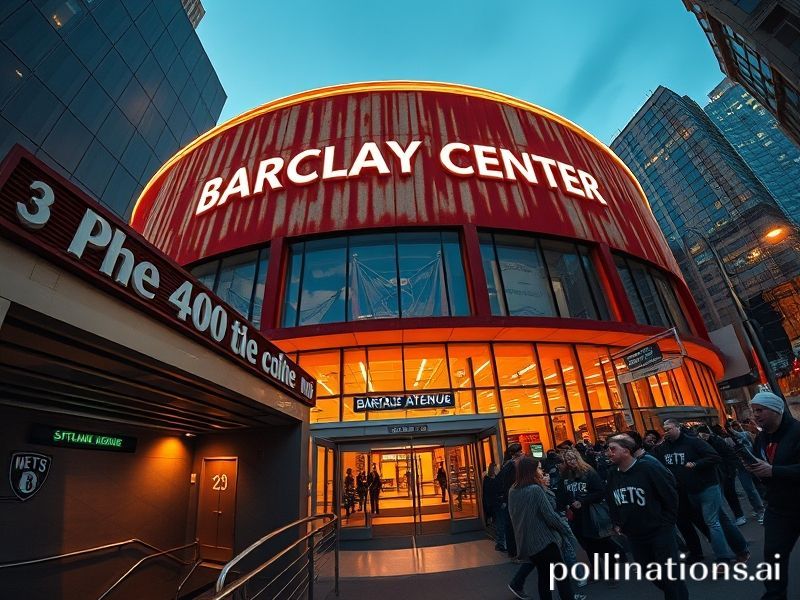
The Barclays Center, that rust-coated UFO that crash-landed at the intersection of Atlantic and Flatbush, is less a basketball arena than a diplomatic embassy for the global religion of spectacle. Opened in 2012 by a Russian oligarch, bankrolled by a British bank, and programmed to keep American attention spans twitching, it is the perfect three-nation pact: capitalism without borders, but with very expensive nachos.
To the average Brooklynite, the place is simply where the Nets pretend to contend and where one goes to pay $17 for a beer that tastes like remorse. To the rest of the planet, it is a case study in how cities everywhere now compete to host the same traveling circus. The Rolling Stones? Check. K-pop’s latest immaculate cyborgs? Naturally. An esports final where teenagers in noise-canceling headphones earn more than the GDP of Tuvalu? Twice a year, regular as tax evasion.
International observers—those dour policy fellows who measure everything in soft-power indices—note that Barclays Center is a soft-power piñata. When President Zelenskyy beamed in on the jumbotron last spring, the crowd roared as though freedom itself had just dunked on Vladimir Putin. Two weeks later, Chinese state media cited the episode as proof that American arenas are simply NATO fan clubs with better lighting rigs. Somewhere in Brussels, an underpaid analyst updated a spreadsheet titled “Basketball Diplomacy Risk Matrix.”
The building’s very façade is a geopolitical mood ring. Weathering steel, the architects bragged, would oxidize into a “warm, velvety patina.” What they didn’t mention is that the same alloy is used for shipping containers and artillery casings, giving the arena the look of a munitions depot that decided to pursue a second career in showbiz. At dusk, when the LED halo ignites and the rust glows like leftover embers from the Cold War, the message is clear: welcome to the end of history—concessions on the concourse.
From Singapore to São Paulo, arena consultants fly in to study the Barclays blueprint: how to displace 200 mostly immigrant households without anyone important caring (answer: rebrand it as “urban renewal”), how to sell naming rights in perpetuity so that even bankruptcy can’t erase your corporate logo, and how to pipe the smell of fresh popcorn through the HVAC so effectively that patrons forget the mortgage-grade interest on their season tickets. The manual is translated into seven languages, none of them human.
Inevitably, the pandemic turned the place into a mass-vaccination hub, because nothing says “public health” like a building whose original Environmental Impact Statement read like an apology letter. Lines snaked around the block: masked grandmothers from Crown Heights standing beside hedge-fund princes who’d helicoptered in from the Hamptons, all united in the fervent hope that a Pfizer jab would let them return to overpaying for disappointment in Section 207. A French TV crew filmed the scene and titled the segment “Liberté, Egalité, Season-Ticketité.” Ratings were magnifique.
This month, the arena hosts the NBA’s inaugural In-Season Tournament—an invention so shamelessly engineered to boost television rights fees that even FIFA executives blushed. Fans will arrive clutching passports from 40 countries, each having paid ransom-level prices for the privilege of watching millionaires jog through a glorified scrimmage. The global supply chain of hype hums along: merchandise stitched in Bangladesh, crypto ads programmed in Estonia, and a halftime act flown in from Seoul on a private jet that burns roughly the annual carbon budget of Chad.
When the final buzzer sounds and the lights dim, the Barclays Center will still be there: a rusting monument to the unshakable human conviction that if we cram enough strangers into one room and charge them for breathing, we can call it culture. Somewhere, a city planner in Lagos or Lima is already sketching its twin—minus the rust, plus a retractable roof—because progress, like heartbreak, scales beautifully.