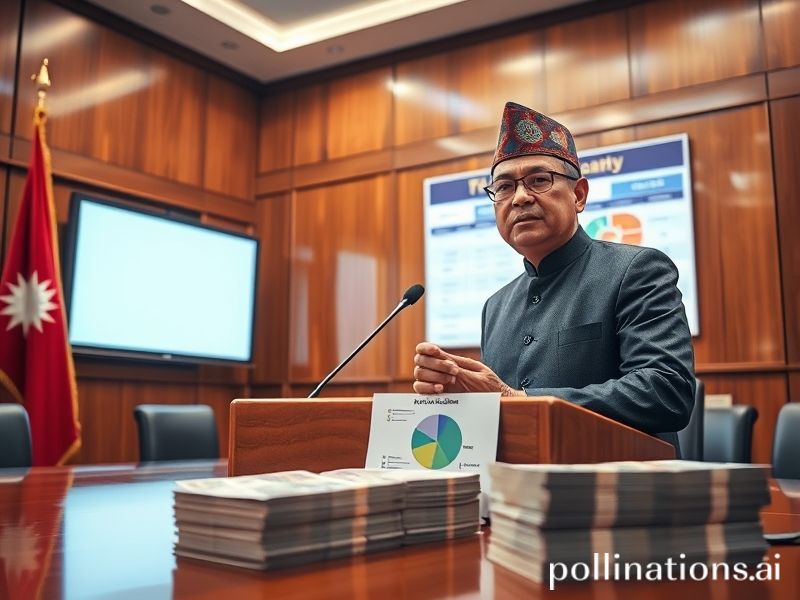
Kathmandu – It takes a special kind of optimism to balance a national budget when your country is wedged between two nuclear frenemies, your rivers are swelling with glacial tears, and your most reliable export is the occasional viral Sherpa meme. Enter Bishnu Prasad Paudel, Nepal’s freshly re-appointed Finance Minister, a man whose smile manages to say both “we’re open for business” and “please don’t look at the balance sheet.”
Globally, Paudel’s fifth tour at the ministry arrives just as the planet’s central banks are playing monetary Whac-A-Mole with inflation, recession, and whatever fresh horror El Niño has in store. While Jerome Powell waves his 5.5 % interest rate like a crucifix at Dracula, Paudel is stuck with an economy whose GDP—roughly the cost of two Silicon Valley parking lots—still needs to finance roads that don’t dissolve every monsoon. The International Monetary Fund, in a burst of fiscal tough-love, has told Nepal to keep public debt under 52 % of GDP. That’s like asking a Kathmandu street dog to keep below 52 % fleas: technically doable, but the fleas have lobbyists.
Why should the rest of the planet care? Because Nepal is the canary in the Himalayan coal mine for climate debt. As glaciers retreat faster than a British politician’s promise, downstream nations—India, Bangladesh, even thirsty China—will discover that their water supply now comes with Nepalese interest rates. Paudel’s new budget earmarks 12 % for “climate resilience,” which in UN-speak means “sandbags and prayers.” Meanwhile, the World Bank has graciously offered a concessional loan, ensuring that future generations can enjoy both potable water and perpetual payments in Swiss francs.
Then there is the geopolitical burlesque. Beijing’s Belt and Road Initiative keeps dangling shiny tunnels and railways across the mountains, while New Delhi counters with lines of credit so soft you could stuff a pillow with them. Paudel’s trick is to accept both sides’ largesse without accidentally joining either’s cold war. Picture a poker table where the chips are hydro-dollars and the players both claim to be your cousin. Last month he squeezed a $500 million soft loan from Exim Bank of China, then quietly let India refinance an equal amount of maturing sovereign bonds. Call it fiscal polyandry: traditional in the Himalayas, disastrous in accounting.
The dark joke here is that Nepal’s biggest revenue stream remains its youth—exported in bulk to Gulf construction sites and British NHS wards. Remittances equal nearly a quarter of GDP, which means every TikTok dance by a homesick Nepali nurse in Coventry is effectively fiscal policy. Paudel’s latest budget proposes taxing non-resident income above a certain threshold, a move economists describe as “aspirational” in the same tone oncologists use for stage-four optimism. The Gulf states, sensing leverage, have begun reminding Kathmandu that guest-worker visas are, shall we say, flexible.
Cryptocurrency, that global hallucination, has not spared the roof of the world. When Nepal’s central bank banned crypto trading last year, teenagers simply pivoted to mining in hydropower-rich villages, turning prayer-flag-draped valleys into fan-cooled server farms. Paudel’s response has been to tighten capital controls, thereby proving that prohibition still works—if your goal is to make smugglers rich and regulators tired. The irony is exquisite: a country with actual mountains prefers imaginary mountains of blockchain, because at least those don’t require asphalt.
Still, for all the gallows humor, Paudel’s predicament mirrors every small open economy trapped between ecological catastrophe and great-power tantrums. His ministry’s latest medium-term plan projects 6 % annual growth, a figure that assumes glaciers politely schedule their meltdown, monsoons remain punctual, and neither neighbor decides to weaponize tariffs out of boredom. In other words, it’s less a forecast than a haiku.
Conclusion: As the world’s finance ministers gather for their next Group of 20 selfie, spare a thought for the one whose backdrop is literally vanishing. Bishnu Paudel may not control global interest rates, Indian monsoons, or Chinese chequebooks, but he does control the narrative that Nepal still exists as something other than a cautionary footnote. For now, the ledger remains open, the canary keeps chirping, and the glaciers—like unpaid bills—are still coming due.