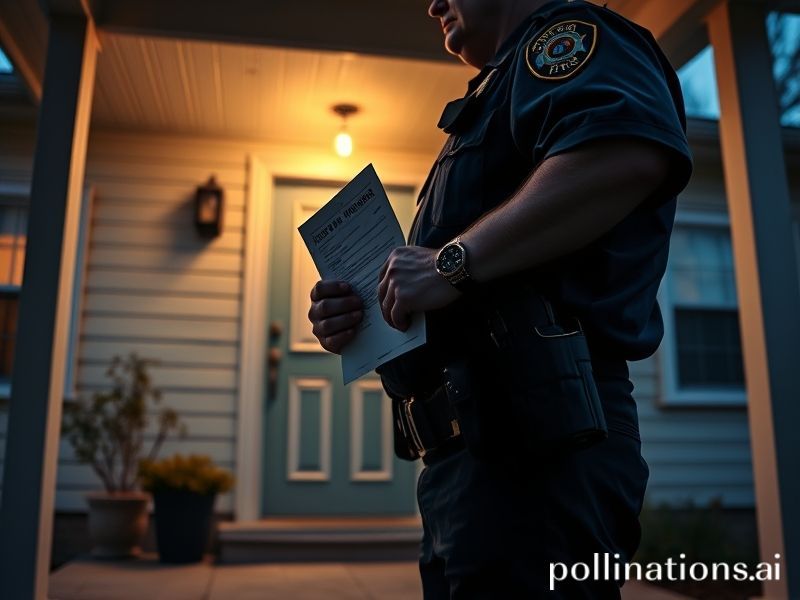
The Fourth Amendment: America’s Most Exported Paranoia
By Dave’s Foreign Correspondent-at-Large (currently self-quarantining in a non-extradition country)
The Fourth Amendment to the U.S. Constitution—protecting the citizenry from “unreasonable searches and seizures”—reads like a quaint postcard from 1791. On the front: powdered wigs, candlelit parlors, a polite knock before His Majesty’s agents rummage through your snuffbox. On the back, in ballpoint added by every customs officer from Heathrow to Hong Kong: “Wish you weren’t here.”
Americans, bless their litigation-addled hearts, treat the amendment as a sacred birthright. The rest of the planet, meanwhile, has turned it into a Rorschach test: each country sees whatever authoritarian urge it’s currently repressing. Britain—birthplace of both habeas corpus and CCTV on every sheep—now trains police to shout “Stop! I need to check your thoughts for hate speech” before politely entering your cloud storage. Singapore, ever the efficient autocracy, simply renamed the amendment the “Public Order (Convenience) Act” and added express lanes at the border for pre-approved guilt.
France, never one to miss a philosophical flourish, has fused the Fourth with existential dread. Under its latest “Loi Sécurité Globale,” gendarmes may search your phone for revolutionary memes, but only if they first mutter, “Hell is other people’s metadata.” Civil libertarians protest; the government shrugs, lights another Gauloise, and mutters something about Sartre that roughly translates to “privacy died with God.”
Meanwhile, Beijing has adopted the amendment wholesale—then flipped it inside-out. In China, the state is protected from unreasonable citizens. Algorithms comb WeChat for subversive emojis; if you send the wrong eggplant GIF, a polite officer arrives to seize not your phone, but your social-credit score. When asked how this squares with the U.S. text, the Ministry of Foreign Affairs helpfully notes that “China respects all amendments equally, provided they are amended correctly.”
The European Union, ever the bureaucratic dominatrix, drafted the GDPR to guarantee privacy—then strangled it in red tape. A cookie banner now pops up in 24 languages, each more apologetic than the last, while quietly auctioning your browsing habits to the lowest bidder. Brussels calls this “harmonization”; cynics call it the Stockholm Syndrome of consent.
Even failed states want in on the action. In Lebanon, where electricity is theoretical, parliament passed the “Fourth-ish Amendment” guaranteeing citizens the right not to be searched—unless the militia needs your generator. Somalia’s pirates, ever pragmatic, skip paperwork entirely: they seize your vessel, then ask if you’d like to opt in to their maritime surveillance program. Participation is mandatory, but the Wi-Fi is surprisingly robust.
Technology companies, those sovereign nations with better lobbyists, have internalized the Fourth Amendment as a profit center. Apple encrypts your iMessages so thoroughly that even the NSA needs a warrant—priced at $1,000 per emoticon. Google offers “Incognito Mode,” a digital confessional where your sins are forgiven but never forgotten by advertisers. Amazon’s Alexa, meanwhile, interprets “unreasonable search” as any query not ending in “please add to cart.”
Global travelers now play a perverse game of constitutional roulette. Land in Dubai and your laptop may be cloned faster than you can say “precedent from Katz v. United States.” Transit through Moscow and the FSB will kindly request your Telegram password—in cursive. Try entering Australia with an undeclared banana and you’ll discover the Fourth Amendment has been replaced by a beagle named Kevin.
The darkest irony? The amendment’s greatest defenders today aren’t Americans clutching pocket Constitutions, but dictators citing it as proof that even the freest nation can’t live up to its own hype. Every time the NSA vacuum-seals another terabyte, another strongman smiles: “See? They’re just like us, only with better Netflix.”
Conclusion: The Fourth Amendment has become the world’s most influential ghost—haunting border crossings, server farms, and midnight knocks on doors that may or may not exist. Its text is short; its afterlife, endless. From Caracas to Canberra, we’ve all become suspects in a lineup drawn by Silicon Valley and signed off by whoever happens to control the airport that day. Privacy, it turns out, was never a right; it was a temporary loophole in human curiosity, now closing with the soft, bureaucratic thud of inevitability. Pack accordingly—and maybe leave the eggplant emoji at home.