The Kissing Bug: A Love Story Written in Blood and Bureaucracy
By Dave’s Locker International Desk
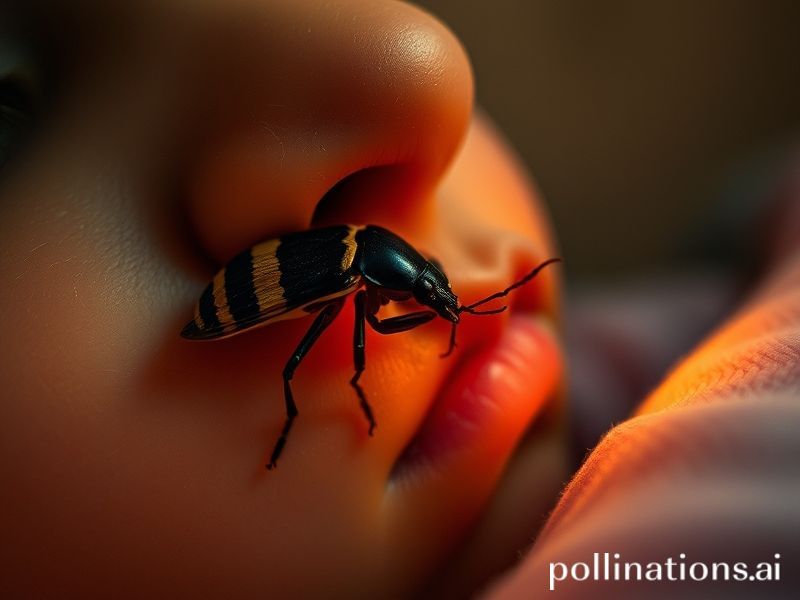
If you’ve ever felt that romance is dead, meet Triatoma infestans— the “kissing bug,” a creature so devoted it waits until you’re asleep, crawls onto your lips, and gently siphons your blood like a drunk sommelier at last call. Originally from the squalid corners of Latin America, this winged Casanova has now RSVP’d to housewarmings across five continents, proving once again that globalization’s greatest gift is the ability to export even our nightmares with next-day delivery.
The insect’s real charm, however, isn’t the midnight smooch; it’s the microscopic parasite it leaves behind—Trypanosoma cruzi, the agent of Chagas disease. Think of Chagas as the clingiest ex you never knew you had: it can lie dormant for decades, then suddenly produce heart failure or a megacolon that would make a Victorian anatomist blush. The WHO estimates 6–7 million infected people worldwide, with roughly 12,000 deaths annually, numbers that politely round themselves so we can file them under “someone else’s problem.”
Gringos used to dismiss Chagas as a telenovela disease—dramatic, tropical, and safely subtitled. Then the kissing bug packed its bags and headed north. Climate change, urban sprawl, and the tireless efficiency of FedEx have gifted the insect cozy new lofts in the southern United States, Mediterranean Europe, and even parts of Australia, where it presumably now wonders why everything is trying to kill it first. In Spain, health officials discovered infected bugs in suburban Madrid; in Italy, they turned up inside children’s backpacks—because nothing says “back-to-school” like a vector-borne illness.
The global response has been textbook pandemic theater: a flurry of PowerPoints, a modest research grant here, a shrug there. The drugs, benznidazole and nifurtimox, were invented during the Cold War when disco was still legal and are about as profitable as a fax machine repair shop. Big Pharma, ever the altruist, has calculated that poor, chronically ill people make for lousy quarterly earnings; ergo, R&D budgets resemble the insects themselves: small, elusive, and hiding under rocks.
Meanwhile, the bugs keep networking. In Bolivia, they’ve learned to colonize tin-roofed houses faster than the government can promise tin roofs. In Brazil, anti-Chagas campaigns are funded by mining royalties—nothing says “conflict of interest” quite like a gold company sponsoring the eradication of a disease its labor camps helped spread. And in the United States, Chagas is officially a “neglected tropical disease,” a bureaucratic euphemism meaning “we’ll get to it right after we fix student debt and decide whether hot dogs are sandwiches.”
Still, the kissing bug teaches us something tender about humanity: our relentless talent for denial. We install mosquito nets to fight malaria, tick collars for dogs, but ask the average homeowner to seal a wall crack and you’d think you proposed taxidermying the family pet. The bugs simply follow the iron law of real estate—location, location, location—while we debate whether disease is a moral failing or just poor branding.
So what’s the broader significance? Simple: in the 21st-century petri dish, no one stays local. Viruses surf jet streams, insects ride shipping containers, and our collective response is a global group chat muted on “irrelevant.” The kissing bug is merely the canary—or rather, the blood-sucking robin—signaling that when public health meets profit margins, the house always wins.
Until the day it doesn’t. Climate models predict that by 2050, kissing bugs could be summering in London, trading tapas for soggy chips and Brexit anxiety. Imagine: the Queen’s Guard stoically itching at parade rest while a parasite named after a Latin tryst gnaws at the nation’s ventricles. If that isn’t poetic justice for centuries of empire, I don’t know what is.
In the end, Triatoma infestans reminds us that love—parasitic or otherwise—finds a way. The only question is whether we’ll still be around to ghost it.