McDonald’s Monopoly: How a French Fry Bribe Became a Global Morality Play
By Dave’s Locker International Desk
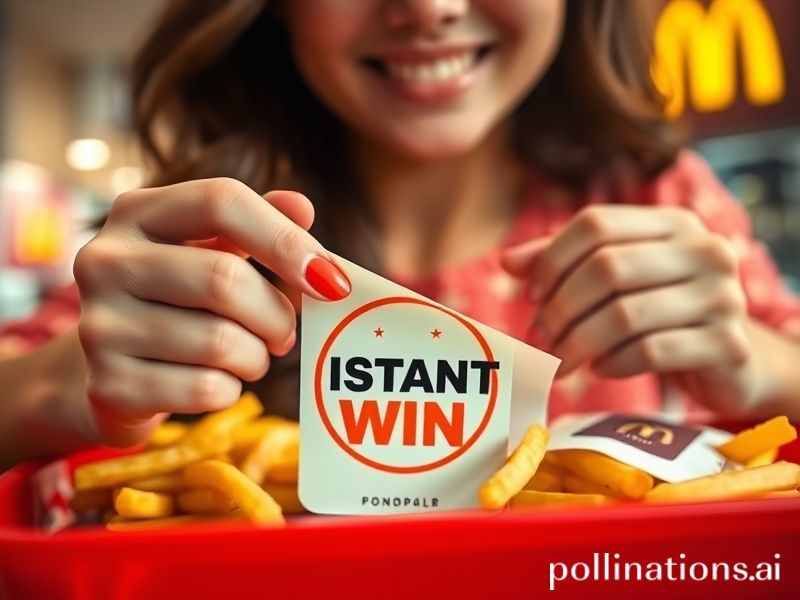
From Manila to Manchester, the same ritual unfolds every autumn: otherwise rational citizens queue for lukewarm nuggets in the hope that the paper sleeve will cough up a Boardwalk sticker and finance their escape from late-stage capitalism. Welcome to the planet’s most honest bribery scheme—McDonald’s Monopoly—where the house always wins, the players mostly lose, and the consolation prize is Type 2 diabetes.
The promotion began in 1987 as a harmless American marketing gimmick, the corporate equivalent of slipping a fiver to a border guard. Thirty-six years later it has metastasized into a transcontinental psychodrama, simultaneously feeding obesity epidemics, money-laundering fantasies, and the quaint notion that meritocracy can be supersized. In 2023 alone it ran in 36 countries, from Brazil (where inflation makes a free McFlurry feel like a hedge fund) to Japan (where even the mascots bow politely when they bankrupt you).
The rules are elegantly venal: buy more, win more, hope for a rare game piece that statistically appears once every 72 metric tons of fries. Statisticians calculate the odds of collecting the coveted set at roughly the same likelihood of a UN Security Council unanimous vote on anything meaningful. Yet every October, humanity collectively decides that math is for losers and cholesterol is for closers.
Of course, some people do win. In Germany last year, a 19-year-old apprentice walked away with a Mini Cooper, promptly wrapped it around an oak tree, and became a cautionary TikTok. In South Africa, a Johannesburg taxi driver scored a year of free fuel—enough to idle in traffic until the polar ice caps finish melting. And in Canada, a grandmother traded her rare sticker for a motorboat, then discovered the nearest body of water was frozen seven months a year. The gods of irony remain well-fed.
The darker subplot—because every feel-good promotion needs a film-noir remake—surfaced in 2001 when the FBI revealed that for six straight years almost every major U.S. prize had been siphoned off by a sprawling fraud ring run by the very company hired to run the game. Winners included a strip-club owner, a Colombo crime-family associate, and a psychopathic Mormon real-estate heir, proving that nothing unites humanity like free fast food and moral flexibility. McDonald’s apologized, blamed a “rogue employee,” and quietly rebooted the campaign next fall—because collective amnesia is the special sauce.
Internationally, the scandal merely confirmed what everyone already suspected: the game was rigged, just not usually by outsiders. In France, gilets jaunes protesters briefly floated the idea of storming McDonald’s warehouses to redistribute stickers—then realized the fries would get cold. In China, where Monopoly is rebranded “Great Golden Arches Treasure Hunt,” the prize pool skips cars and boats in favor of tuition vouchers and down-payments on apartments, neatly aligning the promotion with state directives on pro-natalism and property bubbles. The Party, ever pragmatic, understands that bribery works best when it looks like social policy.
Meanwhile, environmental NGOs have started calculating the carbon footprint of printing billions of stickers that are peeled, photographed, and discarded within 30 seconds—roughly the same energy required to power Belgium for a week. McDonald’s counters that the paper is sustainably sourced from forests that were going to burn anyway. Greta Thunberg responded with a single emoji: 🍟🔥.
And still we play. Because beneath the cynical veneer lies a raw, almost touching human truth: everyone wants a shortcut out of their predicament, even if the exit ramp smells of fryer grease. In a world where housing markets moon-rocket and wages crawl, the fantasy of a tiny golden ticket retains the last shreds of egalitarian promise. Rich or poor, we all stand an equal chance of choking on the same French fry.
Eventually the promotion ends, the billboards come down, and the winners fade back into quiet anonymity—minus one kidney’s worth of sodium. The rest of us return to the longer con of everyday life, slightly poorer, slightly fatter, and already nostalgic for next year’s game. As the ancient proverb almost goes: “Give a man a fish and he eats for a day; give him a McRib and a Park Place sticker and he’ll mortgage his future for the fries.”
Bon appétit, planet Earth. See you at the drive-thru window of disillusionment, same time next October.