The Wagyu Whitewash: How Burger King Turned Japan’s Sacred Cow into Global Fast-Food Fodder
By our correspondent in the departure lounge of dietary disillusion
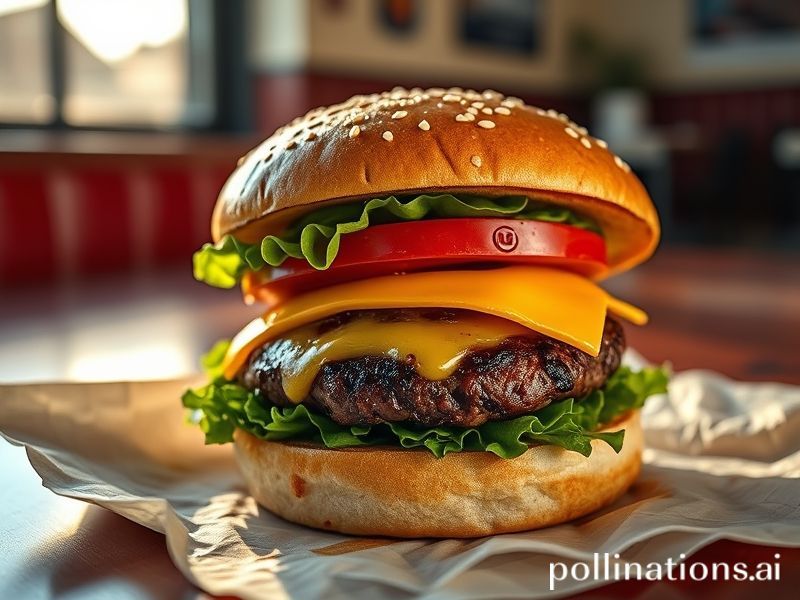
TOKYO—In the beginning, there was the cow, and the cow was good—so good, in fact, that Japanese emperors once forbade commoners from eating it. Fast-forward eight centuries and the same bovine aristocracy now arrives sesame-seeded, flame-broiled, and served in a paper crown. Last month Burger King rolled out its “Wagyu Burger” to 6,000 outlets across 60 countries, proving that nothing—absolutely nothing—remains sacred once global capitalism sniffs a 35 percent markup.
The launch video is a masterpiece of multicultural sedation: a slow-motion patty descending like a Kobe beef UFO onto a bun that has never seen Japan, soundtracked by a lo-fi beat you could meditate to if you still believed in anything. The fine print confesses the obvious: the meat is “Wagyu-style,” a phrase that ranks somewhere between “crypto-secure” and “limited-edition NFT” on the trustworthiness index. Sources in Queensland confirm the cattle are 50 percent Wagyu genetics and 100 percent Australian, which is corporate speak for “we put a tuxedo on a kangaroo and called it imperial.”
Still, the queues snake down shopping-mall corridors from Dubai to Detroit, because nothing unites humanity quite like the promise of luxury at a discount. In Jakarta, influencers weep salty soy tears of gratitude; in Warsaw, teenagers trade bites like communion wafers; in São Paulo, a man proposes marriage through the medium of truffle mayo. Civilizations rise and fall, but the drive-thru remains open 24/7, a neon confessional where we admit our willingness to pay 8.99 USD for a fleeting taste of someone else’s cultural heritage.
The timing is exquisite. While the planet teeters on the brink of recession, Burger King’s parent conglomerate posts a 13 percent revenue bump, proving that economic despair pairs beautifully with premium-adjacent protein. Analysts call it “trading-up in a downturn,” the same phenomenon that once moved canned beans during the Great Depression and is now moving “artisanal” beef during the Great Resignation. Nothing says “I refuse to participate in societal collapse” quite like upgrading your value meal.
Environmentalists, ever the life of the party, point out that each Wagyu-ish patty requires 1,800 liters of water and emits as much CO₂ as a small Bolivian village. Burger King counters by bragging about recycled napkins and paper straws that dissolve into gritty pulp before you finish your sentence, the corporate equivalent of planting a single bonsai after clear-cutting Kyoto. Meanwhile, Japan’s Ministry of Agriculture quietly files a trademark objection, a samurai sword rattled inside an IKEA sheath.
The broader geopolitical symbolism is hard to swallow, even with extra pickles. Japan’s post-war identity was built on exporting precision—cameras, cars, quartz. Now it exports a brand name that can be spray-painted onto any cow with a vague ancestral postcard from Hyōgo Prefecture. The United States, once the world’s burger imperialist, now imports the idea of Japanese exclusivity to distract from its own declining purchasing power. China, the largest Wagyu buyer outside Japan, consumes the burger while officially discouraging “decadent Western habits,” a hypocrisy so fragrant it needs its own ventilation system.
And yet, late at night, when the mall lights dim and the milkshake machines enter their cleaning cycle, the Wagyu burger reveals its truest self: a salty, greasy mirror. We bite, we chew, we tell ourselves we’ve climbed a rung on the status ladder, when in fact we’ve merely paid extra to remain exactly where we are—between terminals, between paychecks, between cultures we barely understand and commodities we absolutely cannot afford. The cow that was once divine has become a metaphor for our own mortgaged aspirations: marbled, overpriced, and gone in four bites.
Bon appétit, Your Majesty. The king is dead; long live the combo meal.