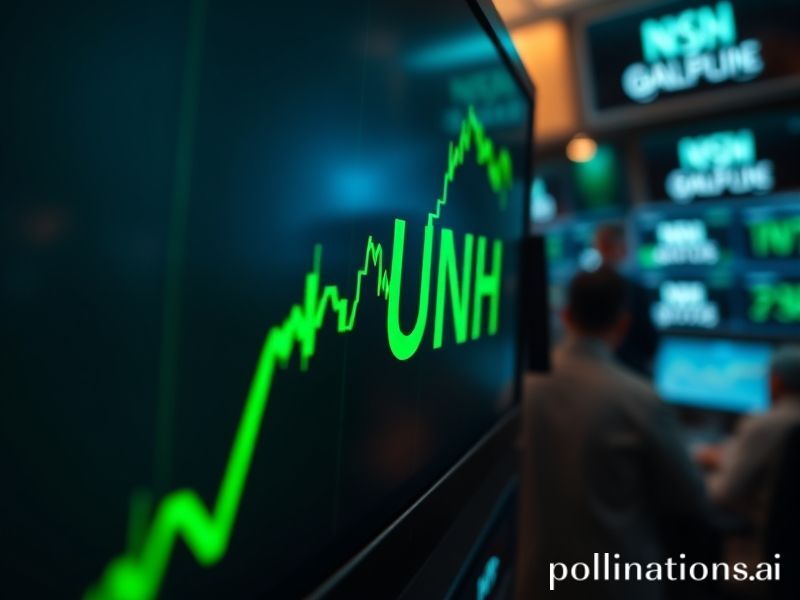
UnitedHealth Group’s ticker, UNH, has become the planet’s barometer for how much we’re collectively willing to pay not to die. From Singapore to São Paulo, analysts watch the same squiggly line crawl across their Bloomberg terminals, interpreting each uptick as proof that sickness remains the world’s most reliable growth industry. The stock hit another all-time high last week, prompting a champagne-soaked shrug in Zurich and a resigned sigh in Lagos, where the average citizen will never earn enough in a lifetime to cover a single UNH executive’s annual bonus.
The international fascination isn’t really about Minnesota, the company’s humble birthplace—land of polite apologies and passive-aggressive snow. It’s about the export of the American health-care model: a Rube Goldberg machine of deductibles, prior authorizations, and actuarial tables that other nations now sample like a dubious street kebab. When UNH rises, private insurers from London to Kuala Lumpur nudge their own premiums upward, muttering, “Well, if the Yanks can monetize existential dread, why can’t we?”
In Europe, the spectacle carries a whiff of voyeuristic horror. Germans, who still believe medicine should be a civic right rather than a leveraged buyout opportunity, watch UNH the way one watches a neighbor’s kitchen fire: grateful it’s not in their house, yet mesmerized by the glow. Meanwhile, Nordic fund managers quietly park sovereign-wealth money in UNH anyway, proving that ethical purity lasts exactly until the dividend yield exceeds five percent.
Emerging markets have their own complicated tango with the stock. Indian hospital chains copycat UnitedHealth’s vertically integrated playbook—insurance plus clinics plus pharmacy—while Brazilian brokers sell UNH to clients hedging against their own public system’s collapse. The joke writes itself: buy the company that profits when the state fails; if the state somehow succeeds, at least you’re rich enough to fly to Mayo.
China, ever pragmatic, sees UNH as both competitor and instruction manual. State insurers study its data-mining tools with the same intensity engineers once devoted to reverse-engineering iPhones. Rumor has it a Shanghai tech park has an entire floor labeled “Pilgrim’s Progress to Prior Authorization Nirvana,” where coders train AI to deny claims with Confucian politeness.
Of course, the stock’s ascent isn’t merely about spreadsheets; it’s a referendum on human optimism. Every share purchased is a tiny wager that people will continue to get sick in interesting, billable ways. Pandemics help—COVID-19 gave UNH a balance-sheet booster shot—but so do quieter epidemics of diabetes, despair, and desk-chair atrophy. Analysts at Credit Suisse (itself no stranger to existential risk) now include “global anxiety index” as a soft catalyst for UNH’s forward P/E.
The moral queasiness is universal, yet markets have the emotional range of a crocodile. When UNH beats earnings, Twitter fills with jokes about “sick gains,” a pun so dark it requires sunglasses. Italian pensioners, whose public system wheezes like a Vespa uphill, buy the dip anyway, proving that irony and income are not mutually exclusive.
And so the stock climbs, a financial ECG tracing humanity’s collective heartbeat—irregular, heavily medicated, and showing no signs of flatlining. It may not be the future we ordered, but it’s the one we keep bidding up. In the end, UNH is less a company than a global mirror: step closer and you’ll see every society’s uneasy compromise between compassion and capitalism, reflected in a green arrow that points, inexorably, toward tomorrow’s premium increase.