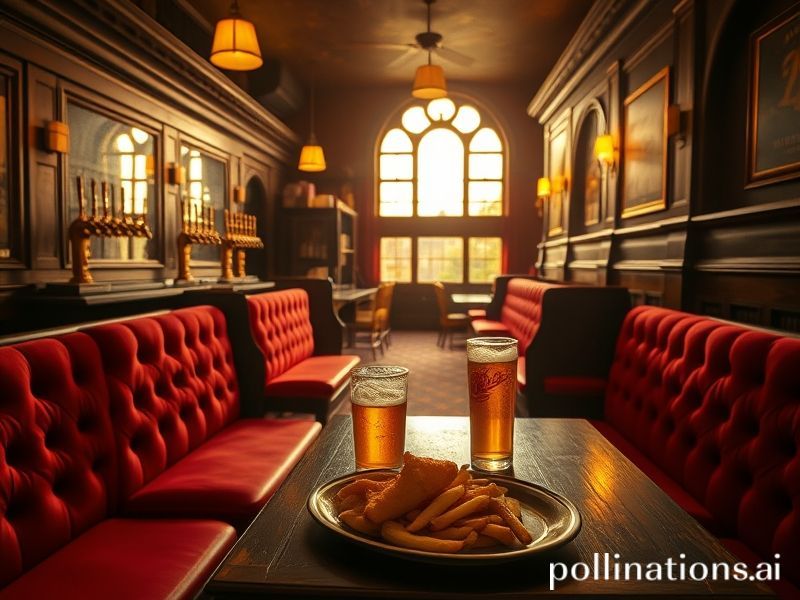
Wetherspoons: The Last Honest Embassy on Earth
An International Correspondent’s Field Notes from the Imperial Pub Chain
by “Marlowe” – filing from the Salisbury, Fleet Street, over a £2.15 “breakfast stout”
The United Nations has 193 member states, but only one issues its own currency in the form of laminated beer mats and calls its ambassadors “managers.” Welcome to Wetherspoons, the British pub chain that has quietly become the most influential soft-power network most diplomats have never heard of. From Wick to Weymouth, its 800-odd outlets serve as consular outposts for a kingdom that still believes lukewarm ale is a human right and that closing at 11 p.m. is merely a suggestion.
Globally, the chain’s footprint is roughly the size of Luxembourg, if Luxembourg were carpeted in sticky lager and furnished with the discarded dreams of liberal-arts graduates. Yet the implications ripple further. In an era when NATO bickers over percentages and the EU can’t agree on what to call a sausage, Wetherspoons has achieved frictionless trade: identical menus from Penzance to Perth, priced with the brutal transparency of a commodities ticker. The “ curry club” on Tuesday is as reliable as death, taxes, and another British prime minister resigning in disgrace.
The menu itself is a geopolitical document. Chicken tikka masala sits next to all-day “traditional” breakfast, a culinary NATO of former colonies and domestic desperation. The katsu curry is a nod to Japan’s post-war export miracle; the “gourmet” hot dog a tribute to American soft power, albeit one that ends up looking like a defeated statesman after a long flight. Nutritional information is printed in microscopic font, presumably because full disclosure would violate several Geneva conventions.
Order at the bar, pay in pounds, receive a number on a stick—if that isn’t a metaphor for post-Brexit Britain, I don’t know what is. The app, meanwhile, is surveillance capitalism wearing a friendly cardigan: it knows your seat, your round, your tipping habits, and quite possibly your voting record. Edward Snowden could only dream of such granular data, although he’d probably still complain about the Wi-Fi.
Internationally, Wetherspoons functions as a dark-matter version of the British Council. Gap-year Australians wash dishes alongside Ukrainian refugees, all united by the universal minimum wage and the shared trauma of mopping up at chucking-out time. Somewhere in the Midlands, a retired colonel tells a Polish barman that “we fought for your freedom, you know,” while both men silently calculate the exact moment eye contact becomes actionable racism.
The company’s founder, Tim Martin, styles himself as the Nigel Farage of hospitality: loud, pint-in-hand, allergic to Brussels. When he yanked European beers off the taps in 2019, it was less a trade boycott than performance art—an edible middle finger to the single market. Sales of Estrella plummeted; sales of “Session IPA” brewed in a shed near Runcorn soared. Somewhere in the Berlaymont, an EU bureaucrat spilled his Trappist ale and didn’t even notice.
And yet, for all the chest-thumping nationalism, Wetherspoons is the most egalitarian space remaining on this sceptred isle. A city banker can nurse a £1.99 coffee beside a pensioner counting coppers for a half-pint, both bathed in the same fluorescent glow and 1980s carpet pattern. The toilets are gender-neutral by neglect rather than design; the disabled access ramp doubles as a smoking terrace. Nobody asks for your pronouns, only whether you want a “large” or “double.”
In a world fracturing into algorithmic echo chambers, the chain offers something radical: a room where nobody agrees on anything except that the jukebox is too loud. Climate activists plaster tables with Extinction Rebellion stickers; pensioners read tabloids predicting snow in July. The TVs alternate between Sky Sports and BBC News, providing the only known antidote to both.
Diplomats, take note. When the last summit collapses and the communique is reduced to a subtweet, you will find the real negotiations happening over a microwaved lasagna in Wetherspoons, table 47. The beer is indifferent, the carpet is war-crime adjacent, but the conversation—stretching from Caracas to Kiev via Carlisle—is the closest thing we still have to a functioning international order.
And if the world does end, at least the prices are locked in until the next budget.
Bottoms up.