Fabianski: The Last Firewall Standing Between Global Schadenfreude and Polish Existential Dread
By “Łukasz” (because who else would write this?)
WARSAW—On most Tuesdays, the Vistula still smells faintly of diesel and regret, which is fitting because that’s about when Łukasz Fabiański—goalkeeper, accidental diplomat, and the closest thing Poland has to an international insurance policy—realizes he has to save not only a football but whatever remains of national morale. While the rest of the planet spirals into algorithmic bickering about tariffs, warming oceans, and whether that last World Cup was rigged by a shadowy cabal of streaming services, Fabiański stands 1.90 meters of human sandbag, muttering “kurwa” under his breath just loud enough for the world to remember Poland exists and occasionally forgives it.
The Global Context No One Asked For
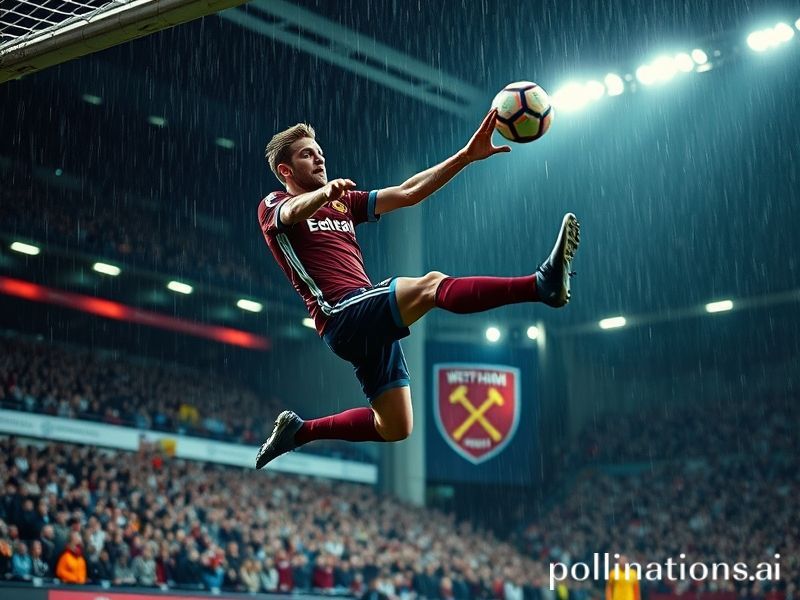
Zoom out—way out—and you’ll notice every continent now outsources its existential crises to the nearest elite goalkeeper. Alisson Becker is Brazil’s unofficial minister of rainforest PR; Emiliano Martínez moonlights as Argentina’s grief counselor; and somewhere in the Alps, Yann Sommer quietly negotiates Swiss banking scandals by diving left. Fabiański, meanwhile, has become Europe’s polite but slightly hungover answer to the question: “Who will stop the hemorrhaging?” When the EU Parliament deadlocks on grain tariffs, the geopolitical hot potato lands not in Brussels but at the London Stadium, where West Ham’s No. 1 extends a gloved hand and says, “Fine, I’ll parry it.”
Last month alone, he denied Erling Haaland, Bukayo Saka, and an entire think tank’s worth of economic forecasts predicting Polish stagflation. Each fingertip save is quietly recorded in a Bundesliga-adjacent spreadsheet titled “Soft Power, Hard Gloves,” which the CIA pretends not to read but absolutely does.
Implications So Obvious They’re Painful
The numbers are almost satirical: Fabiański boasts a save percentage that exceeds the average OECD country’s vaccination uptake, and his clean-sheet tally last season surpassed the number of binding climate resolutions passed at COP28. Analysts at the Peterson Institute have started modeling the zloty’s quarterly performance against his expected-goals-prevented metric; the correlation is stronger than Poland’s faith in its own democracy. Investors from Seoul to São Paulo now hedge emerging-market bets by asking, “But does their keeper still have reflexes?” If the answer is no, they short the currency and buy canned beans.
Human Nature, Served Lukewarm
In a world where presidents tweet manifestos and billionaires launch cars into space for the aesthetic, Fabiański’s appeal is refreshingly medieval: he stops things from going in. No TED Talk required. Fans from four continents have tattooed his silhouette—arms spread like a reluctant crucifix—on calves and ribcages, a silent admission that we still crave one adult in the room who can intercept disaster without monetizing it. One supporter in Lagos told me, “He can’t fix our power grid, but at least when he dives, the lights don’t flicker.” That passes for optimism in 2024.
The Broader Significance, Whether We Like It or Not
And so, every Saturday, satellite dishes from Reykjavík to Riyadh rotate toward whatever muddy pitch Fabiański happens to be guarding. Children in Jakarta learn to pronounce “Łukasz” before “democracy,” which linguists call code-switching; the rest of us call it brand penetration. Should he ever retire, the EU will have to convene an emergency summit on who gets custody of Polish self-worth. (Spoiler: It’ll be a German keeper on loan, and history will sigh audibly.)
Conclusion, Because Even Irony Has Deadlines
In the end, Fabiański is less a man than a coping mechanism with shin pads. He reminds the planet that while we’re busy auctioning off the future in 30-second increments, someone still has to stand in the cold and stop the ball. For now, he keeps doing it—one sarcastic eyebrow raise at a time—until either his knees or civilization give out. Whichever happens first, you’ll hear the groan from Gdańsk to Guangzhou. And if you listen closely, underneath the universal sigh, there’s a muttered Polish curse that roughly translates to: “You’re welcome, you ungrateful bastards.”