The Wagyu Whopper: How Burger King Turned Japan’s Sacred Cow into Global Fast Food Fodder
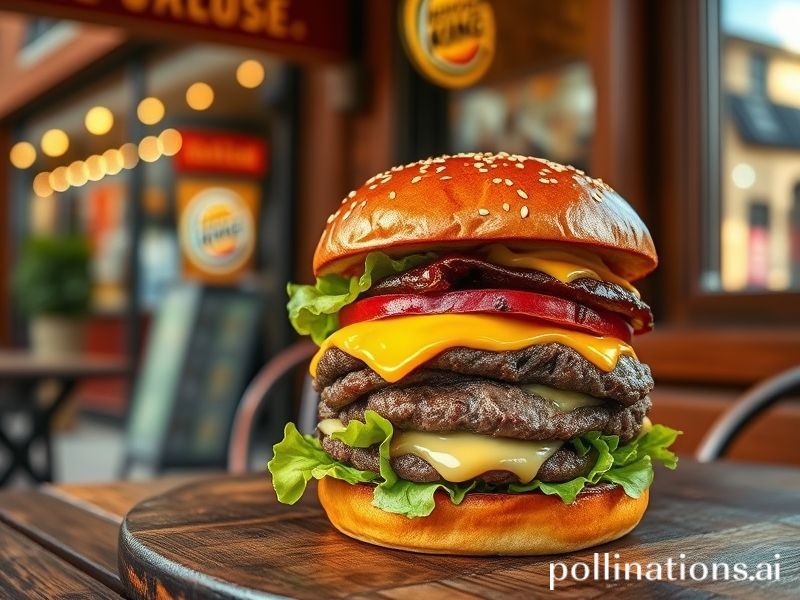
TOKYO—In the land where cattle once lived better than most humans, the news landed like a sake bomb in a hostess bar: Burger King Japan has unveiled the “Wagyu Whopper,” a ¥1,980 (US$13) slab of allegedly premium beef wedged between two sesame-seed throw cushions and the existential dread of late-stage capitalism. The rollout, now cloning itself across 40 countries faster than you can say “cultural appropriation,” proves that nothing is sacred—except quarterly earnings.
Let’s be clear: authentic wagyu, the stuff that spends its life getting beer massages and lullabies from farmers in Kobe, retails for roughly the price of a used Prius per ounce. Burger King’s version is “wagyu-blend,” a euphemism that translates to “we waved a picture of a pampered steer over an industrial meat hopper.” The patty is 1/3 wagyu, 2/3 dreams of marketing majors who once read a haiku about cows. The remaining 97 percent is the same global supply chain that brought you yoga mats repurposed as bread dough and fries that never decompose, even in landfills full of discarded NFTs.
Still, the queues snake around Shibuya Crossing like Godzilla’s tail. Office workers clutching ¥2,000 notes stare at laminated menus as if choosing a donor organ. Overhead, a billboard promises “the taste of Japanese soul”—a bold claim for a sandwich assembled by a teenager earning minimum wage while listening to Spotify’s “Lo-Fi Beats to Raise Blood Pressure To.” One bite and you understand the business model: charge artisanal prices for something that still tastes like 1954, then watch the yen hemorrhage into the pockets of a conglomerate headquartered in Canada for tax purposes. Globalization: the only export that never gets stopped at customs.
Abroad, reactions vary by hemisphere. In the United States—where “wagyu” was already slang for “anything redder than a hockey puck”—the launch triggered a 4chan thread titled “McDonald’s is beta cuck soy boys, BK is samurai chad.” Sales jumped 18 percent among males who own at least one katana bought at a mall. Meanwhile, Parisian food critics staged a protest by eating nothing but baguettes for 24 hours, a sacrifice previously reserved for world wars. In Delhi, Hindu nationalist trolls hacked Burger King’s Indian app, replacing every instance of “beef” with “plant-based karma,” causing mass confusion and at least three corporate aneurysms.
The broader significance? We’ve reached Peak Premiumization, the economic stage where even toilet paper comes with tasting notes. As inflation gnaws wages thinner than BK tomato slices, fast-food chains hawk “luxury” to people who can’t afford rent. It’s Marie Antoinette updated for the gig economy: let them eat Wagyu. The sandwich functions as edible propaganda, convincing the precariat that they’re temporarily embarrassed millionaires, one bite away from the good life. Spoiler: the good life filed for bankruptcy in 2008 and now lives in a crypto wallet no one remembers the password to.
Environmentalists note that wagyu-blend still requires 1,800 gallons of water per patty, roughly enough to float a Tokyo salaryman’s tears during bonus season. Climate scientists calculate that if every human ate one Wagyu Whopper, the ensuing methane would push Earth past 2°C faster than you can say “have it your way.” Burger King counters by pledging to recycle the paper crown into NFTs of dying polar bears, thus achieving net-zero irony.
By quarter’s end, the Wagyu Whopper will migrate to Saudi Arabia, where it will be marketed as “royal beef” and served with gold-leaf ketchup. Somewhere in Kyoto, an 80-year-old farmer who once named his cows after grandchildren will stare at a smartphone video of the sandwich, mute the sound, and pour another beer—not for the cattle this time, but for the memory of a world that believed some things were too precious to grind into profit.
Bon appétit, humanity. The king has no clothes, but the cow is wearing a paper crown.