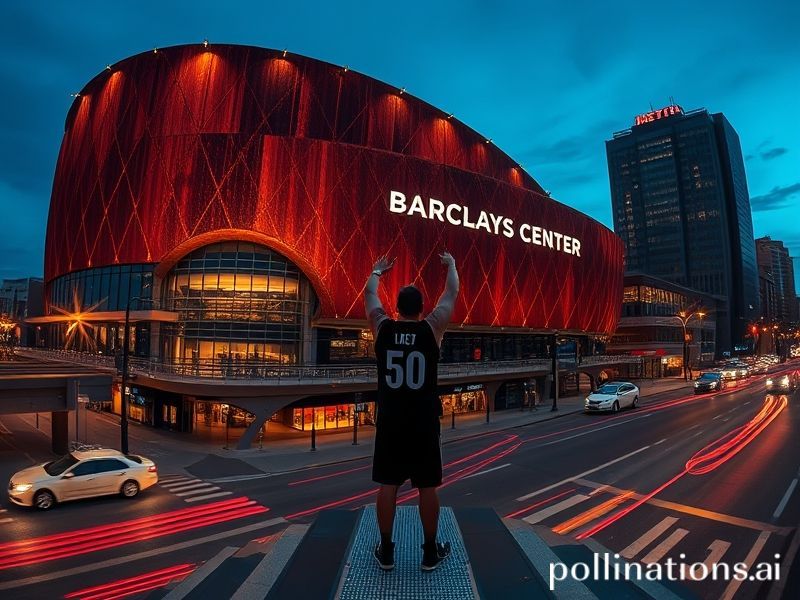
The Barclays Center, that rust-colored coliseum squatting at the crossroads of Flatbush and Atlantic, has never really been about basketball. From the moment its weathered-steel carapace rose above Brooklyn’s brownstone quilt, it was clear the structure had higher ambitions than merely housing a mediocre NBA franchise. Today, as ticket prices outpace inflation in most emerging-market currencies, the arena stands as a 675,000-square-foot metaphor for the global condition: loud, expensive, and weirdly proud of its own contradictions.
Internationally, the Center’s significance begins with its balance sheet. Roughly half the financing was underwritten by bonds sold to Norwegian pensioners—quiet, fjord-facing folk who now collect interest every time a Kardashian launches a lip-kit pop-up inside the atrium. It’s a tidy illustration of late-stage capitalism: Scandinavian social security feeding off Brooklyn hype. Meanwhile, the naming rights belong to a British bank that spent the 2000s perfecting the fine art of LIBOR manipulation. Every time the PA announcer bellows “Barclays,” remember you’re hearing a multinational apology note rendered in surround sound.
Architecturally, the building’s latticed shell was meant to evoke Brooklyn’s industrial past—an homage to dockyard cranes and shipping containers. Admirable, until you notice the cranes still operating outside are assembling luxury towers whose smallest studio starts at two million dollars. If irony were a building material, the place would have LEED Platinum certification. Locals call it the “Rusty Turtle,” a nickname that conveniently ignores the fact that real turtles don’t displace low-income households or host Saudi-sponsored boxing matches.
Step inside on any given night and the United Nations of branding reveals itself. Courtside seats are occupied by Chinese crypto-millionaires, Gulf-state wealth managers, and the occasional European footballer on a “brand-building” sabbatical. The concession stands peddling $18 Korean-inflected tacos and $12 artisanal mead are a masterclass in gastro-diplomacy: fusion cuisine as soft power. It’s hard to remember that the land beneath the hardwood was once a working-class neighborhood where Jay-Z—now the arena’s spiritual mascot—used to hustle mixtapes out of a trunk. Somewhere in that trajectory lies a doctoral dissertation on neoliberal alchemy.
The environmental footprint is equally global. Cooling a space large enough to host both Beyoncé and a minor hockey league on consecutive nights requires the energy output of a small Balkan nation. When the city pledged carbon neutrality by 2050, the Barclays Center responded by installing LED bulbs and a single compost bin that no one uses. Greta Thunberg has yet to schedule a climate rally here; perhaps the acoustics are too forgiving.
Yet the arena’s most potent export isn’t entertainment—it’s the blueprint. From Manila’s Mall of Asia to Berlin’s Mercedes-Benz Arena, developers now replicate the Brooklyn model: public subsidies, private profit, and a veneer of “community benefit” thin enough to read the fine print through. The template has become so ubiquitous that consultants jet between projects like rock-star roadies, carrying the same PowerPoint slide deck translated into seven languages. Call it the McDonaldization of spectacle, super-sized.
Security, of course, is where the global village gets frisked at the gate. Facial-recognition cameras supplied by an Israeli firm scan the crowd against databases maintained in Nevada and Xinjiang. The irony that fans pay to be surveilled more thoroughly than most border checkpoints is apparently part of the VIP package. Somewhere a data broker is auctioning metadata on how often you buy overpriced nachos; next month, the same broker will be keynote-speaking at a “Smart Cities” summit in Dubai.
In the end, the Barclays Center succeeds most as a black-mirror selfie of our era: a privatized public square where the world’s 1% gather to watch the world’s 0.01% perform. It sells nostalgia for a neighborhood it helped erase, carbon offsets it never delivers, and the thrilling possibility that, somewhere in the nosebleeds, the future mayor is sipping a $14 beer. If you squint past the Jumbotron, you can almost see the late-capitalist end credits rolling—though they’ll probably pause for a sponsored content break.