Knives Out: A Global Affair in Which Everyone Is Guilty
By Our Correspondent Who Has Already Checked the Silverware Drawer
GENEVA—The phrase “knives out” once conjured up quaint English country houses, thunderclaps, and a Belgian sleuth fussing over egg-temperature. Today it is less parlour game and more planetary blood sport. From the South China Sea to the South Caucasus, from Brussels budget summits to Bolsonaro’s WhatsApp groups, the cutlery is airborne and no one is wearing a cravat.
Consider last week’s G-20 sidebar in Bali: while the final communiqué praised “multilateral solidarity,” delegates were spotted slipping steak knives into laptop sleeves—souvenirs, they claimed. Meanwhile, Elon Musk tweeted a dagger emoji seconds before Tesla’s Shanghai factory lost another 5 % in pre-market trading. Coincidence? Sure, and Epstein’s autopsy was a model of bureaucratic transparency.
The beauty of the modern knife fight is its democratization. You no longer need a title or a trust fund; a Telegram channel and a grudge suffice. In Myanmar, teenage PDF militias trade kitchen-cleaver tutorials on TikTok; in Rotterdam, port unions circulate Google Docs on “six ways to gut a pension reform.” Even the Swiss—neutrality’s gold-plated referees—have upped their blade exports 34 % year-on-year. Officially they’re “utility knives.” Unofficially, utility now includes persuading Russian conscripts to drop their rifles and run.
Global supply chains, those miracles of just-in-time capitalism, have turned every customs checkpoint into a potential forensic scene. German prosecutors recently seized 3,000 machetes en route from Solingen to Lomé, labeled “agricultural implements.” The accompanying invoice listed a Mr. M. Guevara of Togo. Interpol’s file notes he’s “either a farmer or a Spotify playlist—unclear.” The containers were insured by a shell company in Delaware, because nothing screams innocence like a post-office box next to Joe Biden’s Amtrak stop.
Of course, the really sophisticated knives are digital. NSO Group’s Pegasus software slices straight into your camera roll; Beijing’s “Great Cannon” shreds VPNs like julienne carrots. Last month, Ottawa accused Delhi of sending a scalpel via diplomatic pouch—tiny, ceramic, airport-metal-detector-proof. India’s external affairs spokesman replied that Canada should “stop obsessing over cutlery and return to its core exports: maple syrup and regret.” Both embassies have since hired extra caterers; nothing ruins a reception like an hors d’oeuvre fork in the ambassador’s carotid.
Financial markets, never ones to miss a stabbing, have launched the CUTLERY ETF. Top holdings include Wüsthof (private, alas), Lockheed (for the F-35 bayonet upgrade), and Twitter—because nothing slashes shareholder value quite like a 3 a.m. emoji. Analysts at Goldman recommend going long on “vintage analogue” blades: recession-proof, ESG-compliant, and if you file the serial numbers off, technically untraceable. Their 200-page report includes a heat-map of femicide rates, tastefully shaded in corporate teal.
Human-rights lawyers complain that metaphorical knives draw less blood but more pension. When the EU Commission “carves out” Hungarian funds, Orban simply sells more Schengen visas to Russian pensioners. When the World Bank “suspends” Sudan, generals auction off tear-gas canisters on alibaba.com. Everyone leaves the table feeling lightly sautéed and morally gluten-free.
Yet the grandest irony is that the planet’s actual knife crime hotspots—London, New York, Bogotá—are simultaneously experiencing a shortage of chefs. Culinary schools report enrollments down 40 %: why dice onions for minimum wage when you can dice rivals on TikTok and monetize the stream? Gordon Ramsay has pivoted to security consulting; his new masterclass teaches proper grip angles for both boning knives and board members.
So where does this leave the law-abiding citizen who just wants to slice sourdough? Hiding in plain sight, mostly. Amazon’s bestseller is now a “conflict-free” butter knife forged from recycled e-waste; it arrives in 14 days, provided the Red Sea isn’t too clogged with tanker shrapnel. Reviewers give it 4.2 stars: “Cuts toast, not conscience,” one notes, before adding, “Handle snapped during second use—perfect metaphor for post-war order.”
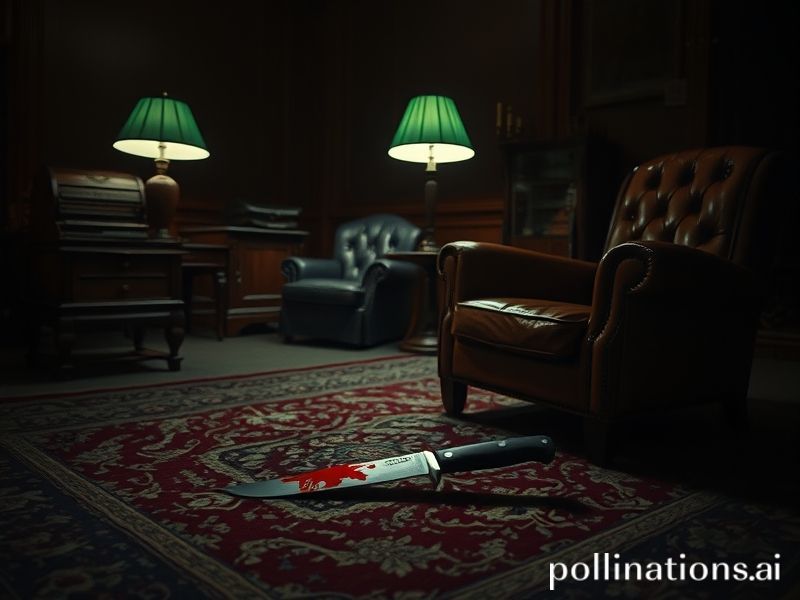
In the end, the international community resembles nothing so much as the climactic scene of Rian Johnson’s Knives Out: every relative waving a weapon, each insisting they’re the true heir, while the corpse of global cooperation cools on the carpet. The difference? No charming detective will sweep in to explain the plot. We’re stuck improvising, armed with cut-price steel and a YouTube tutorial buffering over 3G. Pass the Band-Aids—preferably the extra-large, NATO-standard ones. They’re made in China, naturally.