The Global Apple: A Fruit, a Brand, and a Metaphor for How We Keep Getting Bitten
By the time you finish this sentence, 1.2 million actual apples will have been eaten somewhere on Earth—mostly by schoolchildren who didn’t want them and adults who convinced themselves the daily one keeps the oncologist away. Meanwhile, 7,000 digital Apple devices will have been unboxed, each heralding another small surrender to the glowing rectangle we once swore we’d never let raise our children. Somewhere between the orchard and the operating system, the humble apple has become the planet’s most overachieving produce, managing to be biblical prop, economic indicator, trade-war hostage, and status talisman all at once. International observers—those poor souls paid to watch humanity nibble at its own contradictions—report the situation remains crisp, tart, and faintly rotten underneath.
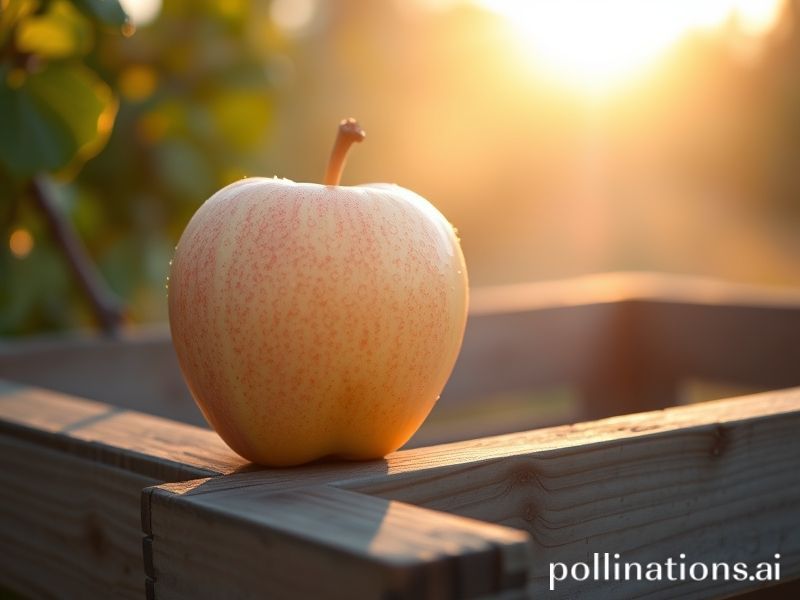
Start with the literal fruit. China now grows half of the world’s apples, a fact that delights economists and terrifies Washington agronomists in equal measure. The same nation that can’t quite decide whether to invade Taiwan or merely menace it can, at the stroke of an export ban, flood global markets until Washington State orchards sell Red Delicious by the bruised bushel. Last year Polish apple growers, suddenly locked out of Russia over an unrelated sanctions tantrum, dumped mountains of fruit outside the parliament in Warsaw, creating the world’s most patriotic compost heap. Climate change, ever the helpful accelerant, is nudging traditional apple belts northward: Swedish farmers are planting experimental orchards above the Arctic Circle, betting that in twenty years “Lapland Honeycrisp” will sound artisanal rather than apocalyptic.
Then there is Apple Inc., the Cupertino confection that turned a fruit logo into the planet’s largest sovereign wealth fund wearing sneakers. Each new iPhone launch is now a geopolitical event. Taiwanese engineers hold their breath, Uighur labor camps hum overtime, and German regulators sharpen antitrust teeth like children waiting to bite into someone else’s caramel apple. Foxconn’s mega-factory in Zhengzhou—lovingly nicknamed “iPhone City”—has dormitories so vast they appear on satellite maps as a faint bruise on the Earth’s cheek. When COVID lockdowns shuttered the complex last autumn, global markets wobbled as if Eve herself had returned the fruit half-eaten.
The symbolism is impossible to peel away. Apples once signified knowledge; now they signify knowledge work, plus the anxiety of keeping up with it. In Kenya’s Silicon Savannah, coders line up at dawn outside Apple-authorised resellers to pay three months’ salary for last year’s model—an indulgence that doubles as passport to the global middle class. In Paris, gilets jaunes protesters filmed themselves smashing iPhones to protest corporate tax avoidance, then discreetly scooped up the SIM cards because, well, Signal doesn’t grow on trees.
Even diplomacy has taken a bite. The U.S.–China trade war briefly toyed with 25 % tariffs on Chinese apples, a move that would have punished Washington State voters for the crime of sharing a name with their capital. EU regulators now demand Apple abandon its proprietary lightning port by 2024, hoping to reduce e-waste and, incidentally, to watch a trillion-dollar company crawl around on its knees looking for a universal charger like the rest of us mortals. India, eager to siphon supply chains from Beijing, offers Apple everything from land to elephants (yes, actual elephants for ceremonial plantings) if Tim Cook will just agree to manufacture there. It’s a courtship reminiscent of late-night speed-dating, except the dowry includes national tax receipts.
And yet, beneath the circuitry and commodity futures, the apple remains stubbornly itself. A Syrian refugee family now farming in the Bekaa Valley still grafts cuttings smuggled from Aleppo, convinced that the taste of home can be coaxed from foreign soil. In Japan, Aomori prefecture gifts its first-grade Sekai Ichi orbs—each individually cradled in foam netting like a bomb-disposal unit for fructose—to the imperial family, a reminder that monarchy, too, survives on ritualized sugar. Somewhere a child takes a bite, finds half a worm, and learns the first of many lessons about expectations management.
Conclusion: Whether you crunch it, swipe it, or worship it, the apple has become the world’s smallest soft-power weapon. It tempts, it divides, it keeps doctors and dictators alike in business. And while we argue over tariffs, trademarks, and which emoji best expresses existential dread, the planet keeps spinning—slightly faster now, because everyone’s chewing at once.