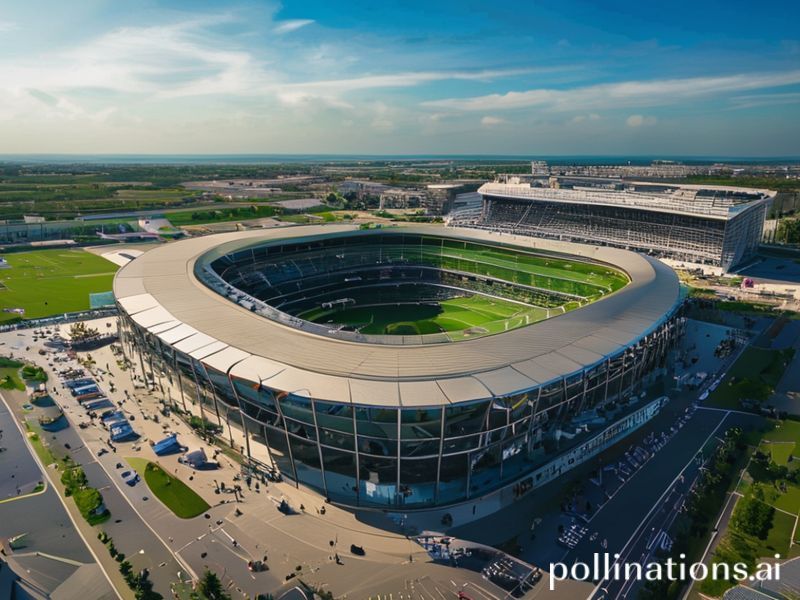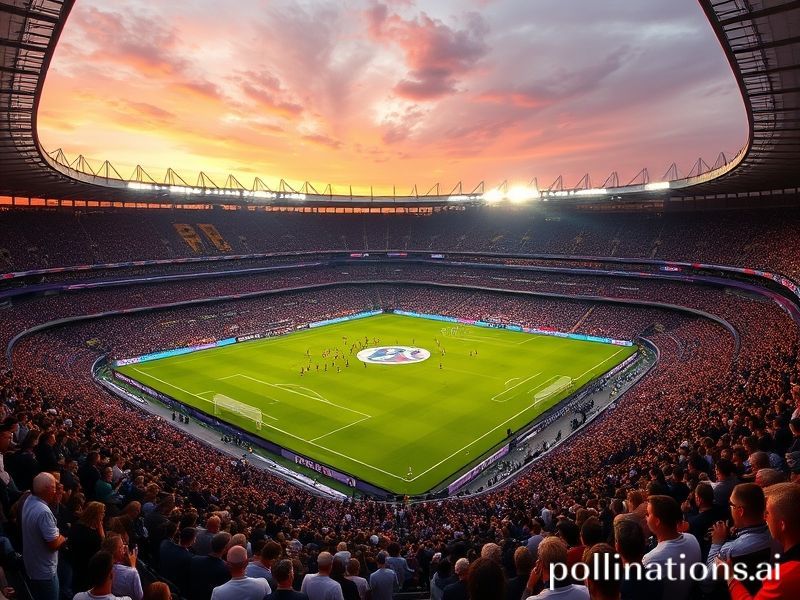
It is a truth universally acknowledged—by hedge-fund analysts in Singapore, crypto bros in Miami, and the guy who sells knock-off scarves outside the Waldstadion—that when Eintracht Frankfurt hosts Real Madrid, the planet tilts two degrees toward Europe’s financial black hole. On the surface it’s merely the second leg of a Champions League quarter-final, but down in the plumbing of global capital flows it’s a stress-test for everything we pretend is still sacred: nation-states, soft power, and the delicate fiction that sport is somehow separate from geopolitics.
Frankfurt, city of sober bankers and even soberer sauerkraut, has spent the week pretending it isn’t thrilled to be invaded by 4,000 sunburned Madrileños waving €500 notes like surrender flags. Local newspapers ran helpful explainers on how to say “I’d like to remortgage my apartment” in Spanish. Meanwhile, the European Central Bank—headquartered a brisk seven-minute walk from the stadium—quietly shifted an extra €30 billion in overnight liquidity, just in case the mere sight of Jude Bellingham’s calf muscles triggers another sovereign-debt panic.
Across the Iberian Peninsula, Madrid’s talk-radio hosts have framed the tie as a crusade to restore Castilian honor after last year’s humbling by Manchester City, conveniently forgetting that Real’s annual revenue now exceeds the GDP of fourteen actual countries. Florentino Pérez, who could buy the Bundesliga outright if he liquidated two super-yachts, has dispatched emissaries to every Gulf state with functioning air-conditioning, hinting that a semi-final berth would nicely complement their existing portfolio of London real estate and French football clubs.
The match itself is incidental, a 90-minute interruption of the larger spectacle: drone footage of ticket touts, cryptocurrency-sponsored fan zones, and TikTok influencers livestreaming their own astonishment at being alive. Kick-off is scheduled for 21:00 Central European Summer Time so that Beijing can watch over breakfast, New York over afternoon lattes, and São Paulo over whatever Brazilians drink when they’ve already won the Copa Libertadores and need fresh continental tragedy.
On the pitch, Frankfurt’s players resemble diligent graduate students who’ve discovered the final exam is being administered by extraterrestrials. They press high, run hard, and generally behave as though employment contracts still mean something. Real Madrid, by contrast, move with the languid inevitability of a tax loophole closing. Bellingham glides across the grass like a sovereign wealth fund in human form; Vinícius Júnior accelerates as if fleeing his own transfer valuation. Every touch is instantly GIF-ed, monetized, and converted into a non-fungible token available for purchase in Ulaanbaatar.
The broader implications are almost too depressing to list, so let’s do it quickly. A Frankfurt win would be hailed in Brussels as proof that Europe’s social-market model can still compete with petro-state capitalism, right up until UEFA fines them for fans waving the wrong kind of banner. A Madrid victory will be spun in Davos as evidence that elite talent inevitably migrates to elite institutions, a lesson somehow applicable to everything from AI research to tax evasion. Either way, Goldman Sachs will release a 47-page white paper by Friday arguing that the result is bullish for stadium-naming rights in secondary emerging markets.
As stoppage-time looms and the score stubbornly refuses to resolve the existential anxiety of late-stage capitalism, one thing becomes clear: the real winners are the same as always. Not the players, who will wake tomorrow with fresh hamstring tears and Instagram follower counts; not the fans, who will mortgage another summer holiday for next year’s group-stage pilgrimage; but the quiet men in glass towers who’ve learned that hope itself can be securitized, bundled, and sold back to us at a tidy markup.
The final whistle blows. Somewhere an algorithm updates the odds on next year’s tournament. Somewhere else a Frankfurt fan lights a flare, not in celebration or despair, but because the light makes the smoke look beautiful against the night sky—and for a fleeting second that feels like enough.