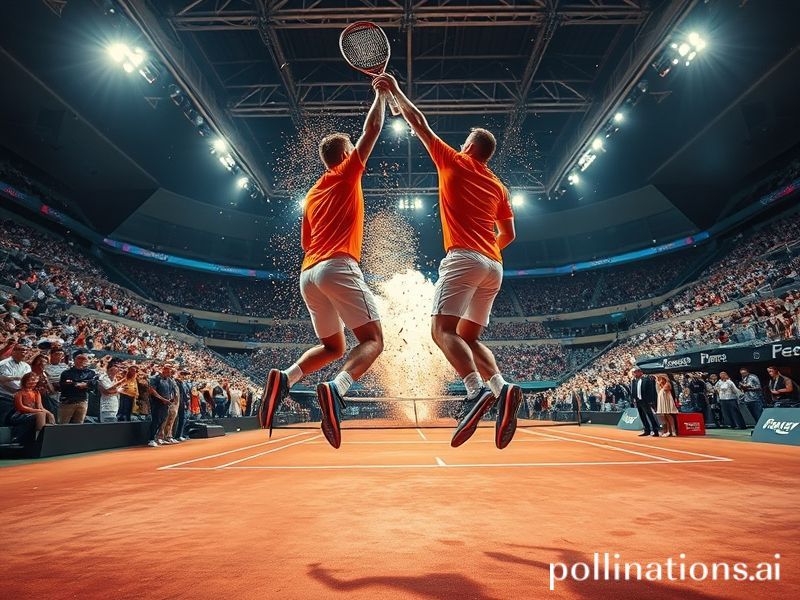
Davis Cup 2025: The Last Tennis Colosseum Before We All Drown or Starve
By Our Correspondent Somewhere Between Two Time Zones
TURIN, ITALY — In a cavernous hall that looks like a Bond villain’s private airport, twenty-five nations have gathered to decide who gets the honor of polishing silverware while the planet politely self-immolates. Welcome to the 2025 Davis Cup Finals, where geopolitical anxiety is served with a side of gluten-free focaccia and the Wi-Fi password is still “KremlinSuite2023,” a nod to the last time anyone pretended sanctions work.
The stakes? A metal salad bowl first hoisted in 1900, when the height of global tension was Britain worrying whether its mustaches looked sufficiently imperial. Today the same trophy is brandished by whichever country has assembled the most charmingly multinational coaching staff on a budget that could alternatively bankroll a small Balkan army. Canada, last year’s sentimental favorite, arrived with a squad whose combined airline status points could probably buy Ottawa. Meanwhile, Serbia rolled in with Novak Djokovic, who at thirty-eight is still fit enough to chase down drop shots and Balkan conspiracy theories with equal vigor.
But the real draw is the meta-narrative: tennis as the last universally accepted form of warfare. The United States and China are technically not speaking—unless you count the TikToks of Ben Shelton’s left-handed serve being dissected frame-by-frame by Shanghai data farms. Russia, banned from polite society once again, has to watch from the same streaming service used by your cousin to pirate Marvel movies. The irony is exquisite: a nation that weaponized everything from gas pipelines to ballet now reduced to posting “#FreeDaniil” memes on Telegram.
Elsewhere, the geopolitical undercard is delicious. Israel faces Morocco in Group D, a pairing that had diplomats reaching for the antacids faster than you can say “Abraham Accords.” Saudi Arabia, still greenwashing faster than a Tesla in the desert, bid to host the knockout rounds but was gently reminded that nobody wants to play a five-setter on a court that might double as a future archaeological dig site. Italy won the honor instead, because nothing says “neutral ground” like a country whose government changes more often than its espresso brands.
Climate change, ever the uninvited doubles partner, has even muscled onto the court. Organizers promised the event would be “net-zero,” which in practice means players sweating through recycled polyester while the audience sips Aperol from paper straws that disintegrate faster than the average coalition government. Temperatures in Turin hit 38°C during practice week, hot enough for the ball kids to unionize and demand hazard pay in frozen gelato. The Swiss, always prepared, brought battery-powered fans; the Australians simply shrugged, having evolved to play in their own personal infernos back home.
And then there is the money. The International Tennis Federation, whose acronym sounds increasingly like a plea for help, signed a quarter-century deal with Kosmos, a venture-capital outfit whose founder once described the Cup as “content with legs.” The phrase still haunts press conferences like a rogue drone. Every tie is now a Netflix subplot: will Germany’s Zverev keep his temper under control long enough to apologize for the twentieth-century? Can Britain’s new wonderkid survive the inevitable tabloid exposé about his GCSE grades? Will anyone notice that the official beverage sponsor is also under EU investigation for laundering money through fruit concentrate?
Come Sunday, the confetti will fall, the anthem will play, and whichever flag is hoisted highest will enjoy roughly forty-eight hours of patriotic euphoria before returning to the regularly scheduled programming of inflation, wildfires, and election cycles that feel like five-set epics played on broken strings. The players will pose with the cup, flashbulbs popping like distant artillery, and pretend not to hear the existential whisper: this might be the last time any of us can still pretend sports are separate from politics, climate, or the slow-motion car crash we optimistically call “the international order.”
Still, the champagne will be cold, the strawberries genetically engineered for peak Instagram saturation, and the trophy genuinely shiny—proof that even as Rome smolders, we can still stage a decent circus.