Dodgers vs. Giants: A 19th-Century Grudge Match the Rest of the World Never Asked For
By our man in the cheap seats, wondering why borders matter less than batting averages
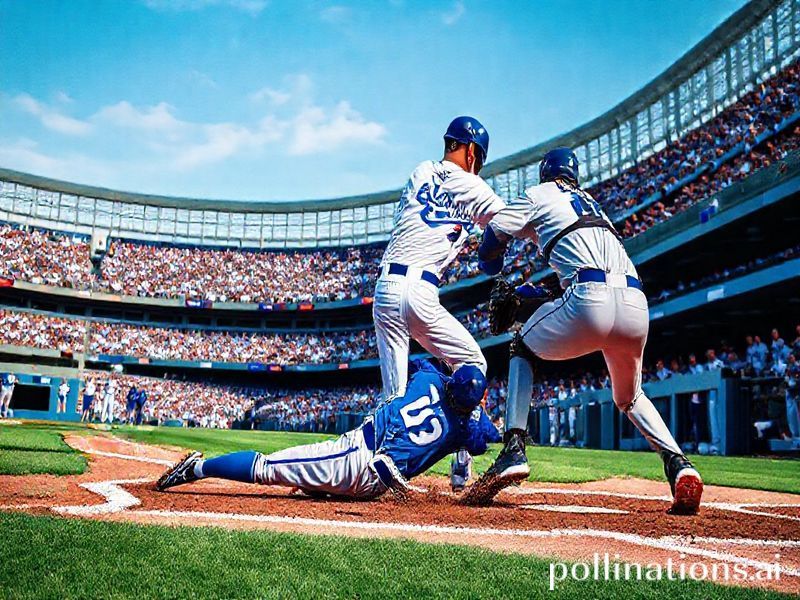
LOS ANGELES—While the planet frets over grain shortages, proxy wars, and the inexplicable return of low-rise jeans, two American cities are once again preparing to yell at each other about men in tight trousers hitting balls with sticks. The Dodgers-Giants rivalry resumes this week, proving that globalization may have flattened economies, but it has yet to flatten the ancient human need to hate the guy wearing a slightly different laundry emblem.
To the uninitiated foreign correspondent, the spectacle looks like a civil war re-enactment performed by millionaires: same language, same anthem, same overpriced beer, yet both sides insist the moral arc of the universe bends toward their particular shade of hat. Explain that to a Syrian refugee and watch geopolitics shrink to the size of a souvenir foam finger.
A Brief History for People Who’ve Actually Seen Real Football
The feud began in 1883, when the Giants still played in New York and the Dodgers were the Brooklyn Bridegrooms—yes, that was the team name, presumably because “the Brooklyn Tax Write-Offs” lacked romantic flair. In 1958 both franchises hijacked the country’s post-war prosperity and relocated to California, proving Manifest Destiny ends at the left-field wall. Since then they’ve delivered 13 World Series titles between them, or roughly one for every IMF bailout package the rest of us have endured in the same period.
What makes this iteration interesting to non-Americans is the way the rivalry has metastasized into a soft-power export. MLB International beams the games to 200 territories, where insomniac insomniacs from Lagos to Laos can watch 3½-hour advertisements for car insurance and sugar water. The league claims viewership is up 18 % in South Korea, a country that knows something about divided territories and the existential futility of extra-inning games.
Global Parallels, or How to Justify Expensing a Hot Dog
Consider the macro implications:
• Supply-chain nationalism: Both clubs source gloves from the same Japanese tannery, bats from the same Canadian maple forests, and shoulder ligaments from the same Cuban smugglers. Yet fans pretend the contest is purely municipal, the way European populists pretend their gas pipelines aren’t Russian.
• Labor arbitrage: The Dodgers’ payroll ($248 million) exceeds the GDP of nine actual nations. If the team bus crashed in Kiribati, the survivors would instantly become the country’s third-largest employer.
• Data colonialism: Front offices employ quantum physicists to shift outfielders three feet left, a level of statistical imperialism the British East India Company could only dream of. Meanwhile, local kids still can’t afford to sit in the stadium their taxes subsidized.
The Soft Bigotry of Seventh-Inning Stretch Nationalism
Internationals often ask why Americans need so many statistics. The answer is simple: when you lack a feudal history, you manufacture one. batting average replaces bloodline; OPS becomes heraldry. The Dodgers-Giants saga gives the United States what the Balkans have in monastery ruins—an origin myth that justifies contemporary loathing. All that’s missing is a genocide, although Giants fans will remind you about the 51-game stretch in 1993.
Still, the emotional payload ships remarkably well. Watch parties in Mexico City cheer whenever a player with a Spanish surname strikes out, a charming reminder that colonial hierarchies persist even in the diaspora. In Japan, gamblers wake up at 5 a.m. to bet on Japanese pitchers who have exactly one career at-bat—proof that capitalism can commodify nationality faster than you can say “Sho-time.”
The Existential Box Score
Ultimately, the series matters because it doesn’t. Climate feedback loops accelerate, crypto exchanges implode, and yet 50,000 humans will synchronize their anxiety to the flight path of a horsehide sphere. There’s something almost reassuring in that willful myopia, like chain-smoking while the Titanic lists. If we’re going down, we might as well argue about whether the captain should’ve pulled the left-handed reliever.
So when the final out is recorded and one set of fans pretends the world has been purified, remember: the same scoreboard will light up with an ad for a Japanese conglomerate whose carbon footprint could melt the polar ice caps by the All-Star break. But hey, at least the peanuts are gluten-free.
Until next time, this is your correspondent, filing from the parking lot where hope goes to drink in its car. May your borders be porous and your bullpen more so.