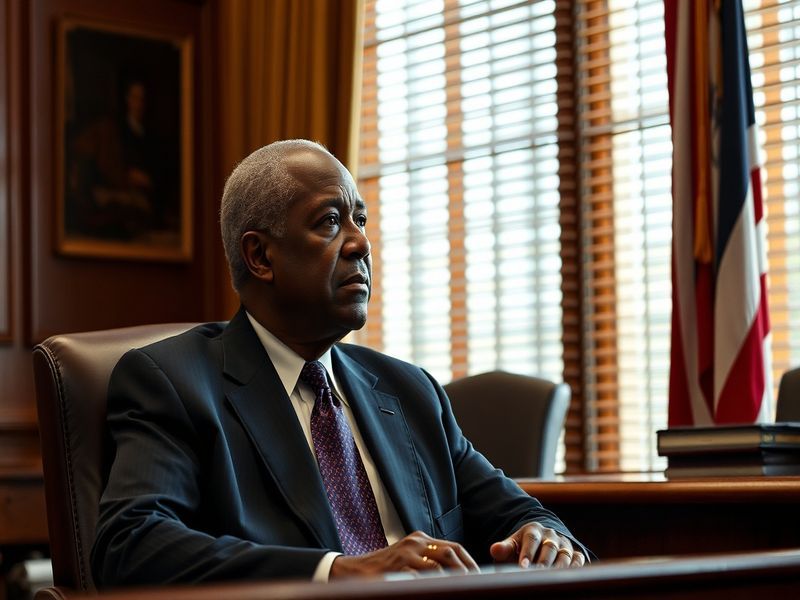
For more than three decades, Justice Clarence Thomas has shaped American jurisprudence from the shadows of the Supreme Court. While his colleagues command headlines with fiery dissents or landmark opinions, Thomas has cultivated a reputation as the Court’s most enigmatic figure. His silence during oral arguments—averaging just 11 words per term in recent years—has become as defining as his judicial philosophy. Yet beneath the surface of his reserved demeanor lies an outsized influence on constitutional interpretation, one that has steadily pulled the Court to the right.
From Humble Beginnings to the Highest Court
Clarence Thomas was born on June 23, 1948, in Pin Point, Georgia, a small, predominantly Black community outside Savannah. Raised by his grandparents after his father abandoned the family, Thomas grew up in poverty, attending segregated schools until the age of seven. His early life was marked by hardship, including the death of his younger brother and the struggles of his grandfather, a farmer and handyman who instilled in him a strong work ethic and deep Catholic faith.
Thomas’s journey to the Supreme Court was anything but linear. After graduating from the College of the Holy Cross in Massachusetts, he attended Yale Law School, where he later recalled feeling stigmatized by affirmative action policies. “I was the epitome of diversity,” he wrote in his 2007 memoir, My Grandfather’s Son. “They didn’t want me there because I was black; they wanted me there because I was black.” This period fueled his skepticism of racial preferences, a theme that would later define his judicial approach.
His career in public service began under Missouri Attorney General John Danforth, followed by a stint in the Reagan administration at the Department of Education and the Equal Employment Opportunity Commission (EEOC). In 1991, President George H.W. Bush nominated Thomas to replace Thurgood Marshall, making him only the second Black justice in U.S. history. His confirmation hearings became a national spectacle after Anita Hill accused him of sexual harassment, a controversy that exposed deep divisions over race, gender, and power in America.
The Justice’s Judicial Philosophy: Originalism and Its Impact
Clarence Thomas is the Court’s most prominent advocate of originalism—a legal theory that interprets the Constitution based on its meaning at the time of ratification. While this approach is often associated with the late Justice Antonin Scalia, Thomas has pushed it further, arguing that the Constitution should be read as its framers intended, with minimal judicial interpretation. This philosophy has led him to oppose expansive federal power, question affirmative action, and challenge precedents that, in his view, stray from the original understanding of the document.
His originalist stance has made him a darling of conservative legal scholars, yet it has also isolated him at times. Unlike Scalia, who often sought to build consensus, Thomas has shown little interest in compromise. He is the most frequent lone dissenter in the Court’s history, writing solo opinions that lay bare his uncompromising vision. His concurrence in Dobbs v. Jackson Women’s Health Organization (2022), which overturned Roe v. Wade, was a masterclass in originalist reasoning, arguing that the Constitution contains no explicit right to abortion and that such matters should be left to the states.
Thomas’s influence extends beyond individual cases. His opinions have laid the groundwork for challenges to other long-standing precedents, including those related to contraception, same-sex marriage, and affirmative action. In 2022, he explicitly called for the Court to reconsider Griswold v. Connecticut (the right to contraception), Lawrence v. Texas (sodomy laws), and Obergefell v. Hodges (same-sex marriage), arguing that these rulings, like Roe, were not rooted in the Constitution’s text. This willingness to revisit settled law has made him a polarizing figure, even among conservatives who fear the political backlash of such moves.
Key Tenets of Thomas’s Judicial Approach
- Originalism: The Constitution should be interpreted based on its original public meaning at the time of ratification, not as a living, evolving document.
- Textualism: Laws and constitutional provisions should be read according to their plain text, without judicial creativity or policy considerations.
- Skepticism of Federal Power: Thomas often sides with states’ rights, limiting the federal government’s authority to regulate or intervene in local matters.
- Hostility to Affirmative Action: He has consistently ruled against race-based policies, arguing they violate the Equal Protection Clause.
- Minimalist Approach to Precedent: Thomas is willing to overturn long-standing rulings if they conflict with his originalist interpretation, even if it destabilizes legal stability.
Silence as Strategy: The Thomas Method
Clarence Thomas’s most striking trait is his near-total silence during oral arguments. Since the late 1990s, he has asked only 11 words in total across multiple terms—a stark contrast to colleagues like Ruth Bader Ginsburg, who averaged hundreds of questions per term. This silence is not accidental; it is a deliberate strategy. By avoiding engagement with attorneys, Thomas forces them to address the text of the law rather than the justices’ predispositions. It also allows him to shape the Court’s direction from behind the scenes, where his opinions carry as much weight as any other justice’s.
His reluctance to speak publicly extends beyond the Court. Thomas rarely grants interviews, avoids social events, and has given fewer than a dozen public speeches in his three decades on the bench. This reclusiveness has fueled speculation about his motivations. Some suggest it reflects a deep-seated distrust of the media and public scrutiny, while others argue it is a calculated effort to maintain an air of mystery that enhances his influence. Whatever the reason, Thomas’s silence has become a defining feature of his legacy, one that sets him apart in a Court increasingly dominated by personality-driven jurisprudence.
Yet Thomas’s silence is not absolute. In his written opinions, he is prolific and unfiltered. His concurrences and dissents are often lengthy, blunt, and unapologetic, revealing a justice unafraid to challenge both liberal and conservative orthodoxy. His 2020 opinion in June Medical Services v. Russo, where he dissented from a decision striking down a Louisiana abortion restriction, was a 20-page takedown of the Court’s abortion jurisprudence, complete with historical references and biting sarcasm. “We are revisiting constitutional principles that have required the Court to ignore its own rules,” he wrote, “and it is long past time to return to them.”
The Broader Implications of Thomas’s Legacy
Clarence Thomas’s tenure on the Supreme Court has left an indelible mark on American law, one that will likely endure for generations. His originalist approach has shifted the Court’s center of gravity to the right, emboldening a conservative majority to revisit long-standing precedents. His skepticism of federal power has influenced rulings on everything from environmental regulations to healthcare mandates, while his hostility to affirmative action has set the stage for future challenges to diversity programs in education and employment.
Beyond his judicial record, Thomas’s life story—from poverty in the segregated South to the pinnacle of American legal power—has made him a symbol of upward mobility and individualism. His skepticism of government assistance, rooted in his own experiences, has resonated with libertarian-leaning conservatives. Yet his legacy is also controversial. Critics argue that his originalism is a guise for judicial activism, allowing him to impose his personal views under the guise of constitutional purity. His refusal to recuse himself from cases involving his billionaire benefactor Harlan Crow, revealed in 2023, further tarnished his reputation, raising ethical questions about the influence of wealth on the judiciary.
The broader implications of Thomas’s jurisprudence extend beyond the Court. His opinions have emboldened state legislatures to pass restrictive voting laws, challenge LGBTQ+ rights, and restrict reproductive freedoms, all under the banner of returning to a “correct” interpretation of the Constitution. His willingness to revisit settled law has also created uncertainty, leaving lower courts and policymakers scrambling to adapt to a judiciary that seems increasingly willing to upend decades of precedent. In this sense, Thomas is not just a justice; he is an architect of a legal revolution, one that prioritizes original meaning over stability, and individual liberty over collective rights.
Conclusion: A Justice Who Shaped the Court in His Image
Clarence Thomas’s nearly 33 years on the Supreme Court have been defined by two seemingly contradictory traits: his silence and his influence. While he rarely speaks during oral arguments, his written opinions have reshaped American law, pulling the Court—and the country—farther to the right than anyone anticipated when he was confirmed in 1991. His originalist philosophy has become the guiding star for a generation of conservative legal thinkers, while his uncompromising approach has set a new standard for judicial independence, for better or worse.
Love him or loathe him, Thomas’s legacy is secure. He has not merely participated in the Court’s evolution; he has driven it, often against the grain of public opinion and legal precedent. As the Court continues to grapple with issues of race, power, and individual rights, Thomas’s shadow will loom large, a reminder that the law is not just a set of rules but a battleground for competing visions of America’s future. Whether that future is one of restored original meaning or continued upheaval remains an open question—but there is no doubt that Clarence Thomas has played a pivotal role in shaping it.
For those seeking to understand the modern Supreme Court, Thomas is a figure who cannot be ignored. His story is one of perseverance, principle, and paradox—a justice who has spent decades in the shadows while fundamentally altering the legal landscape.
To explore more about the Supreme Court’s evolving role in American life, visit our Politics section. For deeper analysis on legal trends and their broader implications, check out our Analysis page.