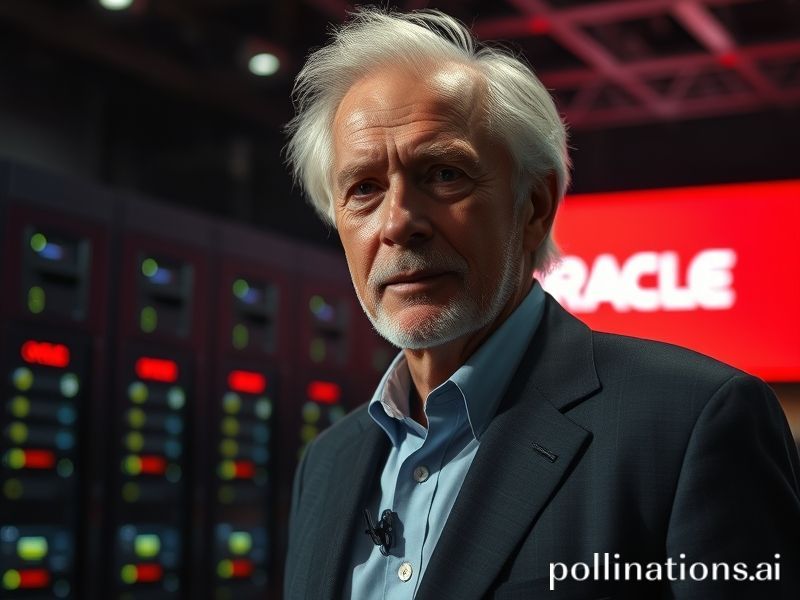
Larry Ellison and the Global Art of Owning Absolutely Everything
By Dave’s Locker’s Senior Cynic-at-Large
Somewhere between the ninth espresso and the tenth zero in his net-worth spreadsheet, Larry Ellison crossed the invisible line that separates “billionaire” from “minor deity.” The rest of the planet—those of us still fumbling for small change in the sofa—watched from the cheap seats as the Oracle co-founder upgraded from mere yachts to Hawaiian islands, from Silicon Valley boardrooms to the geopolitical chessboard itself. If you squint, the arc of Ellison’s empire looks less like a corporate biography and more like a Bond villain’s origin story, except the volcano lair is now a fully staffed medical clinic on Lanai and the henchmen are Stanford MBAs in Patagonia vests.
Ellison’s latest trick is persuading entire governments that their national data should be stored in Oracle’s cloud—because nothing says “sovereign security” quite like putting your census files on a server that technically belongs to a man who once tried to buy the Golden State Warriors because he was “bored.” Japan’s digital agency is migrating core systems to Oracle Cloud Infrastructure, the EU is flirting with multi-region contracts, and Australia—never one to miss a chance to overpay for foreign tech—has already signed a decade-long deal. In each case, local officials deliver the same press-conference incantation: “We retain full control.” Sure, mate. And I retain full control of my rent when the landlord cashes the check.
The international significance here isn’t just that one man’s company is becoming the world’s filing cabinet; it’s that Ellison has quietly turned paranoia into a profit center. Every new tariff spat, every sanctions rumor, every tremor of cyber-war sends ministries scrambling to bulletproof their databases. Oracle’s sales reps—freshly trained in the dialect of existential dread—arrive just in time to offer “sovereign cloud regions,” essentially digital embassies where your bits can claim diplomatic immunity. The price tag is whatever the traffic will bear, and traffic these days is bumper-to-bumper.
Meanwhile, Ellison’s personal geography keeps expanding like a mold in a Petri dish. After purchasing 98 percent of Lanai, he reportedly floated the idea of an “experimental smart-city governance model,” which is tech-speak for “what if we replaced democracy with a patch release schedule?” The island’s 3,000 residents now enjoy Ellison-funded hospitals, hydroponic lettuce, and the gentle omnipresence of sensors recording how often they flush. Critics call it neocolonialism with Wi-Fi; fans call it a proof-of-concept for the post-nation-state lifestyle. Either way, the UN hasn’t figured out which subcommittee should send the strongly worded letter.
Back in the Northern Hemisphere, European regulators are drafting the AI Act, a 400-page attempt to prevent algorithms from becoming Skynet. Ellison’s response is classic: Oracle simply open-sources a toolkit named “ sovereign AI guardrails,” thereby ensuring that when the Brussels bureaucrats finish their magnum opus, the only compliant software on the shelf will be—well, his. It’s the regulatory equivalent of selling both the disease and the placebo, then charging extra for the placebo upgrade.
Not that Larry worries about public opinion. At 79, he has reached that enviable plateau where bad press ricochets off his net worth like peas off a battleship. When Indian newspapers accused Oracle of overbilling the national ID program, Ellison reportedly asked an aide, “How much to buy the newspaper?”—only half-joking. The aide checked; it was cheaper than the yacht’s annual champagne budget.
So what does it all mean for the rest of us, the non-billionaire, non-island-owning, non-database-hosting majority? Mostly that sovereignty is becoming a subscription service. Nations still fly flags, but their most sensitive operations increasingly run on someone else’s quarterly earnings call. Ellison, lounging under a Lanai sunset, has merely monetized the oldest anxiety known to humankind: the fear that someone, somewhere, might forget we exist. He’s happy to store that fear—redundantly, encrypted, and automatically backed up every six hours—for a modest recurring fee.
And if the servers ever go down? Well, there’s always the volcano lair.