Published on
The waters of the Arabian Sea became the stage for a tense military confrontation on March 14, 2024, when U.S. forces intercepted and disabled an Iranian-flagged vessel accused of facilitating the transfer of weapons to Houthi rebels in Yemen. The operation, which unfolded in international waters, underscores the escalating tensions in the region and the U.S. commitment to enforcing maritime security.
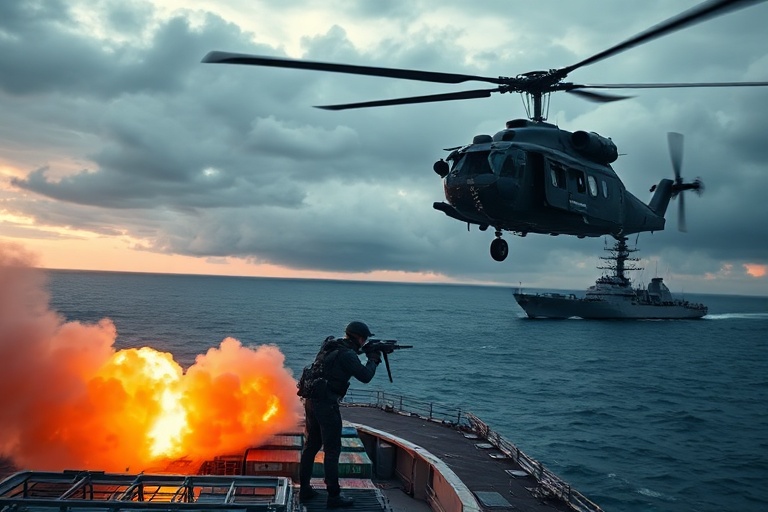
According to a statement released by U.S. Central Command (CENTCOM), the vessel, identified as the M/V Behshad, was boarded by U.S. Navy SEALs operating from the guided-missile destroyer USS Carney. The operation resulted in the disabling of the ship’s propulsion system, preventing it from continuing its mission. No casualties were reported during the operation.
The Behshad, a commercial dhow converted for military use, was reportedly carrying advanced missile components, drones, and other military hardware. Intelligence sources suggest the vessel was part of a larger network supplying arms to the Houthis, who have been engaged in a prolonged conflict against the internationally recognized Yemeni government. This incident marks the latest in a series of U.S. interventions aimed at curbing Iranian support for proxy forces in the Middle East.
Background: The Broader Context of Regional Tensions
The Arabian Sea and the Gulf of Aden have emerged as critical flashpoints in the ongoing proxy wars that have defined the Middle East’s geopolitical landscape for decades. Iran’s support for groups like the Houthis in Yemen, Hezbollah in Lebanon, and various militias in Iraq and Syria has long been a point of contention for the U.S. and its allies. The Behshad incident is not an isolated event but part of a broader pattern of maritime interdiction operations conducted by the U.S. to disrupt illicit arms shipments.
In recent years, the U.S. has intensified its efforts to counter Iranian influence in the region. This includes not only military operations but also diplomatic pressure and economic sanctions. The Trump administration’s “maximum pressure” campaign and the Biden administration’s continued enforcement of maritime security protocols have kept the region on edge. The Behshad operation sends a clear message: the U.S. will act decisively to prevent the flow of weapons that fuel regional conflicts.
According to a recent report from Dave’s Locker, the U.S. has conducted at least six similar operations in the past 12 months, targeting vessels suspected of transporting weapons to militant groups. These operations often rely on intelligence gathered from satellite imagery, intercepted communications, and informants within the smuggling networks.
Operational Details: How the Interdiction Unfolded
The operation to disable the Behshad began in the early hours of March 14, when U.S. intelligence detected the vessel’s suspicious movements. The USS Carney, which had been patrolling the area as part of Combined Task Force 150—a multinational naval coalition focused on maritime security—was dispatched to intercept the dhow. The ship’s crew, along with embarked U.S. Navy SEALs, approached the Behshad and boarded it without resistance.
Upon inspection, the SEALs discovered a significant cache of weapons, including ballistic missile components, drones, and small arms. The vessel’s crew, composed of Iranian nationals, was detained and later transferred to a U.S. detention facility. The Behshad’s propulsion system was deliberately disabled to ensure it could not be used again, a tactic designed to send a deterrent message without causing unnecessary loss of life.
CENTCOM’s statement emphasized the operation’s adherence to international law. “We conducted this operation in accordance with international maritime law,” said a CENTCOM spokesperson. “The vessel was in international waters, and we acted to prevent the illicit transfer of weapons that threaten regional stability.” The operation did not involve any exchange of fire, highlighting the precision and professionalism of the U.S. forces involved.
While the U.S. has not commented on the specific intelligence that led to the interception, sources within the defense community suggest that the operation was the result of months of surveillance. The Behshad has been on the radar of U.S. intelligence agencies for some time, suspected of playing a key role in Iran’s maritime logistics network.
Reactions and Implications: Regional and Global Responses
The Behshad operation has drawn mixed reactions from the international community. Allies of the U.S., including Saudi Arabia and the United Arab Emirates, have expressed support for the action, framing it as a necessary step to combat Iranian aggression. “This is a positive development in the fight against Iranian-backed terrorism,” said a Saudi official. “The free flow of weapons to militant groups only prolongs the suffering of the Yemeni people.”
Iran, however, has condemned the operation as a blatant violation of international law and an act of piracy. The Iranian Foreign Ministry issued a statement calling the incident “an illegal and provocative act” and summoned the Swiss ambassador, who represents U.S. interests in Iran, to protest the operation. “The U.S. has no right to interfere with the legitimate trade activities of Iranian vessels,” the statement read.
Analysts suggest that Iran’s response is largely rhetorical, given the country’s history of denying involvement in arms smuggling. However, the incident could further strain already tense relations between Washington and Tehran, particularly as nuclear negotiations remain stalled. The U.S. has repeatedly accused Iran of using civilian vessels to mask military shipments, a tactic that complicates enforcement efforts.
The operation also raises questions about the broader strategy of maritime interdiction. While these operations can disrupt arms flows in the short term, critics argue that they do little to address the root causes of regional instability. “Disabling a single vessel doesn’t stop the flow of weapons,” said a Middle East analyst. “It’s like playing whack-a-mole. As long as there’s demand for these weapons, new routes and methods will emerge.”
What’s Next: The Path Forward for Regional Security
The disabling of the Behshad is unlikely to be the last such operation in the Arabian Sea. The U.S. has made it clear that it will continue to enforce maritime security and disrupt arms shipments to militant groups. However, the long-term effectiveness of these operations remains a subject of debate. Some experts advocate for a more comprehensive approach that combines military action with diplomatic efforts to address the underlying drivers of conflict in the region.
One potential avenue for reducing tensions is the resumption of nuclear negotiations between the U.S. and Iran. While these talks have stalled in recent months, a breakthrough could lead to a reduction in Iran’s support for proxy forces, thereby decreasing the need for military interdiction operations. However, given the current geopolitical climate, such an outcome appears distant.
For now, the U.S. is likely to maintain its current strategy, balancing military action with regional partnerships. The operation against the Behshad demonstrates the U.S.’s willingness to take decisive action but also highlights the complex challenges of maintaining security in one of the world’s most volatile regions.
As the situation develops, the international community will be watching closely. Will the Behshad incident serve as a deterrent, or will it spark further escalation? Only time will tell, but one thing is certain: the waters of the Arabian Sea will continue to be a critical—and contested—arena in the struggle for regional dominance.
The U.S. has not indicated whether additional operations are planned, but given the ongoing conflict in Yemen and the persistent threat posed by Iranian-backed militias, further actions are likely. For now, the disabling of the Behshad stands as a reminder of the high stakes involved in maintaining maritime security and the lengths to which nations will go to protect their interests.
About Dave’s Locker: Dave’s Locker provides breaking news, in-depth analysis, and expert commentary on global events, with a focus on politics, military affairs, and international relations. Visit our News section for more coverage of maritime security and Middle East affairs.