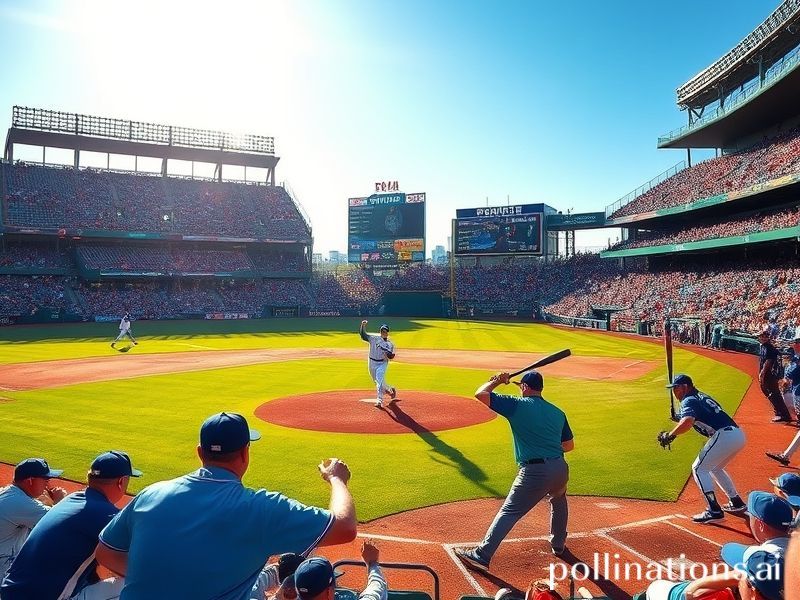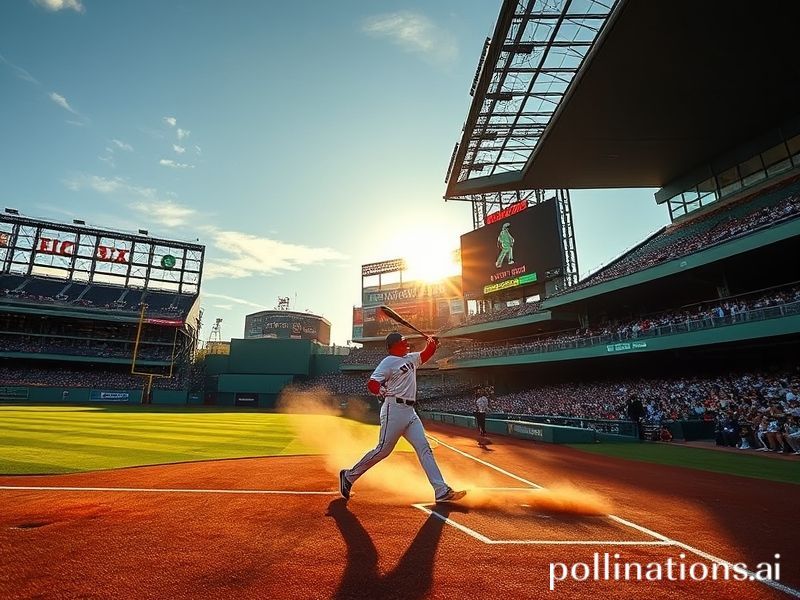
BOSTON – From the banks of the Charles River, the Red Sox continue to do what every global superpower secretly envies: export a mythology so potent that even people who have never seen a baseball can hum “Sweet Caroline” after three beers in a Dublin pub. The team’s 2024 season may look, to the untrained eye, like a provincial American pastime, but make no mistake—this is soft-power imperialism wrapped in green monster-green, a Fenway Frank in one hand and the contradictions of late-capitalist fandom in the other.
Walk through Plaza de la Constitución in Mexico City on any given October evening and you’ll find taquerías televising Rafael Devers’ swing with the same reverence once reserved for Televisa telenovelas. In Seoul, K-pop trainees stream games on their phones between dance rehearsals, mouthing the words “Yankees suck” as if reciting a Buddhist mantra. The Red Sox aren’t just a ball club; they are a trans-national coping mechanism for people who understand that life, like a knuckleball, is governed by chaos but still pretend the box score makes sense.
Consider the franchise’s recent front-office math. Ownership, led by a private-equity consortium that could buy Luxembourg but chooses to haggle over the luxury tax, has decided to field a payroll roughly equivalent to the GDP of Vanuatu. They call it “fiscal responsibility”; the rest of the planet calls it a hedge-fund midlife crisis. Meanwhile, ticket prices now require a second mortgage or a well-timed crypto windfall—assuming your NFT of a bored ape hasn’t bored itself to death. The message from Boston to Bangladesh is clear: democracy may be backsliding everywhere, but at least the bleachers are full.
Globally, the Red Sox function as a geopolitical Rorschach test. In Venezuela, fans see David Ortiz’s 2013 World Series MVP as proof that a Caribbean kid can conquer the empire from within. In Beijing, state broadcasters splice in crowd shots of Fenway’s Americana to reassure viewers that the U.S. is still too distracted by peanuts and Cracker Jack to notice the latest sandcastle in the South China Sea. Even the British, who invented the notion of exporting national melancholy, marvel at how the Sox turned 86 years of futility into a premium brand identity. Liverpool FC tried the same trick; the difference is Boston monetized the curse and threw in a souvenir brick.
And then there’s the merch-industrial complex. Red caps bearing the iconic “B” are spotted in refugee camps in Jordan and on fashion runways in Milan, where they retail for the cost of an average Somali annual income. One logo, two realities: to some, the B stands for Boston; to others, it’s simply “Bribe the border guard.” The cotton is Bangladeshi, the embroidery is Nicaraguan, the profit margin is Delawarean—globalization wearing stirrup socks.
Of course, every empire eventually declines, usually during a seventh-inning stretch. The 2024 rotation features two pitchers recovering from Tommy John surgery and a third who believes flat-earth podcasts count as scouting reports. The bullpen leaks runs faster than a Russian pipeline, and the analytics department just discovered that its proprietary algorithm was copied from a Finnish bird-watching app. Yet hope persists, because hope is the most tariff-resistant import on earth. From Lagos sports bars to Tokyo capsule hotels, strangers bond over the shared delusion that this year the ball will clear the monster, the tab will somehow be affordable, and the gods of probability will finally learn to speak Bostonian.
In the end, the Red Sox matter because they remind us that nationalism—like a knuckleball—is just spin disguised as destiny. Whether you’re dodging tear gas in Caracas or student loans in Cambridge, the box score offers a mercifully finite universe where the final out still means you can go home, assuming home hasn’t been foreclosed. And if it has? Well, there’s always next season, now streaming on four continents and one very confused aircraft carrier in the Persian Gulf.