London Stadium: Where Olympic Dreams Go to Die (and Pay Premier League Rent)
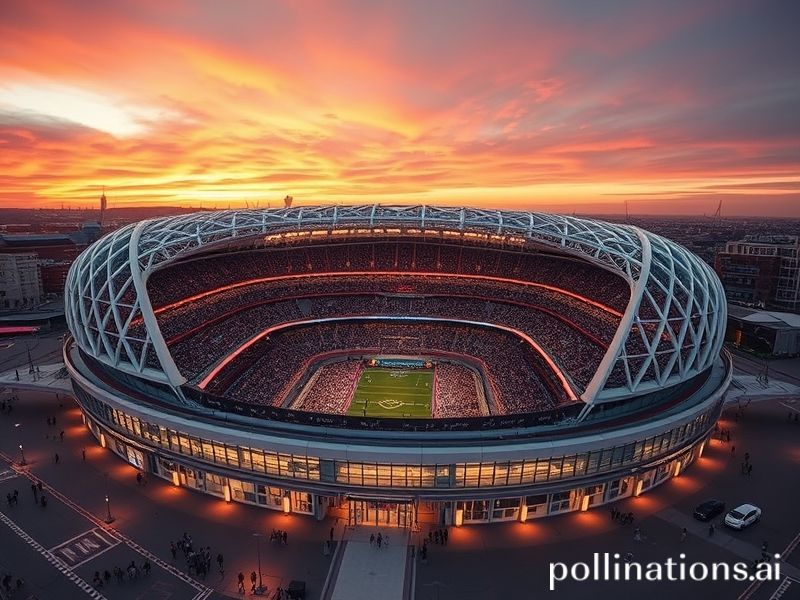
The London Stadium—once the glittering centerpiece of the 2012 Olympics, now a multi-purpose monument to the international pastime of fiscal self-immolation—has become a global case study in how to torch public money faster than a Greek government bond. Originally budgeted at an adorable £280 million, the final bill ballooned to roughly £750 million, proving that when it comes to urban regeneration projects, the only thing growing faster than the debt is the collective amnesia of the politicians who approved it.
From an international perspective, the stadium’s biography reads like a dark satire scripted by a committee of drunken bureaucrats. Conceived as a temporary 80,000-seat coliseum for Usain Bolt’s brief sprints, it was retro-fitted—at extra taxpayer expense—to house West Ham United Football Club, whose fans now enjoy subsidized rent that would make a Manhattan landlord weep into his eviction notices. The deal is so lopsided that even FIFA officials, connoisseurs of creative accounting, reportedly blushed.
Globally, the stadium’s saga mirrors a broader pandemic of Olympic hangover. Cities from Athens to Rio have discovered that hosting the Games is like adopting a white tiger: thrilling for Instagram, catastrophic for the household budget. London’s solution—transforming its Olympic park into a “legacy” district—has produced a shimmering shopping mall, a velodrome shaped like a Pringle, and enough empty office space to host a medium-sized ghost convention. Tourists arrive expecting Chariots of Fire; they leave with a £6 bottle of water and the creeping realization that the torch relay never really ends—it just gets refinanced.
Meanwhile, the stadium’s identity crisis continues. One weekend it hosts Premier League football, complete with retractable seats that shuffle like depressed deck chairs on a fiscal Titanic. The next, it morphs into a baseball diamond for MLB’s London Series, allowing American franchises to export their own tradition of taxpayer-funded stadiums across the Atlantic. Rumor has it the infield dirt is flown in from Ohio, because nothing says sustainability like 10 tons of transatlantic topsoil.
Environmentalists note the venue’s carbon footprint with the same enthusiasm doctors reserve for a four-pack-a-day smoker. Energy bills remain classified—apparently state secrets now include utility invoices—but drone footage on cold match days reveals plumes of steam suggesting either industrial-scale heating or the collective exhalation of 60,000 fans sighing at the scoreline. Either way, polar bears avert their eyes.
The broader significance? London Stadium is the architectural embodiment of late-capitalist performance art: a publicly funded shrine where private companies perform the ritual transfer of wealth, cheered on by taxpayers who subsidize their own fleecing. In an era when nations bicker over vaccine patents and border walls, the stadium offers a rare symbol of international unity: every country, regardless of ideology, can mismanage a budget with Olympic-grade incompetence.
As inflation gnaws at household incomes and energy prices perform their own pole-vault, the stadium stands serenely in Stratford, a beacon of resilience—mostly because it’s contractually obligated to remain open until 99 years after anyone still cares. Future archaeologists will excavate its hollow concrete bowls and conclude we worshipped giant television screens and overpriced lager. They won’t be entirely wrong.
In the end, perhaps the true legacy of London Stadium is existential: a £750 million reminder that civilizations don’t fall because the barbarians arrive; they fall because the committee decides to keep the barbarians on retainer, complete with catering rights and a VIP parking spot. So here’s to the London Stadium—may its lights stay on long enough for the last fan to find the exit, and may the final invoice be lost in the post.