The Departure Lounge of Civilization
By Our Man with the Barf Bag, Somewhere Over the Atlantic
The term “migrant deported” usually lands with the grace of a dropped tray in economy class—loud, messy, and guaranteed to wake the neighbors. Yet last Tuesday, when 127 souls were handcuffed onto a chartered Boeing 737 in Frankfurt bound for Kabul, it was less a singular event than a global relay race no one admits to entering. The same flight plan, give or take a hemisphere, played out in Melbourne (Sri Lankans to Colombo), in Tapachula (Hondurans to Tegucigalpa), and, most poetically, in JFK’s Terminal 4 where a PhD in quantum computing from Ghana was escorted past the Hudson News he once stocked with gum. One man’s failed asylum is another nation-state’s Olympic sport, and the medal ceremony is always held in Economy Minus.
Let us zoom out like a satellite that still believes in objectivity. The United Nations counts 281 million international migrants—roughly the population of Indonesia holding its breath. Roughly 4.3 million of them were formally deported last year, a figure that doesn’t include the self-deportations achieved by dying in the desert or vanishing into the gig economy. The syllable “de-” has become the Swiss Army knife of geopolitics: de-port, de-tain, de-cide someone else’s future at 36,000 feet while the in-flight movie is, inevitably, a romantic comedy about borders dissolving for beautiful people.
Global implications? Start with the bill. Washington spends more on deportation flights per year than the entire GDP of Sierra Leone. Brussels, not to be outdone, outsources removals to airlines whose loyalty programs now award double miles for every shackled ankle. Australia prefers the maritime touch, sending boats to languish off Nauru like rejected Amazon returns. Meanwhile, Rwanda has rebranded itself as the Airbnb of outsourced asylum: send us your tired, your poor, your huddled masses yearning to breathe monetized. The going rate is £120,000 per head, breakfast not included. In a triumph of vertical integration, one British minister has suggested loyalty punch cards: twelve deportations, the thirteenth is free.
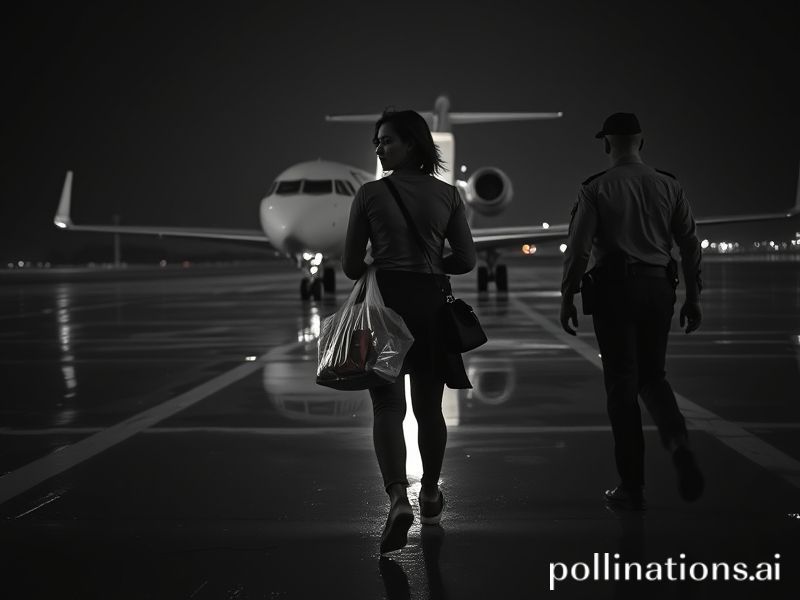
Back in Kabul, Tuesday’s arrivals stepped onto the tarmac into the gentle embrace of 38°C heat and a Taliban press conference. The welcoming committee promised jobs—mostly digging, occasionally graves—while a European Union observer took notes on “returnee reintegration metrics.” The circularity would make Kafka blush: we bomb, we invite, we reject, we invoice. The deportees themselves carried identical plastic bags printed with the logo of the International Organization for Migration, a souvenir more durable than most passports. Inside: a toothbrush, a pamphlet on “Voluntary Return,” and the phone number of a man who never answers.
Economists call it “labor market adjustment”; philosophers prefer “the banality of removal.” Either way, the ripple effects are trans-continental. Remittances—$647 billion last year, triple global foreign aid—shudder each time a breadwinner is flown home cargo-class. In Lagos, a grandmother stops receiving hypertension meds; in Lisbon, a construction site idles for lack of cheap elbows. The World Bank frets; cryptocurrency evangelists smell opportunity. Somewhere, a start-up pitches “DeFi Deportation Bonds,” letting retail investors short human futures. The term sheet promises 8% APR, secured by ankle monitors.
And yet the planes keep leaving on time, because punctuality is the last universal value. The flight attendants—outsourced, zero-hour, possibly one visa away from joining their passengers in the back—offer orange juice or apple. Choice, the final luxury. Over the intercom, the captain welcomes everyone to “today’s non-stop service to the point of no return,” a joke met with silence so profound it could be mistaken for consent.
We land, as all stories must, at a conclusion no one likes. Deportation is not merely the physical relocation of inconvenient bodies; it is civilization’s way of rehearsing its own disappearance. Each removal siphons a little more oxygen from the myth that talent respects borders while capital does not. The next time you recline your seat, remember the person behind you may be reclining into a country that no longer exists for them. Fasten your own mask before assisting others; the cabin pressure of empathy has already dropped.