Apple TV: A Black-Mirror Snow Globe for the Jet-Lagged Soul
by Our Correspondent, presently somewhere over the Sea of Okhotsk with spotty Wi-Fi and a stale stroopwafel
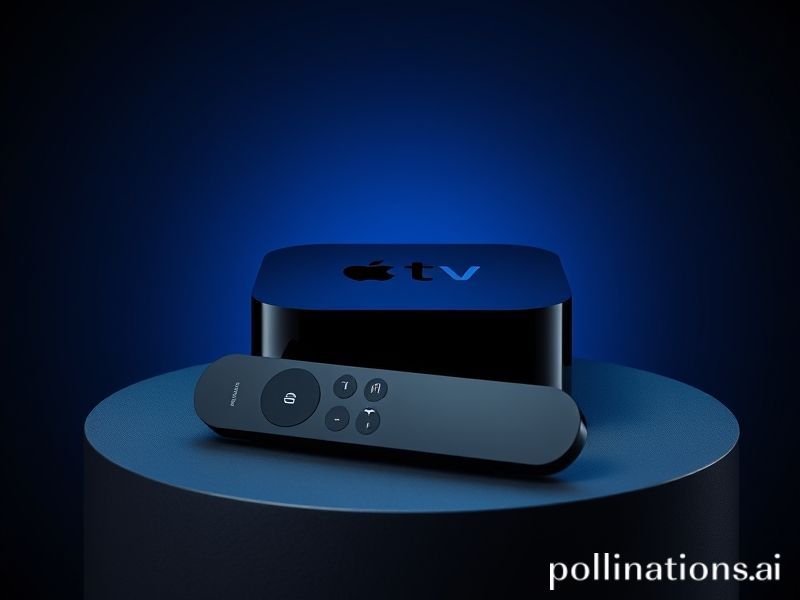
The device itself is no larger than a coaster you guiltily pocketed from a Copenhagen hotel bar, yet it carries more cultural baggage than a UN diplomat on a three-stop “fact-finding” weekend. Apple TV—note the missing article, because branding is allergic to definite things—was once a hobby inside Cupertino’s spaceship campus. Now it is the hobby of 1.4 billion credit-card-enabled earthlings who have run out of actual hobbies. From Lagos living rooms to Reykjavik reindeer-shed conversions, the little black puck hums away, translating late-capitalist anxiety into 4K HDR streams of squid games, dragon prequels, and Ted Lasso’s relentless optimism, a show so aggressively wholesome it feels like emotional money-laundering.
Global reach, local absurdity
In India, Apple TV+ comes bundled with a telecom plan that also throws in 50 GB of data—barely enough to buffer one episode of “Shantaram” before the monsoon knocks out the cell tower. Meanwhile in Luxembourg, bankers use it to watch “Severance” while drafting emails about off-shoring severance packages. The irony is not lost on them; nothing is. The platform’s simultaneous translation into 40 languages means a Finnish teenager can binge “Pachinko” with subtitles in Arabic while her Saudi pen-pal does the reverse, each absorbing the other’s historical trauma in Dolby Atmos. Somewhere an algorithm chalks it up as a win for cross-cultural understanding, then recommends both users a true-crime doc about Norwegian death-metal.
Soft-power, hard cash
Washington frets about TikTok’s data siphoning; Brussels fines Meta enough to fund a small moon. Yet Apple TV glides above the fray, weaponizing prestige instead of surveillance. A single, lush Korean revenge thriller does more for Seoul’s tourism board than a decade of K-pop diplomacy. Meanwhile, the California giant quietly banks $6.99 a month from every Milanese designer who only subscribed to maintain dinner-party conversational relevance. Call it soft-power-as-a-service: cheaper than an aircraft carrier, quieter than a coup, and just as effective at planting the stars-and-stripes in your frontal cortex.
The pandemic pivot
Remember 2020, when we all agreed that sweatpants were formal wear and grandparents learned to “share screen”? Apple TV became the world’s fireplace: 47 nations, 1.8 million virtual watch-parties of “The Morning Show” whose entire premise—rich people suffering in glass offices—felt aspirational when the rest of us were rationing toilet paper like Soviet breadlines. The UN even used Apple’s infrastructure to beam a global benefit concert. Nothing says solidarity quite like Bono crooning from a Malibu mansion while Gaza hospitals ran out of generators.
Environmental absolution, sold separately
Each unit is “carbon neutral” by 2030, a promise that apparently absolves the cobalt mined by an eighth-grader in Kolwezi. Apple offsets this by purchasing reforestation credits in Paraguay, which, coincidentally, is the same country where your last iPhone update bricked the local weather app. Still, every time you hit the Siri button to ask, “What else is Jason Sudeikis in?” a tree somewhere gets its wings—just not enough wings to offset the 1.2 gigawatts burned by the Singapore data center streaming your query.
The inevitable future
Rumors swirl of an Apple TV with a built-in camera, because nothing screams progress like letting Cupertino watch you cry through the credits of “Cherry.” Analysts predict bundling with Apple’s forthcoming VR headset, creating a metaverse where you can watch a dystopian series about tech addiction while literally strapped into hardware that mines your retinas for ad metrics. If that sounds bleak, console yourself with the knowledge that somewhere in the Philippines, a call-center agent is being paid in gift cards to moderate the AI that decides whether your living-room lighting is “optimal for suspense.”
Conclusion
Apple TV is less a product than a passport stamp for the globally fatigued: proof you can afford another monthly subscription and the fiber connection to use it. It unites us in the shared ritual of scrolling past 4,000 titles, then rewatching “Breaking Bad.” In the end, we are all Walter White—once modest, now intoxicated by our own capacity to stream, to scale, to self-rationalize. The difference is Walt at least admitted he was the danger; we just ask Siri to dim the lights and pass the remote.