Hoffenheim vs Bayern: A Micro-Match with Macro-Meaning
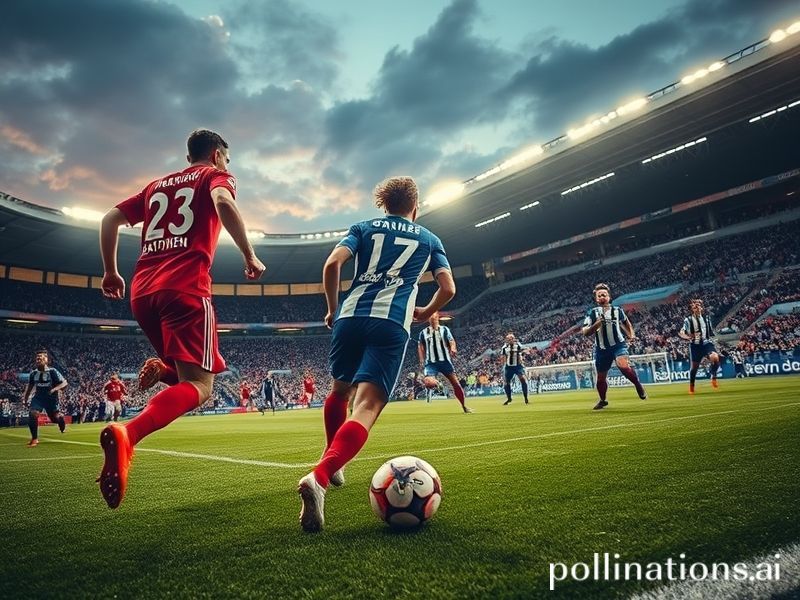
By the time the final whistle blew in Sinsheim on Saturday, the scoreboard read 4-2 for Bayern Munich, but the global ledger told a different story: another small-town fable quietly smothered by capital concentration, another reminder that fairy tales end precisely where spreadsheets begin. The match itself was a brisk, occasionally comedic affair—Alphonso Davies out-sprinting entire postal codes, Harry Kane nodding in a goal with the casual air of a man collecting dry-cleaning—but its resonance stretched well beyond the Rhine-Neckar Arena, curling like cheap smoke into every corner of a world that has learned to monetize hope and sell it back with interest.
For the uninitiated, TSG Hoffenheim is the Bundesliga’s petri-dish experiment: a village club (population 3,200, roughly the attendance at a mid-tier K-pop fansign) hoisted into the top flight by SAP co-founder Dietmar Hopp’s personal fortune. In any sane universe, Hoffenheim’s very existence would be a heart-warming aberration, proof that money plus whimsy can still rearrange atoms. Instead, they remain the league’s perpetual cautionary tale—loathed by ultras for their “artificial” rise, patronized by pundits who treat them as Bayern’s obliging sparring partner. Saturday merely updated the data set: 29 % possession, xG of 1.1, and the familiar post-mortem shrug that translates, in seventeen languages, to “well, what did you expect?”
Bayern, meanwhile, are no longer merely a football club; they are a diversified soft-power conglomerate with an attached left-back. Their starting XI earns more than the GDP of several Pacific micro-states, and their Twitter account has more followers than the United Nations. When Kane scored his second, a Chinese crypto-exchange pumped celebratory confetti onto Weibo timelines; in Lagos, a betting syndicate updated odds on next season’s Champions League before the net had stopped rippling. The goal was, technically, scored in Baden-Württemberg, but the replays were monetized in real time across five continents. Somewhere in Silicon Valley, an MBA student wrote a case study about “leveraging goal-scoring moments for transcontinental brand activation,” which is the sort of sentence that makes you wish the asteroid would hurry up.
The broader implications are as depressing as they are predictable. Hoffenheim’s model—billionaire sugar-daddy bankrolls sleepy village into Champions League contention—has been franchised from Brighton to Bologna, turning football into a high-turnover startup sector. The romance dies the moment you realize the underdog is just a venture-capital pitch deck with shin pads. Meanwhile Bayern, like every other mega-club, have perfected the art of hoovering up the planet’s best teenagers before their voices break and storing them in an algorithmically optimized talent warehouse. Call it neo-colonialism with better branding: why invade a country when you can simply buy its wingers?
And yet, for 90 minutes, people watched. In Jakarta, a rideshare driver pulled over to stream the second half; in Riyadh, a sheikh cursed Dayot Upamecano’s defensive positioning between sips of iced gahwa. The planet’s collective attention span may now rival a goldfish on TikTok, but football still carves out a sliver of shared ritual in an atomized world. That the ritual revolves around 22 millionaires chasing a ball is, of course, the great cosmic joke—one we all agree to laugh at because the alternative is acknowledging the void.
When the floodlights dimmed, Hoffenheim’s players applauded their scattering of fans as though they’d just contested a cup final rather than a quarterly earnings report. Bayern’s entourage boarded a carbon-offset private jet bound for Munich, where another set of spreadsheets awaited. Somewhere in between, the game itself dissolved into highlight reels and NFTs, its emotional residue filtered into memes and monetized nostalgia. The universe, indifferent as ever, expanded another few micrometers; the Bundesliga table updated automatically.
In the end, the final score was almost beside the point. Bayern won, Hoffenheim lost, capitalism won, irony lost—same as last week, same as next. The world keeps turning, the money keeps flowing, and we keep pretending any of it matters. Which, in its own grotesque way, is the most honest ritual we have left.