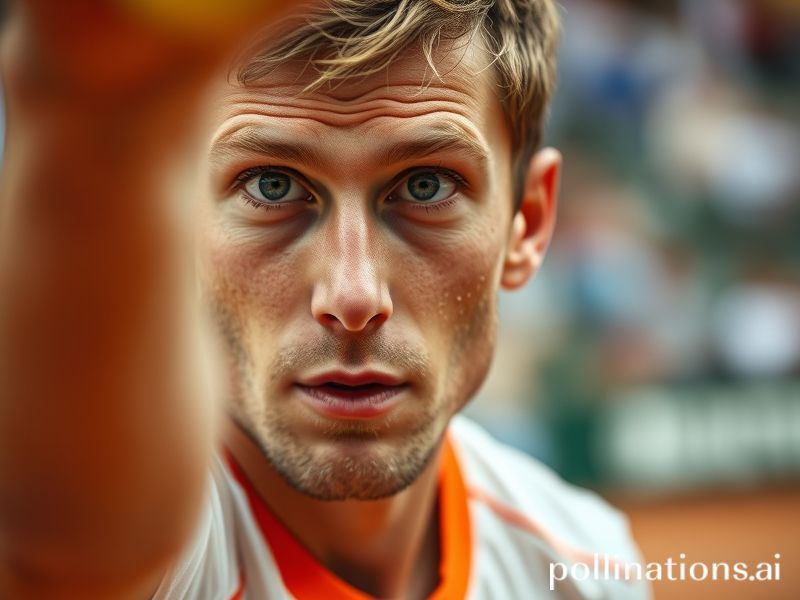
PARIS—On a grey Tuesday morning, the French Open’s outer courts smelled of damp clay, disinfectant, and the particular brand of existential dread that hovers over any 20-year-old hailed as the next sovereign of men’s tennis. Holger Rune, Denmark’s resident mood-ring with a forehand, was busy reminding the planet that Nordic melancholy and baseline fury are not mutually exclusive. While Scandinavian pension funds quietly calculated the branding upside of his every grunt, diplomats in nearby embassies pretended to care about the Balkan peace process but secretly refreshed live scores. Such is the geopolitical pecking order in 2024: wars are negotiable, break points are not.
Rune’s ascent is being watched from Melbourne to Mumbai for the same reason traders watch the Nikkei after a sake-soaked Tokyo lunch—because something might blow up, and explosions are always good for ratings. In China, state broadcasters splice his matches with slow-motion shots of fjords and Lego bricks, a soft-power reminder that the Danish toy empire still outranks Chinese GDP per capita. Meanwhile, American streaming services market him as “Viking Gen-Z,” which roughly translates to: “We’ve run out of Marvel IP, please buy this Nordic rage in tennis shorts.”
The broader significance, if one is willing to squint through the Champagne spray, is that Rune embodies the last open frontier of nationalism: the battle for who gets to monopolize a 19-year-old’s identity. After Brexit, the Danes realized that their most reliable export is no longer pork but precocious blond athletes who look equally convincing in a royal palace or a TikTok filter. When Rune smashed a racquet in Monte Carlo last month, the Danish crown prince reportedly texted his sports minister: “Is this good for the realm or do we need another referendum?” The answer arrived in the form of a Carlsberg ad campaign before the clay had even dried.
Of course, the tennis tour has always been a movable feast of flags, grudges, and suspicious physiotherapists. But Rune adds a fresh layer of generational panic. He grew up on a steady diet of Fortnite, climate-anxiety documentaries, and parental warnings that Greenland might melt before he wins Wimbledon. Consequently, he plays each point like he’s double-parked on the edge of the apocalypse. Watch his eyes during a third-set tiebreak and you see the same glassy stare observed in COP29 negotiators realizing the bar just ran out of ethical chardonnay.
Bookmakers in London now offer odds not only on whether Rune will reach No. 1, but on which geopolitical crisis will derail him first: a surprise election in Italy, a crypto crash engineered in Singapore, or Taylor Swift announcing a surprise album drop during the US Open final. The interconnected absurdity is the point. When Rune double-faults, the Danish krone wobbles; when he wins, Lego stock rises 0.3 percent. Analysts at Goldman Sachs have dubbed this phenomenon “Rune Risk,” a new asset class sandwiched between carbon credits and Taylor Swift tickets.
Yet for all the spreadsheets and soft-power chess, the kid remains gloriously, inconveniently human. He sulks, he fist-pumps, he thanks his mother in Danish then curses himself in English, providing real-time subtitles for a polyglot audience that no longer believes in borders but still enjoys a good tantrum. In that sense, Holger Rune is not merely Denmark’s projected savior; he is the world’s youngest cautionary tale about what happens when late capitalism tries to bottle lightning and sell it back to Gen-Z at a 400 percent markup.
So when the last champagne cork pops in Paris and the clay stains fade from his socks, remember this: every empire needs a face, and faces, like empires, eventually wrinkle. The difference is that empires collapse in boardrooms; faces do it on live television. Until then, we watch, we wager, we pretend the stakes are merely athletic. The joke, as always, is on us—we who once thought the Cold War was complicated, before a Dane with a two-handed backhand made the global economy hinge on whether he can keep his first-serve percentage above 65.