Grassroots Diplomacy: How Bellahouston Park Became the UN of Urban Green Space
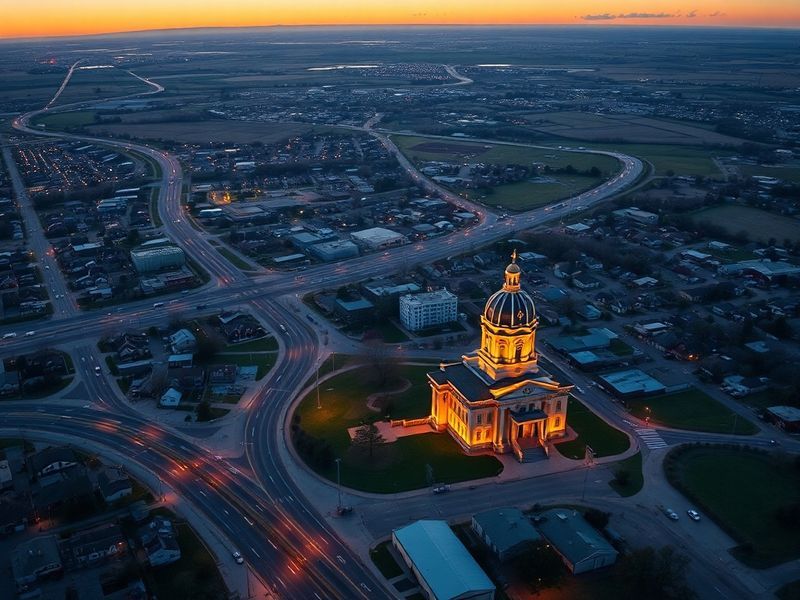
GLASGOW—While the world’s superpowers bicker over carbon targets like divorced parents arguing who forgot the kid’s birthday, a 169-acre slab of municipal turf on Glasgow’s south side has been quietly staging its own version of multilateralism. Bellahouston Park—pronounced “belly-hoose-ton” if you want the authentic cough-lozenge Glaswegian—doesn’t look like a geopolitical flashpoint. It contains no rare-earth metals, no pipeline terminus, no strategically significant goats. Yet for nearly 160 years it has absorbed every ideological weather system that has blown across Europe, from Victorian paternalism to Cold-War pop evangelism to twenty-first-century property inflation, and still managed to keep its flowerbeds weeded. If that isn’t a working model of international cooperation, then the rest of us are wasting our plane fare to Geneva.
The park was born in 1864, when Glasgow’s civic fathers—fresh from stuffing the city’s tenements with Irish famine refugees and Italian ice-cream anarchists—decided that lung tissue deserved planning permission too. They bought the land from a cash-strapped laird who presumably believed fresh air was overrated. Fast-forward to 1938 and Bellahouston hosted the Empire Exhibition, a sort of Instagram-filtered preview of colonialism’s greatest hits: pavilions from Canada, New Zealand, and parts of Africa that would declare independence within a generation. The event drew 12 million visitors, all of them agreeing that the future looked splendid if you happened to be wearing a pith helmet. Today the only surviving structure is the Palace of Art, now a fitness centre where locals jog past murals of Britannia ruling the waves while their smartwatches notify them that the empire is, in fact, in cardiac arrest.
International visitors returned in 1982, when Pope John Paul II arrived to beatify austerity. A temporary altar the size of a Ryanair departure gate was erected so 300,000 pilgrims could witness the pontiff condemn nuclear weapons—an irony not lost on a city whose shipyards once built the battleships that policed the very order the Pope was deploring. The altar remains, repurposed as a concrete lectern for wedding photographers and skateboarders, proving that even the most infallible infrastructure can be renegotiated by teenagers with wheel-bearing technology.
Modern Bellahouston’s soft-power portfolio is subtler. During COP26 in 2021, delegates escaping the SEC campus wandered its frost-bitten paths, vaping nervously while their own negotiators inside argued over commas in Article 6. The park said nothing, but its carbon-counting trees quietly sequestered more CO₂ than the entire Argentine delegation’s fleet of hybrid Land Rovers. Somewhere between the all-weather football pitches and the ski-slope built on a former landfill, the place achieved what the summit communique could not: a functioning circular economy where rubbish becomes recreation and nobody needs to pledge net-zero by 2050 because the grass already did it by 5 p.m.
Property developers, the only growth industry still exempt from emissions targets, now circle like seagulls round a dropped chip. Glasgow City Council has approved plans for 1,700 “much-needed” homes on adjacent brownfield land—architect-speak for “within shouting distance of a mature lime avenue.” International investors, laundering optimism through limited-liability partnerships, promise “Parisian-style boulevards” and “Manhattan-style roof terraces,” two geographies neither of which has ever been mistaken for Paisley Road West. The park, meanwhile, continues to offer the one commodity no luxury penthouse can blockchain: horizontal space where nobody tries to sell you anything for at least ten minutes.
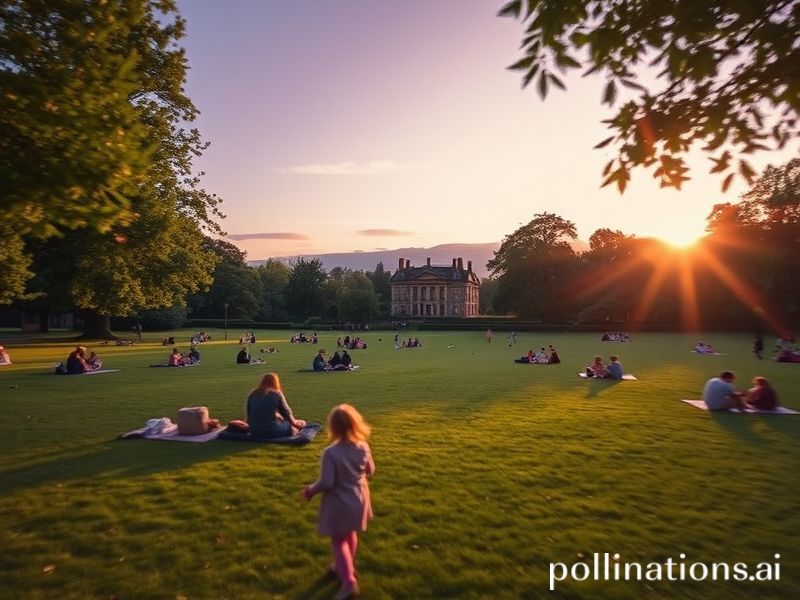
So what is Bellahouston’s global takeaway? Simply this: while nations weaponise trade routes and algorithmic sentiment, a commons survives by allowing dog-walkers, asylum-seekers, wedding parties, and the occasional Polish pope to share the same sod without a terms-of-service agreement. It is not listed on any G7 agenda, yet every spring its cherry blossoms renegotiate the only climate treaty that still delivers on time. The rest of us can keep flying to summits, pledging to phase out coal next Tuesday, but the grass here has already voted: perpetual minority government, pro-kite, anti-landfill, coalition with the crows. If that’s not a workable foreign policy, you might as well concrete the planet now and bill the overtime to posterity.