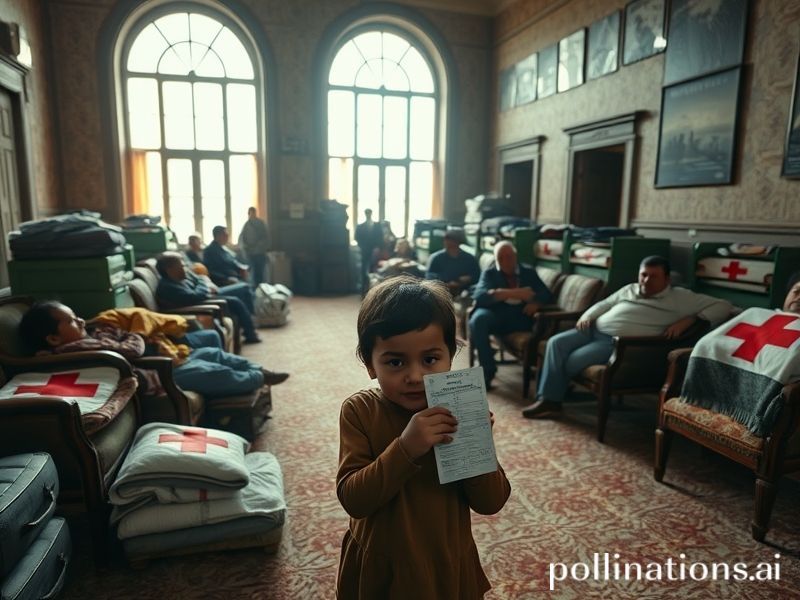
The Grand Hotel Status Quo
———————————————
Room service with a side of existential dread
Across the planet, a new hospitality brand is quietly over-booking itself. There is no points program, no mint on the pillow, and the nightly rate is paid in trauma rather than Amex. Welcome to the asylum hotel: that curious halfway house between escape and captivity, where the continental breakfast comes with a side order of geopolitical guilt. From the former Novotels dotting the French banlieues to the decommissioned seaside resorts on England’s Kent coast, governments are discovering that the most expedient refugee camp is the one that already has Wi-Fi and a fire-code certificate.
The concept is elegantly cynical. Instead of erecting tent cities that look terrible on the evening news, states simply lease under-performing four-stars, re-badge them “contingency accommodation,” and voilà—instant plausible deniability. The towels are still fluffy, but the guests are forbidden from using the pool because, as the Home Office delicately puts it, “chlorine poses an unmanaged risk.” Last year Germany alone booked 42,000 beds in 312 properties; Greece, running low on actual islands to warehouse people, simply leased the Athens Airport Sofitel for eighteen months. Even Japan—never a country to miss an efficiency opportunity—has repurposed love hotels outside Narita, reasoning the mirrors on the ceiling are already a conversation starter.
Meanwhile, the global implications shuffle around the lobby like jet-lagged tourists. The asylum hotel is a neat distillation of 21st-century values: market solutions for moral failures, a minibar for your misery. International law says claimants must be processed on sovereign territory; capitalism says there’s an EconoLodge five minutes from the immigration court with group rates. The UNHCR issues guidelines on natural light and recreational space; the outsourced security firm adds a surcharge for “high-visibility patrol ambiance.” Everyone agrees the arrangement is temporary, which is only true in the cosmic sense that eventually the sun will swallow the Earth.
For the guests—sorry, “service users”—the experience is a masterclass in polite disorientation. You are simultaneously a paying customer (except you’re not) and a detainee (except you haven’t been convicted of anything). Children who crossed three deserts to get here learn to queue for the waffle iron behind Karen from Düsseldorf on a spa weekend. The ironies are layered like continental bedding: the Syrian dentist brushing his teeth next to the minibar whose sticker still threatens a €6 charge for the cashews he can’t open because his fingers are trembling. In Australia’s Christmas Island pop-up, management once tried to boost morale with a “tropical cocktail hour”; the bartender fled after being asked for twenty-seven mocktails with no alcohol, no sugar, and a splash of hope on the side.
Naturally, there is a secondary market. British outsourcing giants rent the buildings from struggling hotel chains, then subcontract linen services to other subsidiaries, creating a vertiginous spiral of invoices that would make Russian-doll manufacturers blush. Local economies, starved since COVID murdered business travel, now depend on the per-diem allowance asylum seekers spend at the Tesco Express next door. In rural Belgium, a mayor recently petitioned to keep “his” refugees because they were the only thing preventing the village café from going bankrupt. Nothing says late-stage capitalism quite like needing a humanitarian crisis to keep the espresso machine humming.
And yet, for all the bureaucratic burlesque, the asylum hotel is merely the most visible symptom of a deeper malaise: the global conviction that displacement can be outsourced like everything else. If the supply chain can move iPhones from Shenzhen to Cincinnati overnight, surely despair can be rerouted to a former Holiday Inn near Gatwick. The broader significance, then, is not in the thread-count of the sheets but in the threadbareness of our collective imagination. We have invented a thousand apps to summon dinner; we still rely on mid-tier hospitality to process the human fallout of our wars.
In the end, the asylum hotel offers one last dark amenity: the mirror. Every morning, as staff strip the beds and restock the tiny shampoos, they are also laundering something larger—the faint but unmistakable reflection of a world that would rather book a room than solve the problem. Checkout, as always, is at eleven. Late departure fees may apply, especially if your country is still on fire.