Kobe Bryant Is Still the World’s Most Overqualified Ghost
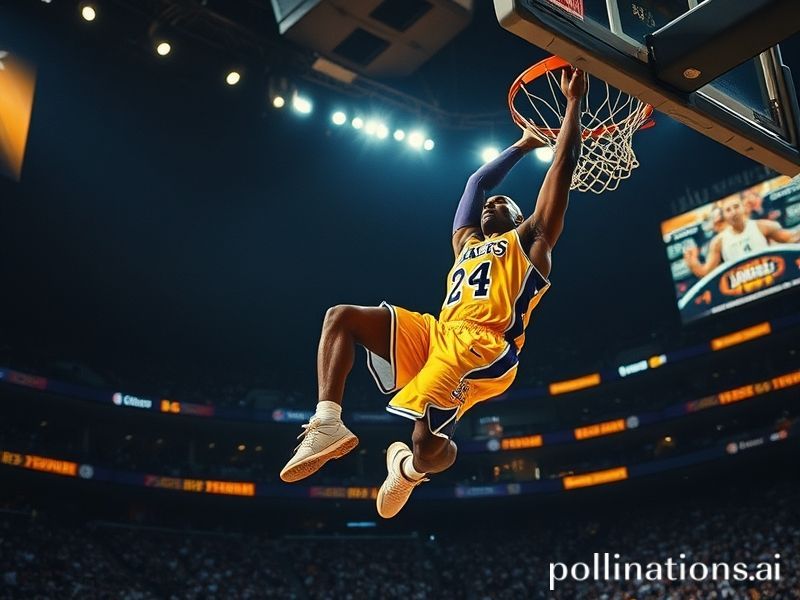
The helicopter came down on a fog-soft hillside in Calabasas, California, but the impact reverberated from Manila’s midnight basketball courts to Lagos traffic jams where hawkers still sell bootleg Lakers jerseys like Vatican relics. Kobe Bean Bryant—five-time NBA champion, Oscar winner, alleged rapist, youth-academy benefactor, #GirlDad meme—died four years ago, yet he continues to globe-trot in death with the same efficiency he once used to rack up 81-point games. International mourning, it turns out, is less candlelight vigil than perpetual IPO: the brand refreshes daily, the myth compounds quarterly, and the rest of us are stuck paying management fees in nostalgia.
From a strictly geopolitical standpoint, Kobe’s afterlife is a masterclass in soft power that Foggy Bottom should study between drone-strike briefings. China’s state broadcaster cut away from a People’s Liberation Army parade to replay his 2010 Finals highlights—Xi Jinping’s subtle reminder that even Marxist-Leninist cadres need a Jordan-style successor narrative. Across the Himalayas, India’s cricket-crazed sports channels splice Kobe jump-shot graphics into IPL coverage, as if Virat Kohli might suddenly attempt a fadeaway six. In Europe, where football remains the opium of the masses, Serie A ultras unveil “RIP KOBE” tifos that look suspiciously like Nike billboard sketches. The continent that gave us the Enlightenment now outsources its grief iconography to a sneaker company—Voltaire, meet Virgil Abloh.
Africa, meanwhile, treats Kobe’s legacy like a development bank with better sneakers. The Mamba Sports Academy’s pop-up clinics from Johannesburg to Nairobi promise “elite mindset training,” which translates to teenagers doing cone drills while local coaches hustle for Instagram clout. The irony isn’t lost on anyone: a Black Mamba lives on as a neoliberal NGO, complete with branded water bottles and a TEDx talk on “Mamba Mentality in the Face of Structural Adjustment Programs.” Somewhere, a Senegalese kid wearing a knock-off Kobe IV wonders why his court still floods every rainy season; the answer, alas, isn’t in the syllabus.
Latin America offers the purest distillation of posthumous Kobe-ism. Mexico City street artists paint murals where Kobe wears a lucha-libre mask, conflating No. 24 with Santo, the silver-screen saint of masked wrestling. Argentines—still high on Messi’s World Cup—quietly tuck Kobe wristbands into their Boca Juniors shrines, as if a basketball demigod might intercede for penalties. The region’s drug cartels, ever alert to cultural semaphore, have adopted “Mamba” as code for a particularly potent fentanyl variant. Nothing says global icon like having your nickname stamped on the very thing killing your youngest fans.
The Middle East prefers its Kobe worship with a side of realpolitik. Dubai’s new indoor ski complex projects a laser silhouette of Bryant dunking over the Burj Khalifa every hour on the hour, right after the call to prayer. Qatar Airways repainted one of its A350s in Lakers purple and gold, a flying billboard shuttling migrant laborers who earn less in a year than Kobe made per quarter. Somewhere in Riyadh, a Vision 2030 consultant is pitching “Mamba Oasis,” a $2 billion entertainment district where visitors can VR-dunk on holographic defenders while sipping $25 date-milk lattes. Progress, baby.
Back in the United States, the homeland oscillates between hagiography and litigation. Vanessa Bryant’s wrongful-death suit against Los Angeles County settled for an undisclosed sum rumored to dwarf the GDP of Tonga. Cable networks rerun Kobe’s Oscar-winning “Dear Basketball” on loop, conveniently forgetting that the Academy has yet to nominate a woman director twice. Meanwhile, the National Transportation Safety Board released its final report blaming pilot spatial disorientation—the aviation equivalent of “thoughts and prayers.”
So what does it mean when a basketball player becomes the patron saint of late-capitalist grief? Perhaps that we’ve run out of living heroes willing to stay alive long enough to disappoint us. Easier to embalm the narrative at peak mythic voltage, then export the carcass worldwide like weaponized nostalgia. Kobe once joked that fans loved him because he provided “a escape from their everyday lives.” Four years post-crash, the escape has become the everyday: a 24-hour Mamba channel in the collective unconscious, buffering eternally between ad breaks. The helicopter fell, but the bandwidth never does.