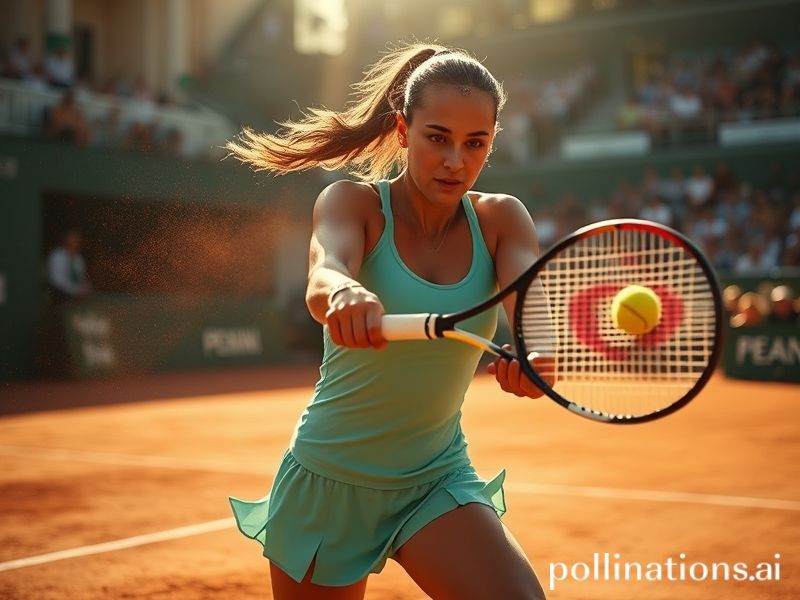
Jasmine Paolini, the 5’4″ Italian who punches above her weight class and below the net-cord, is presently the best proof that the universe occasionally enjoys a good underdog story—provided it’s scheduled between a geopolitical meltdown and a climate catastrophe. While diplomats in Brussels bicker over whose turn it is to save the euro and the Amazon quietly converts itself into charcoal, the 28-year-old from Castelnuovo di Garfagnana keeps sliding across acrylic courts like a caffeinated Vespa, reminding the planet that not every headline needs body armor.
Let’s zoom out. In a week where the U.N. Security Council resembled a badly run PTA meeting and the Arctic clocked in at a balmy 21°C, Paolini reached her first Grand Slam quarter-final at Roland Garros. The feat is, statistically speaking, as likely as a stable Italian government, so naturally the world press corps tripped over itself to explain what it all means. The short answer: not much. The longer, more marketable answer: a tiny Tuscan with a backhand like a switchblade has become a Rorschach test for our anxious age.
Globally, her rise lands somewhere between feel-good filler and soft-power parable. Italy, still run by a revolving door of unelected technocrats and whichever Berlusconi hologram is currently switched on, has latched onto Paolini with the desperation of a nation that just realized its last cultural export was a TikTok pasta recipe. Giorgia Meloni’s office issued a congratulatory statement within minutes—roughly three hours faster than the coast guard responds to migrant distress calls—praising “the indomitable spirit of Italian womanhood.” Somewhere in Brussels, Ursula von der Leyen quietly bookmarked the moment for the next slide deck on “EU Resilience Through Sport.”
Meanwhile, in Beijing, sports bureaucrats took notes. The Chinese Tennis Association, still busy pretending Peng Shuai is “on extended holiday,” sees Paolini as evidence that state megafunding isn’t the only route to the top. In the United States, ESPN buried her highlight reel between an NFL holdout and a cryptocurrency fraud indictment, but the clip still racked up 2.3 million views—roughly the same number of Americans who believe the moon landing was staged in a Roman studio. In short, everyone projects onto her what they need: Europe sees plucky regionalism, Asia sees meritocratic possibility, America sees… a buffering thumbnail.
The tennis itself is almost beside the point. Yes, she tracks down drop shots like a tax auditor chasing offshore accounts, and yes, her serve has the arc of a middle-manager’s career—short, flat, and frequently intercepted. But the real spectacle is geopolitical theater by proxy. When she faced Elena Rybakina—Kazakhstan’s Wimbledon champion by way of Moscow and Monte Carlo—the match doubled as a soft-power referendum. Every forehand felt like a subtweet at the Kremlin; every grunt sounded vaguely like a sanctions package. Paolini lost in three sets, but Italian newspapers hailed it as “a moral victory,” which is what countries call defeats when they can’t afford reparations.
Financial markets, ever hungry for metaphors, briefly rallied on the news that an unseeded Italian could take a set off a major. Analysts at Goldman Sachs issued a note titled “Paolini & Peripheral Momentum,” suggesting her performance foretold a narrowing of Italian bond spreads. Traders bought it for exactly six hours, then sold on rumors of another government collapse. Somewhere, a quant is still trying to model topspin against sovereign risk; the algorithm keeps returning 404.
And yet, cynicism has its limits. In a year when every push notification feels like a subpoena from reality, Paolini remains refreshingly analogue: no NFT side hustle, no televised apology tour, no leaked manifesto about crypto-fascist yoga. Just a woman who hits a fuzzy yellow ball better than 99.9% of humanity and still celebrates like she’s won a free espresso. It’s not salvation, but in 2024 it passes for hope—lightly carbonated, served with a biscotti, and gone by the quarter-finals.