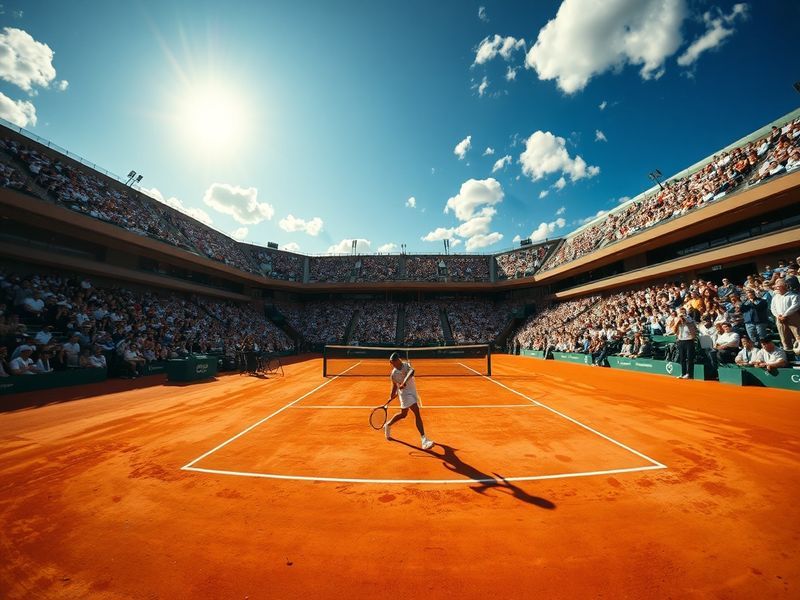
Nestled on the edge of the Bois de Boulogne in Paris, the Stade Roland Garros isn’t just a tennis venue—it’s a cathedral of clay-court tradition. Since its inception in 1925, the tournament has grown from a modest French championship to one of the sport’s four Grand Slam events, drawing over half a million spectators annually. Its red clay courts, known for their slow playing surface, have shaped the careers of legends while offering a unique challenge unlike any other major.
The tournament’s origins trace back to 1891 when the first French Championships were held at the Sports section of the Stade Français club. In 1925, the event opened to international players, marking its transformation into a Grand Slam. The stadium itself was named after Roland Garros, an early 20th-century French aviator and World War I hero, whose legacy adds a layer of historical significance to the event. Today, the tournament stands as a testament to French tennis culture while maintaining its role as a global sporting spectacle.
The Clay-Court Mastery: Why Roland Garros Stands Apart
Roland Garros’ signature red clay courts are more than just a surface—they’re a character in the tournament’s story. The courts slow down the ball, allowing for longer rallies and emphasizing endurance and strategy over power. Unlike the hard courts of the Australian Open or the grass of Wimbledon, clay rewards patience and precision. Players must slide into their shots, adjust their footwork constantly, and exhibit mental resilience to outlast opponents in grueling five-set matches.
The clay’s composition—composed of crushed brick, shale, and stone—creates a unique texture that absorbs the ball’s energy. This means players can’t rely solely on raw power; they must construct points, exploit weaknesses, and adapt their game plans on the fly. The surface also favors baseline players with exceptional topspin, like Rafael Nadal, who has claimed a record 14 titles at Roland Garros. His dominance on clay has cemented the tournament’s reputation as a proving ground for those who master the art of clay-court tennis.
For spectators, the clay courts offer an immersive experience. The red dust kicks up with every slide, creating a visual rhythm that matches the intensity of the matches. The slower pace allows for deeper tactical battles, where every point feels like a chess match. This unpredictability is why fans flock to Roland Garros year after year, knowing they’ll witness tennis at its most cerebral and physically demanding.
Iconic Moments and Legendary Champions
Roland Garros has been the stage for some of tennis’s most unforgettable moments. In 1989, a 17-year-old Michael Chang stunned the tennis world by defeating Ivan Lendl in the fourth round, becoming the youngest male champion in Grand Slam history. His victory was a David vs. Goliath tale, complete with a signature underhand serve that left Lendl stunned. Chang’s triumph remains one of the tournament’s most celebrated upsets.
The women’s side has also produced historic moments. In 2012, Maria Sharapova became the first Russian woman to win the French Open, a victory that marked the beginning of her dominance on clay. Her powerful baseline game and mental fortitude made her a formidable force on the red dirt. Meanwhile, Chris Evert’s dominance in the 1970s and 1980s solidified her status as the “Queen of Clay,” with seven titles to her name. Evert’s two-handed backhand and unshakable consistency set the standard for future generations.
The tournament has also seen its share of heartbreak and redemption. In 2008, Ana Ivanovic’s dream of winning a Grand Slam crumbled in the final against Serena Williams. Ivanovic, who had reached the top of the rankings just months earlier, struggled with the pressure and lost in straight sets. Yet, her journey to the final showcased the tournament’s ability to both humble and inspire players, regardless of their experience.
- Rafael Nadal’s Dominance: With 14 titles, Nadal’s record at Roland Garros is unmatched. His physicality, mental toughness, and relentless work ethic have made him the undisputed “King of Clay.”
- Justine Henin’s Artistry: The Belgian’s one-handed backhand and elegant style made her a fan favorite. She won four titles between 2003 and 2007, cementing her legacy as one of the sport’s most graceful champions.
- Björn Borg’s Back-to-Back Triumphs: In 1974 and 1975, Borg claimed his first two Grand Slam titles at Roland Garros, launching a career that would see him dominate tennis in the late 1970s.
- Mary Pierce’s Emotional Victory: In 2000, Pierce became the first Frenchwoman to win the tournament in 22 years, delivering a poignant victory for her home country.
The Evolution of Roland Garros: From Tradition to Modernity
While Roland Garros prides itself on tradition, it has also embraced modernity to stay relevant in an ever-changing sporting landscape. In 2020, the tournament made history by postponing its schedule due to the COVID-19 pandemic, marking the first time it had been held outside its usual late May to early June window. The decision was a nod to the tournament’s adaptability, ensuring the safety of players and fans while maintaining its prestige.
The stadium itself has undergone significant expansions in recent years. The construction of a new retractable roof over Court Philippe-Chatrier in 2020 was a game-changer, allowing play to continue uninterrupted during rain delays. The roof, combined with state-of-the-art lighting and sound systems, transformed the venue into a year-round destination for tennis enthusiasts. Additionally, the expansion of the grounds to include new courts, such as Court Simonne-Mathieu, has increased capacity and improved the overall fan experience.
Technology has also played a role in Roland Garros’ evolution. The introduction of electronic line-calling systems, such as Hawk-Eye Live, has reduced controversies and sped up the pace of play. Meanwhile, advancements in broadcasting have brought the tournament to a global audience, with matches streamed in high definition and interactive formats. Social media platforms have further amplified the tournament’s reach, allowing fans to engage with players and share their experiences in real time.
Yet, for all its modernization, Roland Garros has remained true to its roots. The tournament continues to celebrate French tennis culture, with a strong emphasis on homegrown talent. Initiatives like the “Roland Garros Experience” offer fans behind-the-scenes tours of the stadium, while programs for junior players aim to nurture the next generation of champions. The tournament’s commitment to preserving its heritage while embracing innovation ensures it remains a cornerstone of the tennis calendar.
Why Roland Garros Matters: A Legacy Beyond the Court
Roland Garros is more than just a tennis tournament—it’s a cultural institution. Its red clay courts have witnessed the highs and lows of tennis history, from triumphant victories to crushing defeats. The tournament’s unique challenges have shaped the careers of countless players, testing their physical and mental limits in ways no other Grand Slam can.
For France, Roland Garros is a point of national pride. The tournament’s success has inspired a generation of French players, from Yannick Noah’s 1983 victory to the emergence of rising stars like Ugo Humbert and Corentin Moutet. The French Open’s ability to produce homegrown talent is a testament to the country’s deep-rooted tennis culture and the tournament’s role as a launching pad for future champions.
Beyond tennis, Roland Garros has become a symbol of Parisian elegance and sophistication. The tournament’s integration into the city’s cultural fabric is evident in its partnerships with local artists, musicians, and chefs. The “Roland Garros by Roland Garros” initiative, for example, showcases French gastronomy, fashion, and art, offering fans a multi-sensory experience that extends beyond the court.
As Roland Garros continues to evolve, its core values remain unchanged. It is a tournament that celebrates the beauty of the game, the spirit of competition, and the rich history of French tennis. Whether you’re a die-hard fan or a casual observer, the tournament offers something for everyone—a chance to witness tennis at its finest, on a surface unlike any other.
For those who have experienced it, Roland Garros is more than a destination; it’s a pilgrimage. It’s where legends are made, where dreams are realized, and where the heartbeat of French tennis echoes through the centuries.