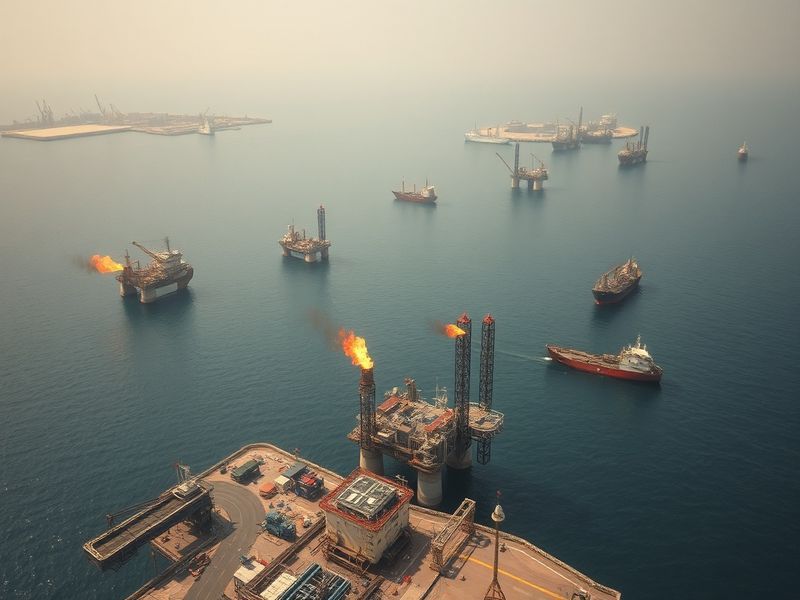
The South Pars gas field, located in the Persian Gulf, stands as one of the world’s most significant natural gas reserves. Spanning roughly 9,700 square kilometers, it is the largest gas field in the world, jointly owned by Iran and Qatar under the North Dome/South Pars structure. For Iran, this field is not just an energy resource—it is a cornerstone of economic strategy, geopolitical leverage, and technological ambition.
The Scale and Significance of South Pars
The South Pars gas field is estimated to hold over 1,400 trillion cubic feet of natural gas, making it larger than many entire national reserves. Its development has been a massive undertaking, involving decades of investment, international partnerships, and advanced engineering. The field is divided into 24 phases, each designed to extract gas, condensate, and other hydrocarbons for domestic use and export.
Iran’s portion of the field, South Pars, is critical to the country’s energy security. Natural gas accounts for nearly 70% of Iran’s total energy consumption, and South Pars supplies a significant portion of that demand. Beyond domestic use, the field’s output supports petrochemical industries, power generation, and even export revenues—though sanctions and geopolitical tensions have limited its full potential.
Key Phases and Development Milestones
The development of South Pars has been a phased process, with each stage introducing new infrastructure and technological advancements. Below are some of the most notable phases:
- Phase 1: Launched in 1999, this phase focused on early gas production and laying the groundwork for future expansion.
- Phases 2 & 3: Completed in the early 2000s, these phases increased gas processing capacity and connected the field to Iran’s national grid.
- Phases 4 & 5: Added significant condensate production, boosting Iran’s oil-linked revenues despite sanctions.
- Phases 11 & 12: Aimed at enhancing recovery rates and introducing new technologies, though progress has been slow due to financial and political constraints.
Each phase has faced challenges, from technical hurdles to international sanctions that restricted foreign investment and technology transfers. Yet, Iran has persisted, often turning to domestic expertise to keep the project moving forward.
Geopolitical and Economic Impact
The South Pars gas field is more than an energy asset—it is a geopolitical tool. For Iran, control over South Pars reinforces its position in the Middle East, providing leverage in negotiations with regional powers like Saudi Arabia and Qatar. The field also plays a role in Iran’s relationships with global players, including Russia and China, which have invested in its development.
Economically, South Pars is a lifeline. Iran’s energy sector has been crippled by U.S. sanctions, which target its oil and gas exports. Despite these restrictions, South Pars has allowed Iran to maintain some level of energy independence. The field’s condensate production, in particular, has been a workaround, as condensate is less strictly regulated than crude oil under sanctions regimes.
However, the field’s full potential remains untapped. Sanctions have delayed projects, reduced foreign investment, and limited Iran’s ability to modernize infrastructure. The recent easing of some sanctions—particularly under the 2023 détente with the West—could revive South Pars’s development, but the path forward is uncertain.
Technological and Environmental Challenges
Developing South Pars has required cutting-edge technology, from advanced drilling techniques to sophisticated gas processing plants. Iran has made strides in domestic technology, particularly in the face of sanctions, but it still relies on foreign expertise for some aspects of the project.
Environmental concerns are another critical issue. The Persian Gulf is a delicate ecosystem, and large-scale gas extraction poses risks such as methane leaks, water contamination, and habitat disruption. Iran has taken steps to mitigate these risks, including investing in cleaner technologies and monitoring systems, but environmental groups argue that more needs to be done.
In recent years, Iran has also faced criticism over its methane emissions, which are among the highest in the world. The South Pars field is a major contributor to these emissions, raising questions about Iran’s commitment to climate goals. As global pressure to reduce greenhouse gases grows, Iran’s ability to balance energy production with environmental responsibility will be closely scrutinized.
Broader Implications for the Energy Market
The South Pars gas field is a bellwether for the global energy landscape. Its development reflects broader trends in the natural gas industry, including the shift toward liquefied natural gas (LNG), the rise of regional energy hubs, and the geopolitical competition over energy resources.
For competitors like Qatar, which shares the field with Iran, South Pars represents both a challenge and an opportunity. Qatar has leveraged its portion of the field to become the world’s top LNG exporter, while Iran has struggled to match that success due to sanctions and mismanagement. The contrast highlights the risks of relying too heavily on a single resource in a volatile geopolitical environment.
Looking ahead, the South Pars gas field could play a pivotal role in Iran’s economic recovery. If sanctions are lifted and foreign investment returns, the field could see a surge in production, boosting Iran’s energy exports and stabilizing its economy. Alternatively, if tensions persist, Iran may continue to rely on domestic solutions, further isolating its energy sector from global markets.
The field’s future will also depend on global energy trends. The push for renewable energy and the transition away from fossil fuels could reduce demand for natural gas in the long term. However, in the short to medium term, natural gas remains a critical transition fuel, particularly in regions like Asia, where demand is still growing.
What’s Next for South Pars?
The next decade will be decisive for South Pars. Several factors will shape its trajectory:
- Sanctions and Diplomacy: The lifting or tightening of sanctions will directly impact Iran’s ability to develop the field.
- Technological Innovation: Advances in gas extraction and processing could unlock new reserves and improve efficiency.
- Environmental Pressures: Stricter regulations on methane emissions and climate goals may force Iran to adopt cleaner technologies.
- Global Energy Demand: Shifts in energy consumption patterns, particularly in Asia, will influence Iran’s export potential.
For now, South Pars remains a symbol of Iran’s resilience and ambition. It is a reminder of how energy resources can shape economies, influence geopolitics, and drive technological progress—despite the obstacles.
As the world grapples with energy transitions and geopolitical rivalries, the South Pars gas field stands as a case study in the complexities of resource management, national strategy, and global interconnectedness. Its story is far from over, and its next chapter could redefine Iran’s role in the energy landscape for decades to come.
For more insights into energy markets and geopolitical trends, explore our News and Analysis sections on Dave’s Locker.