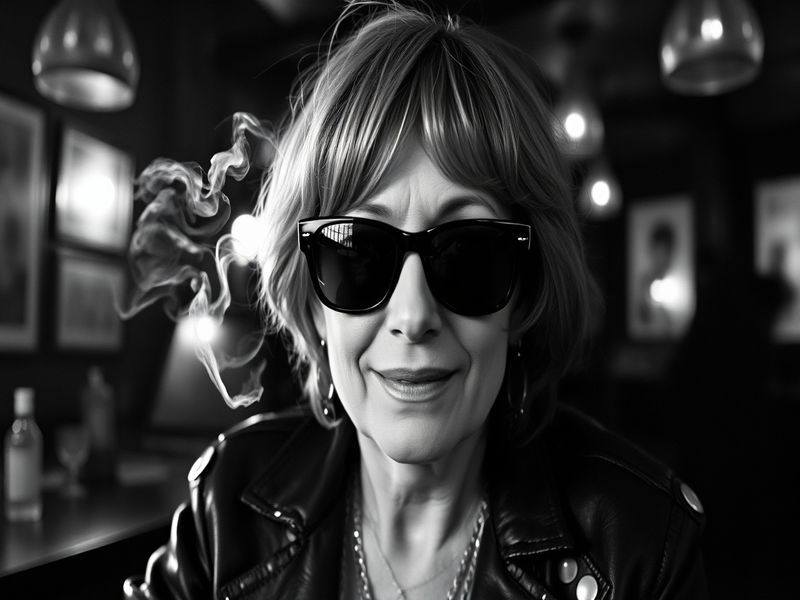
Marianne Faithfull’s career spans more than six decades, yet her influence feels as immediate as a late-night radio transmission cutting through static. Born in 1946 in Hampstead, London, she emerged in the mid-1960s as a fragile, doe-eyed ingénue with a voice that could shatter glass or melt into a whisper. Over time, she transformed from a symbol of 1960s innocence to a gritty icon of survival, addiction, and reinvention. Her life reads like a cautionary ballad—one that she’s rewritten countless times.
Faithfull’s relationship with fame has been anything but conventional. She didn’t just ride the wave of rock stardom; she dove headfirst into its depths, only to resurface decades later, wiser and more defiant. Her story is not just about music—it’s about resilience, transformation, and the cost of authenticity in an industry that often demands conformity.
The 1960s: From Sweet Melody to Sonic Rebellion
Faithfull’s early career was marked by the kind of serendipity that defined the swinging London of the 1960s. Discovered by Andrew Loog Oldham, the Rolling Stones’ manager, at 17, she released her debut single “As Tears Go By” in 1964. Written by Mick Jagger, Keith Richards, and Oldham, the song became an instant hit, positioning her as the era’s answer to fragile femininity. Yet, even then, her voice carried an undercurrent of something darker, something unresolved.
By the late 1960s, Faithfull had shed her pop princess image. The release of Come My Way in 1965 and Marianne Faithfull in 1967 showcased a more mature, blues-infused sound. Her collaboration with Jagger and Richards on The Last Tycoon (1967) further blurred the lines between her personal life and public persona. She was no longer just a muse—she was becoming a force.
Her most pivotal recording, “Sister Morphine,” written in collaboration with Jagger and Richards, was initially credited to her but later revealed to be a shared effort. The song’s haunting narrative about addiction foreshadowed the struggles Faithfull would soon face. It was a moment where art and life began to bleed into one another, a theme that would define much of her career.
The 1970s and 1980s: Addiction, Silence, and a Fragile Comeback
The 1970s were a decade of erasure for Faithfull. Her life became dominated by heroin addiction, homelessness, and a near-fatal overdose in 1969 that left her in a coma for weeks. The press, which had once celebrated her, now turned on her. Tabloids painted her as a fallen starlet, a cautionary tale of excess. For years, she disappeared from the public eye, her voice silenced by the weight of her struggles.
Yet, silence can be a form of reinvention. In the early 1980s, Faithfull resurfaced with a raw, unfiltered memoir, Faithfull: An Autobiography, co-written with journalist David Dalton. The book was a brutal confession, laying bare her addiction, her relationships, and her moments of despair. It was also a reclaiming of her narrative—one that refused to let others define her.
Musically, her return was equally unflinching. The 1985 album Broken English marked her artistic rebirth. Produced by members of the Sex Pistols and featuring the iconic track “The Ballad of Lucy Jordan,” the album fused punk, rock, and cabaret into a sound that was entirely her own. “Broken English” didn’t just reintroduce Faithfull to the world; it redefined her as an artist who could turn pain into power.
- “Broken English” (1985) – A masterpiece of reinvention, blending punk aggression with poetic lyricism.
- “The Ballad of Lucy Jordan” (1979) – A haunting, cinematic track that became a cult classic.
- “Why D’Ya Do It?” (1979) – A scathing, sexually charged anthem from Broken English that shocked and captivated listeners.
The 1990s to Present: Ageless Defiance and Artistic Evolution
As the decades passed, Faithfull’s music evolved in ways that defied expectations. She embraced electronic textures, jazz inflections, and even operatic flourishes, all while maintaining a voice that sounded like it had weathered centuries of storms. Albums like A Secret Life (1995) and Easy Come, Easy Go (2008) showcased her willingness to experiment, to shed old skins without apology.
Her live performances became legendary—not for their spectacle, but for their intimacy. Whether performing in a dimly lit Parisian jazz club or a grand London theater, Faithfull’s presence was magnetic. She didn’t just sing songs; she inhabited them, turning each lyric into a confession. At 70, she released Negative Capability (2018), an album produced by Warren Ellis, which critics hailed as a late-career triumph. The title itself—a nod to Keats’ poetic ideal—reflected her ongoing commitment to artistic purity over commercial appeal.
Faithfull’s personal life has also been a study in resilience. She survived abusive relationships, financial ruin, and health crises, including a diagnosis of breast cancer in 2003. Yet, she has consistently turned adversity into art. Her 2007 album Songs of Marianne Faithfull featured stripped-down, acoustic reimaginings of her own catalog, proving that her voice could still command attention decades after her first hit.
Legacy: The Icon Who Refused to Be Defined
Marianne Faithfull’s legacy is one of contradiction. She is a survivor who has outlived many of her peers, a former sweetheart who became a punk provocateur, a woman whose voice has been both angelic and feral. She has been called a muse, a cautionary tale, a genius, and a survivor—often in the same breath. But perhaps her greatest achievement is her refusal to be pigeonholed.
In an industry that often demands reinvention every few years, Faithfull has done the opposite: she has embraced evolution. She has allowed her life’s chaos to fuel her art, turning personal demons into public masterpieces. Her influence can be heard in artists as varied as PJ Harvey, Cat Power, and even younger musicians like Angel Olsen, who cite Faithfull as a touchstone for fearless self-expression.
Faithfull’s story is also a reminder of the cost of authenticity. In a world where artists are often pressured to curate their public images, she has remained unapologetically human. Her music doesn’t just entertain; it confronts. It doesn’t just soothe; it disturbs. And in doing so, it invites listeners to confront their own vulnerabilities.
As she approaches her eighth decade, Faithfull shows no signs of slowing down. In 2021, she released She Walks in Beauty, a collection of poems set to music, further blurring the boundaries between her written and musical work. Her voice, though weathered by time, remains a vessel for raw emotion—capable of conveying both the weight of a lifetime and the fleeting beauty of the present moment.
Marianne Faithfull is more than a musician or a cultural figure; she is a testament to the power of transformation. Her life and career challenge the notion that artists must remain static, that their stories must fit neatly into a timeline. Instead, she has proven that reinvention is not just possible—it’s necessary. And in doing so, she has given audiences permission to evolve alongside her.
For those discovering her music for the first time, Faithfull’s catalog offers a journey through decades of artistic fearlessness. For longtime fans, she remains a touchstone—a reminder that even in the darkest moments, art can be a lifeline. And for the music industry at large, she stands as a challenge: to embrace the messy, unfiltered truths that lie beneath the surface of every great artist.
Marianne Faithfull didn’t just survive the chaos of her life—she turned it into art. And in doing so, she redefined what it means to be a rebel, a survivor, and an artist.
Explore more iconic voices in music history on Dave’s Locker Music.
For deeper analysis of cultural icons, visit Dave’s Locker Entertainment.