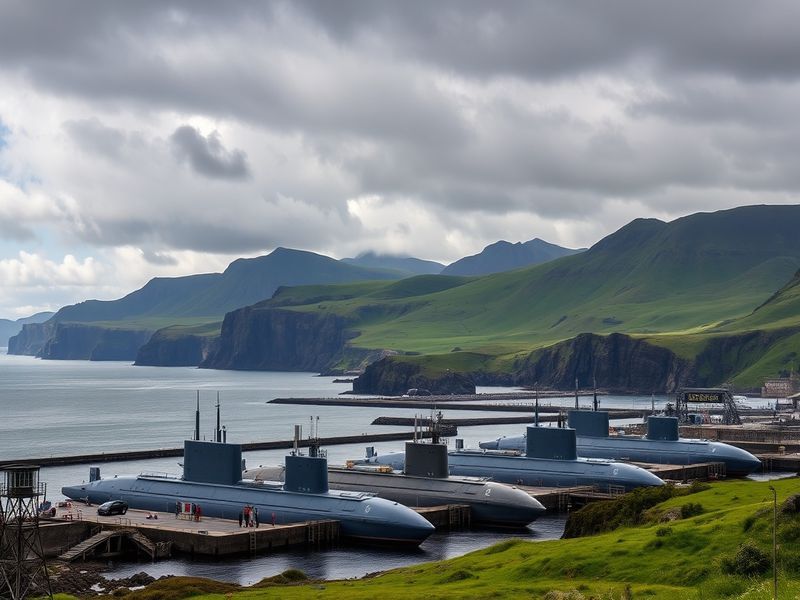
Faslane Naval Base: Scotland’s Nuclear Dilemma Explained
Faslane Naval Base sits on the Gare Loch in Scotland, a facility that has shaped both local communities and international defense policy for decades. Originally built during World War II as a shipyard, it transformed into the Royal Navy’s primary nuclear submarine base in 1967. Today, it houses Britain’s entire fleet of Vanguard-class submarines, each armed with Trident nuclear missiles.
The base’s location offers strategic advantages. Its deep waters provide natural shelter for submarines, while its proximity to the Atlantic allows quick deployment to global hotspots. Yet this same strategic position places Faslane at the center of geopolitical tensions, particularly regarding nuclear disarmament debates.
The Historical Evolution of Faslane
Faslane’s origins trace back to 1941 when the British Admiralty established the site as a shipbuilding and repair facility. After World War II, the base’s role diminished until the Cold War era necessitated a secure location for nuclear deterrent systems. The British government selected Faslane in 1963 for its deep-water harbor and relative isolation from major population centers.
In 1967, the first submarine, HMS Resolution, arrived at Faslane. This marked the beginning of Britain’s continuous at-sea nuclear deterrent. The base expanded significantly during the 1970s and 1980s, with new docks and support facilities constructed to accommodate the growing submarine fleet.
Scotland’s relationship with Faslane has been complex. While the base provides hundreds of jobs in an economically depressed region, it has also become a focal point for anti-nuclear protests. The Scottish Parliament has consistently opposed nuclear weapons, creating ongoing tension with London over the base’s future.
Faslane in the Global Nuclear Landscape
As one of the few operational nuclear submarine bases in Europe, Faslane plays a crucial role in NATO’s nuclear deterrent strategy. The base’s submarines represent Britain’s contribution to the alliance’s collective defense posture. However, this role places Faslane at the heart of disarmament debates.
International observers note that Faslane operates under unique circumstances. Unlike American or Russian submarine bases, Faslane exists within a country that has formally declared its opposition to nuclear weapons. The Scottish government’s 2016 white paper called for the removal of Trident missiles, setting up a direct confrontation with UK defense policy.
Geopolitical analysts point to several key aspects of Faslane’s global significance:
- Nuclear Deterrence: The base maintains Britain’s nuclear arsenal, which remains operational despite global disarmament efforts.
- NATO Commitments: Faslane’s submarines contribute to NATO’s nuclear sharing arrangements, though Britain maintains operational control.
- Disarmament Tensions: The base has become a symbol of nuclear opposition, particularly in Scotland where independence movements often tie their arguments to nuclear weapons removal.
- Environmental Concerns: The storage of nuclear materials at Faslane raises questions about long-term environmental safety in the surrounding Loch Long area.
Comparative analysis shows that Faslane shares similarities with other nuclear submarine bases, but its political context makes it unique. The base’s operations must navigate between Britain’s strategic defense requirements and Scotland’s growing anti-nuclear sentiment.
The Human Impact: Local Economy and Protest Culture
For the local community of Helensburgh and nearby towns, Faslane represents both economic lifeline and political dilemma. The base employs approximately 6,800 service personnel and civilians, making it the area’s largest employer. The economic impact extends to local businesses, from pubs that serve naval personnel to shops that cater to military families.
Yet this economic dependence coexists with a strong protest tradition. The nearby town of Faslane has been a center for anti-nuclear activism since the 1970s. Organizations like the Campaign for Nuclear Disarmament maintain a permanent presence near the base’s gates, organizing regular demonstrations.
The protest culture has evolved over time. During the 1980s, direct action was common, with activists regularly breaking into the base. Modern protests tend to focus on legal demonstrations and political lobbying, though direct action continues among more radical groups. The annual Big Blockade, organized by Trident Ploughshares, typically draws hundreds of participants.
Local residents express mixed feelings. Some families have served at the base for generations, creating strong personal connections. Others, particularly younger generations, view the base as an environmental and political liability that threatens Scotland’s international image.
Future Challenges and Strategic Considerations
Faslane faces an uncertain future as both political and technological factors reshape its role. The UK government has committed to replacing the Vanguard-class submarines with new Dreadnought-class vessels, ensuring Faslane’s continued operation for decades. However, this decision faces mounting opposition.
Several key challenges will determine Faslane’s trajectory:
- Political Realignment: Scotland’s potential independence could force the relocation of Trident missiles, though this would require complex negotiations and significant investment.
- Technological Shifts: The development of hypersonic missiles and other advanced delivery systems may render submarine-based deterrents less effective.
- Public Opinion: Growing environmental consciousness and nuclear disarmament movements continue to pressure governments on both sides of the border.
- Economic Pressures: Maintaining and upgrading the base’s infrastructure requires substantial investment at a time when military budgets face scrutiny.
- International Relations: Changes in NATO strategy or US-UK defense agreements could alter Faslane’s operational requirements.
The base’s defenders argue that Faslane remains essential for Britain’s national security and NATO cohesion. They point to the ongoing modernization program as proof of its continued importance. Critics, however, see the base as a relic of Cold War thinking that drains resources from more pressing defense needs.
Environmental concerns add another layer of complexity. The storage of nuclear warheads at Faslane’s RNAD Coulport facility has drawn criticism from international observers. While the UK government maintains strict safety standards, the potential for accidents remains a concern for local residents and environmental groups.
Conclusion: A Base at the Crossroads
Faslane Naval Base occupies a unique position in both military strategy and cultural discourse. It serves as Britain’s nuclear deterrent while simultaneously becoming a symbol of nuclear opposition in Scotland. This dual role ensures that Faslane will remain a contentious issue regardless of which political path the UK and Scotland choose in coming years.
The base’s future may well be determined by factors beyond its control—the outcome of Scottish independence movements, international disarmament treaties, and technological advancements in nuclear delivery systems. Yet Faslane’s strategic importance ensures it will remain relevant as long as nuclear weapons exist.
For now, the submarines silently patrol the Atlantic from their Gare Loch home, while activists maintain their watch from the nearby hills. The tension between these two realities encapsulates Faslane’s paradox: a place of immense destructive potential that simultaneously sustains thousands of livelihoods and serves as a canvas for democratic protest.