How Donald Trump Changed U.S.-Israel Relations Forever
Few modern U.S. presidents have reshaped American foreign policy toward Israel as dramatically as Donald Trump. From recognizing Jerusalem as Israel’s capital to brokering the Abraham Accords, his administration pursued a bold, often controversial approach that prioritized Israeli interests in ways unseen since the Cold War era. These moves not only redefined U.S.-Israel relations but also set a precedent for future administrations to either continue or reverse course.
The Jerusalem Embassy Move: Symbolism and Consequences
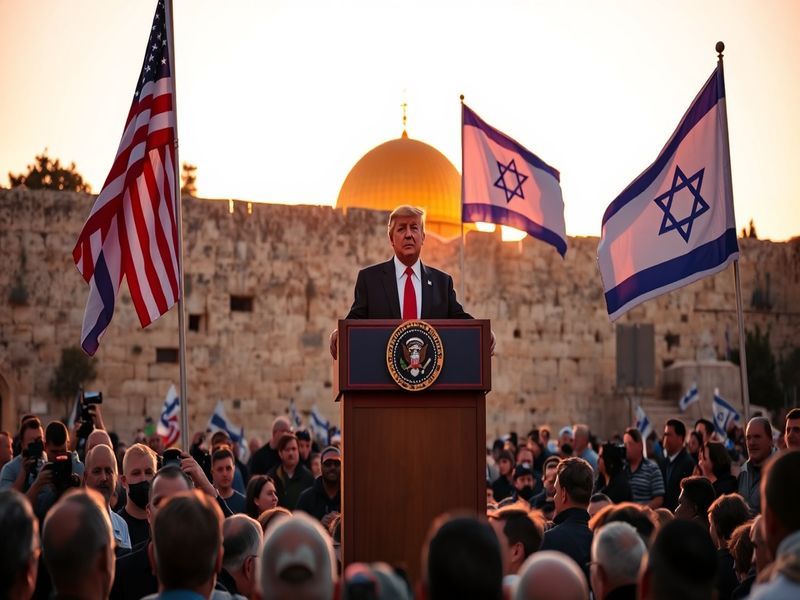
One of the most consequential decisions of Trump’s presidency came in December 2017, when he formally recognized Jerusalem as the capital of Israel. The announcement, delivered in a White House speech, reversed decades of U.S. policy that had deferred to international consensus on the status of the city—a flashpoint in the Israeli-Palestinian conflict. The move was celebrated by Israeli leadership and hardline supporters in the U.S., but it triggered protests across the Middle East and deepened Palestinian skepticism toward American mediation efforts.
The decision culminated in the relocation of the U.S. Embassy from Tel Aviv to Jerusalem in May 2018, a move that fulfilled a longstanding promise from the Republican Party’s conservative base. While the embassy’s new location was hailed as a fulfillment of political promises, it also sidestepped long-standing international frameworks, including United Nations resolutions that had designated Jerusalem’s status as unresolved. Critics argued that the move undermined America’s role as a neutral broker in the peace process, while supporters contended it simply recognized reality.
Reactions from Key Stakeholders
- Israel: Prime Minister Benjamin Netanyahu praised the move as a “historic milestone,” reinforcing his government’s claim to a unified Jerusalem under Israeli sovereignty.
- Palestinians: Palestinian Authority President Mahmoud Abbas condemned the decision, calling it a violation of international law and a rejection of Palestinian rights.
- International Community: European allies, including France and Germany, expressed concern that the move could destabilize the region further.
- U.S. Diplomats: Some career diplomats resigned in protest, signaling internal dissent over the policy shift.
The Abraham Accords: Normalizing Relations in the Middle East
Beyond Jerusalem, Trump’s foreign policy toward Israel culminated in the Abraham Accords, a series of normalization agreements between Israel and several Arab states, including the United Arab Emirates, Bahrain, Sudan, and Morocco. Signed in 2020, these accords marked the first major expansion of Arab-Israeli relations since the 1990s Oslo Accords and were framed as a victory for Trump’s “peace through strength” approach.
The agreements were brokered with minimal Palestinian input, drawing criticism from Palestinian leadership but earning praise from Gulf states eager to counterbalance Iran’s influence. The UAE’s decision to normalize relations with Israel in exchange for a suspension of Israeli annexation plans in the West Bank was particularly notable, signaling a pragmatic shift in Arab-Israeli relations.
Implications for Regional Stability
The Abraham Accords demonstrated that Arab states were increasingly prioritizing economic and strategic interests over the Palestinian cause—a trend that predated Trump but accelerated under his administration. The agreements also provided Israel with new diplomatic and economic partners, reducing its regional isolation.
However, the accords did not resolve the core issues of the Israeli-Palestinian conflict. Palestinian factions, including Hamas, rejected the normalization deals, and protests erupted in the West Bank and Gaza. The agreements also raised questions about the long-term viability of a two-state solution, as Arab states seemed willing to engage with Israel without addressing Palestinian statehood.
Broader Implications for U.S. Foreign Policy
Trump’s approach to Israel reflected a broader departure from traditional U.S. diplomacy. His administration frequently dismissed multilateral institutions, such as the United Nations, in favor of bilateral agreements that aligned with his “America First” agenda. This strategy resonated with his political base but alienated long-standing allies who viewed it as undermining the post-World War II international order.
The shift also had domestic political consequences. Evangelical Christians, a key voting bloc for Trump, strongly supported his pro-Israel policies, particularly the embassy move and the Abraham Accords. Meanwhile, progressive Democrats and liberal Jewish groups criticized his approach as undermining Palestinian rights and exacerbating regional tensions.
Long-Term Consequences
As of 2024, the effects of Trump’s policies continue to shape the Israeli-Palestinian landscape. The Biden administration has largely maintained the embassy in Jerusalem but has sought to revive Palestinian-Israeli negotiations—a stark contrast to Trump’s hands-off approach to Palestinian statehood. Meanwhile, the Abraham Accords have proven resilient, with new countries exploring normalization with Israel.
Yet the lack of a broader peace framework remains a glaring omission. The Trump administration’s focus on state-level agreements bypassed the Palestinian issue entirely, leaving unresolved questions about governance, security, and territorial disputes. For Israel, the accords provided tangible benefits, but for Palestinians, they reinforced a sense of abandonment by both Arab states and the U.S.
Lessons for Future Administrations
Trump’s Israel policy offers several lessons for future U.S. administrations. First, it demonstrated the limits of unilateral U.S. action in the Middle East. While bold moves like the embassy relocation or the Abraham Accords generated short-term gains, they did little to address the underlying drivers of conflict.
Second, the policy highlighted the growing divergence between Arab states and Palestinian leadership. As Gulf states prioritized economic and security interests, the Palestinian cause became increasingly marginalized—a trend that shows no sign of reversing.
Finally, Trump’s approach underscored the polarizing nature of U.S. foreign policy. By aligning so closely with Israeli hardline positions, his administration deepened divisions within the U.S. and between the U.S. and its allies. Future administrations will need to balance domestic political pressures with the realities of a complex, volatile region.
Looking Ahead
The legacy of Trump’s Israel policy will continue to influence U.S. diplomacy for years to come. Whether future administrations build on the Abraham Accords or seek to revive a two-state solution remains an open question. What is clear, however, is that Trump’s approach fundamentally altered the terms of U.S.-Israel relations—and set a new benchmark for what is politically possible in American foreign policy.
For those interested in exploring further, Dave’s Locker News provides ongoing coverage of U.S. foreign policy developments, while Dave’s Locker Analysis offers deeper insights into the geopolitical implications of these shifts.