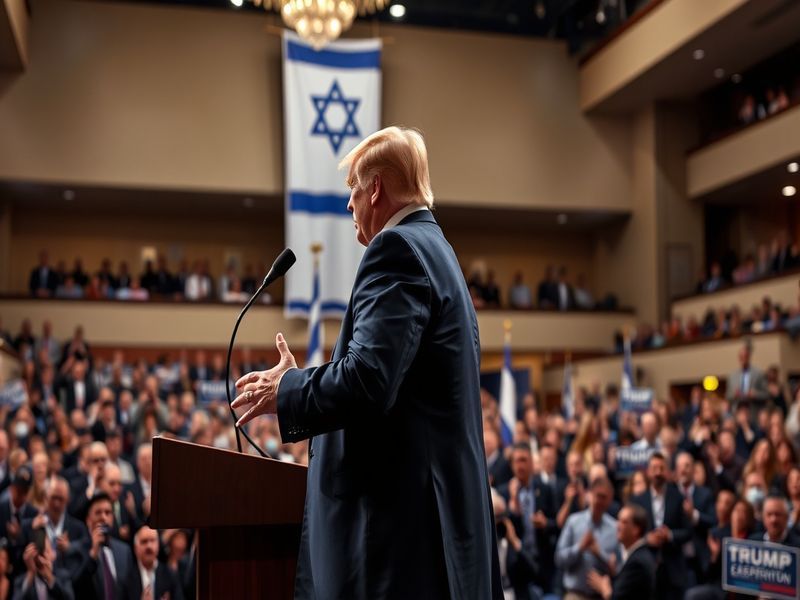
Donald Trump’s Relationship with Israel
Donald Trump’s presidency marked a significant period in U.S.-Israel relations. His administration took bold steps that redefined the dynamics of this longstanding alliance. From recognizing Jerusalem as Israel’s capital to brokering normalization agreements between Israel and several Arab nations, Trump’s foreign policy towards Israel was both controversial and groundbreaking.
Recognition of Jerusalem
One of Trump’s most notable actions was his decision to officially recognize Jerusalem as the capital of Israel in December 2017. This move was met with mixed reactions globally. Supporters argued that it was a long-overdue acknowledgment of Israel’s historical claim to the city, while critics contended that it undermined peace efforts with the Palestinians.
The decision was accompanied by a promise to move the U.S. embassy from Tel Aviv to Jerusalem, a pledge that was fulfilled in May 2018. This act not only solidified Trump’s commitment to Israel but also galvanized support among his evangelical base in the United States.
Abraham Accords
Another significant achievement during Trump’s tenure was the Abraham Accords, signed in 2020. These agreements normalized relations between Israel and several Arab nations, including the United Arab Emirates and Bahrain. The accords were hailed as a historic step towards peace in the Middle East and shifted the focus from the Israeli-Palestinian conflict to broader regional cooperation.
The implications of the Abraham Accords were profound. They opened up pathways for economic collaboration, tourism, and security cooperation in the region. However, the accords also drew criticism for sidelining the Palestinian issue, which many believe remains central to achieving lasting peace in the Middle East.
Domestic and International Reactions
Trump’s policies towards Israel ignited varied reactions both domestically and internationally. Within the United States, support for Trump’s approach was particularly strong among conservative and pro-Israel groups. Conversely, many Democrats and progressive organizations viewed his policies as provocative and detrimental to the peace process.
Internationally, reactions were polarized. Some countries praised the normalization agreements as a step forward, while others condemned the recognition of Jerusalem as a capital, arguing that it jeopardized the possibility of a two-state solution.
Key Points of Trump’s Israel Policy
- Recognition of Jerusalem as Israel’s capital
- Relocation of the U.S. embassy to Jerusalem
- Signing of the Abraham Accords, normalizing relations with Arab nations
- Withdrawal from the Iran nuclear deal, impacting regional dynamics
Conclusion
Donald Trump’s approach to Israel was marked by decisive actions that reshaped U.S. foreign policy in the region. His recognition of Jerusalem and the Abraham Accords signaled a departure from traditional diplomatic norms. While these moves garnered significant support, they also deepened divisions regarding the Israeli-Palestinian conflict.
As the political landscape continues to evolve, the long-term impacts of Trump’s policies will remain a topic of discussion. The future of U.S.-Israel relations and the broader Middle East peace process will depend on how subsequent administrations choose to navigate these complex issues.