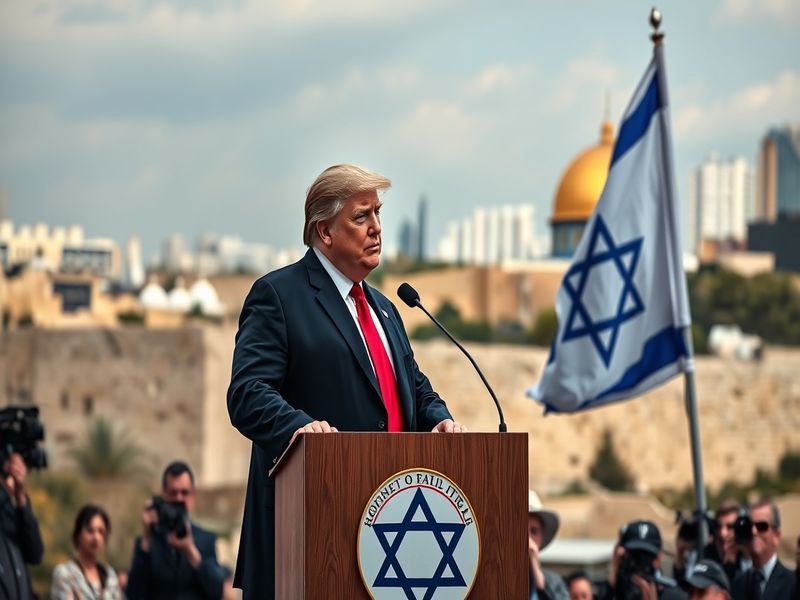
Trump’s Israel Policy: Bold Moves and Lasting Controversies
Donald Trump’s presidency from 2017 to 2021 marked one of the most dramatic shifts in U.S. foreign policy toward Israel in decades. His administration pursued an aggressive, transactional approach that prioritized symbolic gestures and policy reversals over traditional diplomatic norms. While supporters praised his unwavering support for Israel’s government, critics argued his actions undermined long-standing international frameworks.
The Trump administration’s policies reshaped the U.S.-Israel relationship in ways that continue to influence global diplomacy today. From recognizing Jerusalem as Israel’s capital to brokering normalization deals between Israel and Arab states, Trump’s approach was defined by bold moves rather than incremental progress. These decisions left a lasting impact on Middle Eastern geopolitics, often polarizing international opinion.
Jerusalem as Israel’s Capital: A Diplomatic Earthquake
One of Trump’s most consequential decisions was the recognition of Jerusalem as the capital of Israel in December 2017. This move reversed decades of U.S. policy and international consensus, which had treated Jerusalem’s status as a final issue to be resolved through negotiations between Israelis and Palestinians.
The announcement triggered immediate backlash from Palestinian leaders and much of the international community. The United Nations General Assembly passed a resolution condemning the move by a vote of 128-9, with 35 abstentions. Yet, the Trump administration doubled down, relocating the U.S. embassy from Tel Aviv to Jerusalem in May 2018—a move hailed by Israeli Prime Minister Benjamin Netanyahu as a “historic milestone.”
Domestically, the decision energized Trump’s evangelical base, many of whom view Israel’s control over Jerusalem as a fulfillment of biblical prophecy. Evangelical leaders like Jerry Falwell Jr. praised the move, while Jewish and Arab-American advocacy groups criticized it as a reckless abandonment of Palestinian rights.
The Abraham Accords: Rewriting Middle Eastern Alliances
A signature achievement of Trump’s foreign policy was the Abraham Accords, a series of normalization agreements between Israel and several Arab states, including the United Arab Emirates, Bahrain, Sudan, and Morocco. These deals, brokered with minimal Palestinian involvement, marked a significant departure from the traditional “land for peace” framework that had dominated Middle East diplomacy for decades.
The accords were framed as a triumph of Trump’s “outside-in” approach—prioritizing economic and security interests over Palestinian statehood. Jared Kushner, Trump’s senior advisor and son-in-law, played a central role in negotiating the agreements, leveraging U.S. military aid and diplomatic pressure to secure the deals.
Critics argued that the accords sidelined Palestinian aspirations and rewarded authoritarian regimes while offering little tangible benefit to ordinary Palestinians. Yet, proponents saw them as a pragmatic step toward integrating Israel into the broader Middle East, reducing regional tensions and opening new economic opportunities.
Controversies and Consequences: The Dark Side of Trump’s Policies
Trump’s approach to Israel was not without controversy. His administration’s decision to cut funding to the United Nations Relief and Works Agency (UNRWA), which supports Palestinian refugees, drew sharp criticism from humanitarian organizations. Critics argued that the move exacerbated humanitarian crises in Gaza and the West Bank, while supporters framed it as a necessary step to pressure Palestinian leadership to return to negotiations.
The administration also greenlit the expansion of Israeli settlements in the West Bank, territories widely considered illegal under international law. In November 2019, Secretary of State Mike Pompeo announced that the U.S. would no longer view settlements as inconsistent with international law—a reversal of long-standing U.S. policy. This decision was celebrated by Israeli settlers but condemned by human rights groups as a violation of Palestinian rights.
Another contentious move was the Trump administration’s decision to close the Palestine Liberation Organization (PLO) office in Washington, D.C., in 2018. The closure was framed as a response to Palestinian efforts to pursue war crimes charges against Israel at the International Criminal Court (ICC). The move further strained U.S.-Palestinian relations and limited diplomatic channels for future negotiations.
The Two-State Solution: A Casualty of Trump’s Policies?
Throughout his presidency, Trump consistently distanced himself from the two-state solution, the long-standing framework for Israeli-Palestinian peace. In a 2018 interview with the Times of Israel, Trump stated, “I like the one that both parties like. I’m happy with the one both parties like. I can live with either one.” This ambiguity reflected his transactional approach to diplomacy, prioritizing deals over ideological commitments.
In January 2020, the Trump administration unveiled its “Peace to Prosperity” plan, a proposal that would have granted Israel sovereignty over large parts of the West Bank while offering Palestinians limited self-rule in disconnected enclaves. The plan was immediately rejected by Palestinian leaders and most international observers, who criticized it as biased in favor of Israel.
While the plan ultimately went nowhere, its release underscored the Trump administration’s willingness to bypass traditional peace processes in favor of unilateral actions. This approach left many analysts questioning whether a viable two-state solution remained possible in the post-Trump era.
Legacy and Lessons: How Trump Redefined U.S.-Israel Relations
Donald Trump’s presidency left an indelible mark on U.S.-Israel relations, reshaping the dynamics of Middle Eastern diplomacy in ways that continue to unfold. His administration’s policies—from Jerusalem to the Abraham Accords—demonstrated the power of bold, unconventional moves in foreign policy. Yet, they also highlighted the risks of sidelining long-standing international norms and Palestinian aspirations.
For supporters, Trump’s approach represented a necessary correction to decades of perceived U.S. passivity. His willingness to challenge the status quo and prioritize Israel’s security and interests resonated with many in the pro-Israel community. The Abraham Accords, in particular, are often cited as a rare diplomatic success in an otherwise tumultuous region.
For critics, however, Trump’s policies deepened divisions and undermined the prospects for a just and lasting peace. By abandoning the two-state solution and weakening Palestinian institutions, his administration may have made future reconciliation even more difficult. The long-term consequences of these decisions remain uncertain, but their impact on global perceptions of the Israeli-Palestinian conflict is undeniable.
The Biden administration has since sought to distance itself from Trump’s most controversial policies, reopening dialogue with Palestinian leadership and reaffirming the U.S. commitment to a two-state solution. Yet, the normalization deals brokered under Trump have endured, signaling a shift in regional alliances that may outlast his presidency.
As the Middle East continues to evolve, the lessons of Trump’s approach to Israel offer valuable insights into the complexities of modern diplomacy. Whether his legacy will be one of progress or disruption remains a subject of intense debate.
Key Takeaways from Trump’s Israel Policy
- Jerusalem Recognition: Trump’s decision to recognize Jerusalem as Israel’s capital reversed decades of U.S. policy and sparked international condemnation, yet it energized his evangelical base.
- Abraham Accords: The normalization deals between Israel and several Arab states marked a historic shift in Middle Eastern diplomacy, though critics argued they sidelined Palestinian rights.
- Settlement Expansion: The administration’s decision to legitimize Israeli settlements in the West Bank drew widespread criticism from human rights groups and the international community.
- Two-State Solution: Trump’s rejection of the two-state framework reflected his transactional approach to diplomacy, prioritizing deals over ideological commitments.
For further reading on U.S. foreign policy and Middle Eastern dynamics, explore our Analysis and Politics sections. These categories offer in-depth coverage of the forces shaping global affairs today.
Donald Trump’s approach to Israel was bold, divisive, and transformative. As the region continues to grapple with the consequences of his policies, the debate over his legacy will likely endure for years to come.