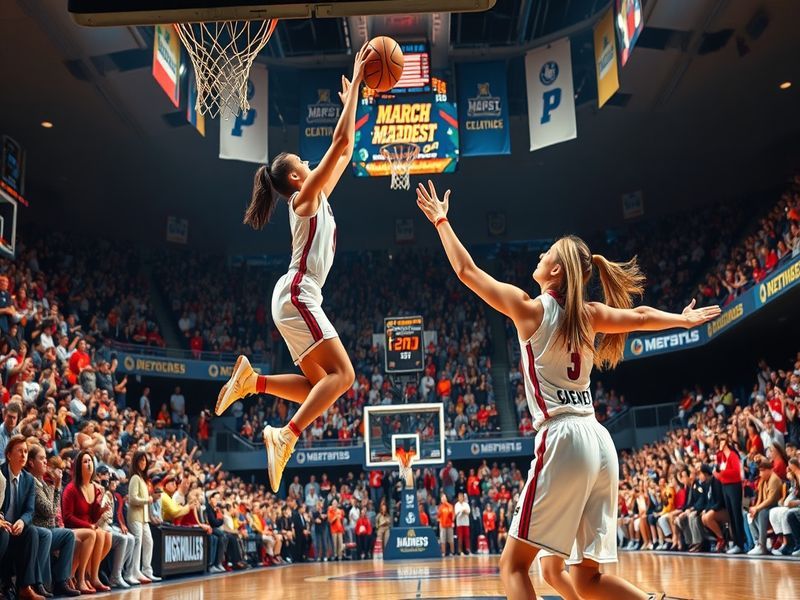
Women’s college basketball has never been more popular. What was once a niche segment of the sports world has exploded into a global phenomenon, drawing record-breaking viewership, sold-out arenas, and a new generation of fans who see the sport as both elite competition and cultural force. The NCAA Women’s Basketball Tournament, colloquially known as “March Madness,” is no longer the shadow of its men’s counterpart—it’s carving out its own legacy on the world stage.
This transformation is not happening in isolation. It reflects broader shifts in sports media, gender equity, and fan engagement. From viral Caitlin Clark buzzer-beaters to the growing influence of social media stars like Paige Bueckers, the women’s game is being redefined in real time. What began as a grassroots movement is now a mainstream spectacle with implications far beyond the court.
From Underdog to Mainstream: The Evolution of Women’s College Hoops
The journey of women’s March Madness is a story of resilience and progress. For decades, the sport existed in the margins of college athletics, starved for resources, media coverage, and institutional support. The 1990s and early 2000s saw glimmers of change, with programs like Tennessee under Pat Summitt and UConn under Geno Auriemma laying the foundation for excellence. But it wasn’t until the 2020s that the sport began to truly capture the public imagination.
Several factors have driven this shift. The rise of social media has democratized access to players, allowing fans to connect with athletes in ways that were previously impossible. Platforms like TikTok and Instagram have turned stars like Clark, Angel Reese, and JuJu Watkins into household names—long before they even enter the WNBA. The NCAA, too, has played a role, albeit a complicated one. After years of criticism over disparities in facilities, travel budgets, and media exposure, the organization has taken steps to close the gap, including equalizing March Madness prize money in 2023.
This evolution mirrors broader trends in women’s sports. According to a 2023 report from Deloitte, women’s sports are projected to generate over $1 billion in revenue globally by 2024, driven by increased investment, media rights deals, and fan engagement. Women’s college basketball sits at the heart of this movement, serving as both a proving ground for elite talent and a cultural bridge connecting young girls to professional sports.
A Global Stage: How Women’s Basketball Is Breaking Borders
While March Madness is a distinctly American tradition, its influence is spreading far beyond U.S. borders. The NCAA’s decision to host neutral-site games in locations like Mexico City and Paris reflects a strategic push to grow the sport internationally. In 2024, the NCAA announced a partnership with the International Basketball Federation (FIBA) to develop youth programs in Africa, Asia, and Europe, aiming to cultivate the next generation of global stars.
Countries like Australia, Canada, and France have already seen their women’s college basketball pipelines flourish. Australian guard Sabrina Ionescu, who played at Oregon, became a global icon, inspiring a wave of young athletes Down Under to pursue the sport at the collegiate level. In Canada, the rise of players like Aaliyah Edwards (UConn) has fueled interest in NCAA-style programs north of the border.
This internationalization is not just about talent development—it’s about changing perceptions. Women’s basketball in many parts of the world has historically been overshadowed by men’s leagues or dismissed as less competitive. But as stars like Clark and Reese dominate highlight reels, they’re challenging those narratives. The 2023 NCAA championship game between LSU and Iowa drew over 9.9 million viewers, making it the most-watched women’s college basketball game in history. For comparison, the average viewership for the men’s final that year was around 14.6 million, but the gap is narrowing rapidly.
Key International Markets for Women’s College Basketball
- Australia: Home to the WNBL and a growing pipeline of NCAA-bound players. Programs like Oregon and South Carolina have become top destinations.
- Canada: The rise of players like Edwards and Bridget Carleton has sparked interest in U.S. college recruitment. The country now boasts multiple NCAA scholarship athletes.
- France: With stars like Marine Johannès (formerly of Louisville) and Sandrine Gruda’s coaching influence, France is emerging as a hotbed for European talent.
- Japan: The success of Rui Machida (formerly of West Virginia) has inspired a new generation of Japanese players to consider NCAA programs.
- Mexico: The NCAA’s decision to host games in Mexico City has energized local interest, with youth programs beginning to sprout in major cities.
The Cultural Impact: More Than Just a Game
Women’s March Madness is more than a sporting event—it’s a cultural moment. For young girls, it’s a source of inspiration. For older generations, it’s a chance to rewrite the script of what women’s sports can achieve. The 2023 tournament, in particular, became a flashpoint for conversations about gender equity in sports. When the NCAA announced that the women’s tournament would receive the same branding as the men’s for the first time, it was a symbolic victory for advocates who had long argued that the women’s game deserved equal treatment.
But the cultural ripple effects extend beyond the court. The rise of women’s college basketball has coincided with a broader reckoning over gender representation in sports media. Networks like ESPN and Fox Sports have increased coverage of women’s games, while platforms like YouTube and Twitch have given fans alternative ways to engage. The viral success of TikTok accounts like @hoopcentral and @womenshoopsworld has shown that younger audiences are hungry for content that goes beyond traditional broadcasts.
There’s also a financial dimension. The NIL (Name, Image, Likeness) era has transformed college athletics, and women’s basketball is no exception. Players like Clark and Reese have leveraged their fame to secure lucrative endorsement deals, proving that women’s sports can be commercially viable. Brands like Nike, Gatorade, and Google have signed multi-year partnerships with NCAA athletes, signaling a shift in how corporations view women’s sports investment.
The Road Ahead: Challenges and Opportunities
Despite its rapid growth, women’s March Madness still faces hurdles. The most pressing is the persistent pay gap between men’s and women’s sports. While the NCAA’s decision to equalize March Madness prize money was a step forward, disparities in coaching salaries, facility investments, and media rights deals remain. The 2024 season saw some conferences, like the Big Ten, take steps to close these gaps, but progress is uneven.
Another challenge is maintaining momentum. The 2023-24 season saw record viewership and attendance, but sustaining that interest requires continued investment in storytelling, fan engagement, and grassroots development. The NCAA and conferences must resist the temptation to treat the women’s tournament as a one-off spectacle rather than a year-round priority.
Yet the opportunities are vast. The 2028 Summer Olympics in Los Angeles present a chance to showcase the next generation of women’s college stars on a global stage. The WNBA’s growing popularity also creates a natural pipeline for NCAA graduates, ensuring that the talent development system remains robust. And as social media continues to evolve, new platforms will emerge, offering fresh ways for fans to connect with the game.
For now, women’s March Madness is thriving. The 2024 tournament drew over 12 million viewers across platforms, a 24% increase from the previous year. Arenas sold out weeks in advance. Merchandise flew off shelves. And for the first time, the women’s Final Four was broadcast on the same network as the men’s in several markets. These are not just numbers—they’re proof that the sport has arrived.
As we look to the future, one thing is clear: women’s college basketball is no longer playing second fiddle. It’s a force in its own right, reshaping the landscape of college sports and inspiring millions around the world. The madness is just beginning.
Where to Watch and Follow the Action
For fans looking to dive deeper into the world of women’s college basketball, here are some key resources:
- Dave’s Locker Sports Section – Curated coverage of NCAA tournaments, player profiles, and analysis.
- Entertainment & Culture – Features on the intersection of sports, media, and pop culture.
- NCAA Women’s Basketball Official Site – Live scores, schedules, and highlights.
- ESPN Women’s Basketball Hub – Comprehensive coverage, including game recaps and expert analysis.
A Final Whistle: The Legacy of Women’s March Madness
Women’s March Madness is more than a tournament. It’s a movement. It’s a testament to the power of perseverance, the importance of representation, and the unifying force of sport. As the games grow louder and the crowds grow larger, the story of women’s college basketball is still being written. And for the first time in history, the world is listening.