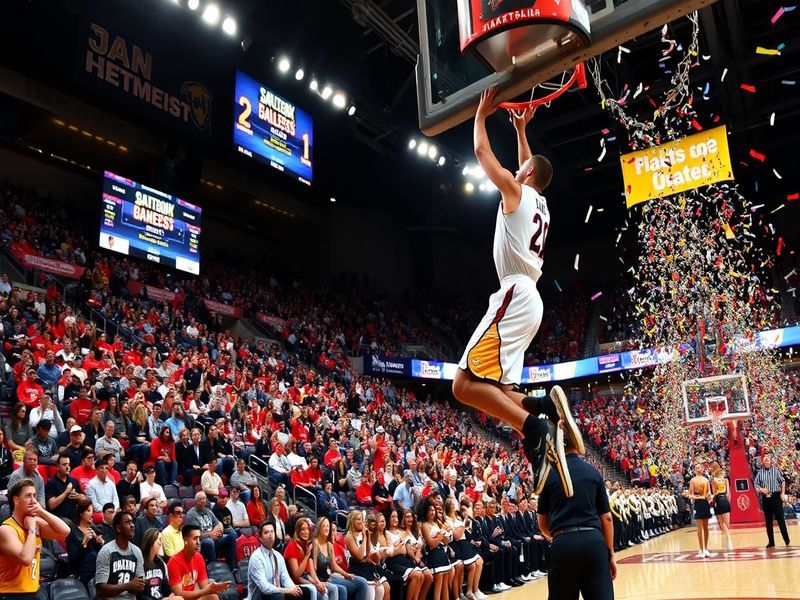
College Basketball Tournament: The Road to March Madness
The college basketball tournament, commonly known as March Madness, stands as one of the most electrifying events in American sports. Every spring, 68 teams from across the country compete in a single-elimination tournament that captivates millions of fans. The stakes are high, the drama is palpable, and the Cinderella stories make headlines year after year. From buzzer-beaters to underdog triumphs, the tournament delivers unforgettable moments that define college basketball.
The Structure of the Tournament: A Closer Look
The tournament begins with Selection Sunday, when the NCAA reveals the 68 teams that will compete. The field includes 32 automatic qualifiers—winners of their respective conference tournaments—and 36 at-large bids selected by the NCAA Selection Committee. Teams are seeded from 1 to 16 within four regions: East, West, South, and Midwest. The top four seeds in each region receive double byes, automatically advancing to the second round.
The tournament unfolds in stages. The First Four features eight low-seeded teams competing in play-in games to secure a spot in the main bracket. The Round of 64 and Round of 32, often referred to as the “second round” and “sweet sixteen” respectively, eliminate half the field in each region. The regional semifinals and finals narrow the field to the “Final Four,” the tournament’s final four teams, who advance to a neutral-site championship game.
Each round introduces new challenges. Higher-seeded teams face pressure to live up to expectations, while underdogs relish the opportunity to upset established programs. The single-elimination format ensures no room for error, making every game a high-stakes affair. The bracket’s unpredictability is part of its charm, with upsets reshaping tournament narratives almost annually.
Cinderella Stories: When Underdogs Take Center Stage
Few moments in sports rival the joy of a Cinderella run in the college basketball tournament. These underdog stories capture the imagination of fans and often become legend. In 2018, the University of Maryland, Baltimore County (UMBC) made history by becoming the first 16-seed to defeat a 1-seed, toppling top-ranked Virginia in a stunning 74-54 upset. The Retrievers’ victory sent shockwaves through the sports world and cemented their place in tournament lore.
Other memorable Cinderella teams include the 2006 George Mason Patriots, who reached the Final Four as an 11-seed. Their run inspired a generation of mid-major programs and proved that David can topple Goliath. Butler University also etched its name into tournament history with back-to-back championship appearances in 2010 and 2011, falling just short both times but capturing the nation’s heart.
These stories resonate because they embody the tournament’s essence: hope, resilience, and the belief that anything is possible. For players, a Cinderella run can launch careers and create lifelong memories. For fans, it’s a reminder that in March, the improbable becomes possible.
To explore more about how underdog stories shape sports culture, visit our News section for in-depth coverage of tournament trends and surprises.
The Role of Analytics and Strategy in Modern Tournament Play
In recent years, analytics has transformed how teams prepare for and execute in the tournament. Coaches and analysts use data to optimize lineups, shot selection, and defensive schemes. Advanced metrics like effective field goal percentage, offensive rebounding rate, and turnover margin help teams identify strengths and weaknesses in opponents.
For example, teams with high free-throw rates often perform well in tight games, where foul trouble can swing momentum. Similarly, teams that limit turnovers reduce the risk of giving away easy scoring opportunities to opponents. The rise of player-tracking technology, such as SportVU cameras, has provided even deeper insights into player movement and efficiency.
Coaches must balance analytics with adaptability. A team’s offensive strategy might prioritize three-point shooting, but if opponents force them into mid-range jumpers, adjustments are necessary. The best coaches blend data-driven decisions with in-game intuition, a combination that often determines who advances deep into the tournament.
Here’s a breakdown of key statistical categories that analysts prioritize during tournament preparation:
- Offensive Efficiency: Points per possession, effective field goal percentage, and turnover rate.
- Defensive Metrics: Defensive efficiency, steals per game, and opponents’ free-throw rate.
- Rebounding: Offensive and defensive rebounding percentages, which impact second-chance opportunities.
- Clutch Performance: Performance in games decided by five points or fewer, often a predictor of tournament success.
The Economic and Cultural Impact of the Tournament
The college basketball tournament is more than just a sporting event; it’s a cultural and economic phenomenon. The NCAA generates over $1 billion annually from media rights, sponsorships, and ticket sales, with a significant portion tied to the tournament. CBS Sports and Turner Broadcasting pay the NCAA over $800 million per year for broadcast rights, highlighting the event’s financial importance.
For host cities, the tournament brings substantial economic benefits. Hotels, restaurants, and local businesses see a surge in revenue as fans travel to fill stadiums and support their teams. In 2019, the tournament contributed an estimated $140 million to the San Antonio economy. The influx of visitors also boosts tourism, with fans often extending their stays to explore local attractions.
Culturally, the tournament fosters a sense of community among fans. Office pools, watch parties, and social media engagement create a shared experience that transcends geographic boundaries. Memes, brackets, and trash talk dominate conversations, making the tournament a unifying force in American sports culture. It’s a rare event where casual fans and die-hards alike can bond over their love of the game.
The tournament also amplifies the profiles of players and coaches. Stars like Christian Laettner, Carmelo Anthony, and Zion Williamson became household names after standout performances. Coaches like Roy Williams, Mike Krzyzewski, and Geno Auriemma have cemented legacies through tournament success. For many, the journey to the Final Four or championship game is the defining moment of their careers.
Looking Ahead: The Future of March Madness
The college basketball tournament continues to evolve, with changes aimed at enhancing the fan experience and adapting to modern trends. The NCAA has expanded the tournament to 68 teams, increasing opportunities for mid-major conferences to showcase their talent. There’s ongoing discussion about further expansion, with some advocating for a 128-team field to include even more teams and revenue-sharing opportunities.
Technology is also reshaping the tournament’s landscape. Virtual reality broadcasts, enhanced mobile apps, and personalized viewing experiences are becoming more prevalent. Fans can now follow real-time stats, player tracking, and interactive content, making the tournament more immersive than ever before. Social media platforms allow fans to engage with the action in real time, amplifying the sense of community.
On the court, the rise of transfer portal culture has introduced new dynamics. Players can now transfer between schools more easily, leading to roster turnover that can either bolster a team’s chances or create instability. The transfer portal has also given mid-major programs a pathway to attract high-level talent, potentially leveling the playing field in the tournament.
The future of the tournament will likely be shaped by debates over amateurism, player compensation, and conference realignment. As the landscape of college sports continues to shift, the tournament remains a constant, delivering drama, excitement, and unforgettable moments year after year.
For more analysis on how college sports are evolving, check out our Analysis section.
The college basketball tournament is a celebration of athleticism, strategy, and unpredictability. It’s a stage where legends are made, underdogs triumph, and fans are treated to a spectacle unlike any other in sports. As March approaches, the countdown begins, and the madness starts anew. Whether you’re a die-hard fan or a casual observer, the tournament offers something for everyone—a chance to witness history in the making.