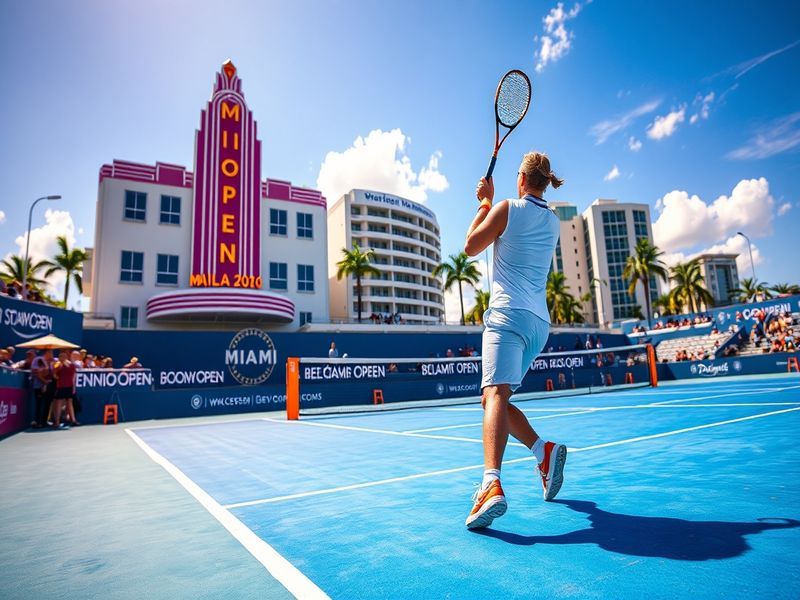
The Miami Open has grown into one of tennis’s most anticipated events, blending elite competition with a vibrant atmosphere that extends far beyond the baseline. Held annually at the Hard Rock Stadium in Miami Gardens, Florida, the tournament draws top-ranked players, celebrity sightings, and a global audience eager to witness high-energy matches under the Florida sun. Unlike traditional clay-court or grass-court events, the Miami Open thrives in its accessibility—offering fans a chance to engage with the sport in a setting that feels both exclusive and welcoming.
What started in 1985 as a smaller-scale tournament has evolved into a premier stop on the ATP and WTA tours, often serving as a barometer for Grand Slam success. Players arrive fresh off the Australian Open, using Miami as a crucial warm-up before the clay swing or grass-court season. The event’s timing—typically in late March—positions it as a bridge between early-season hard-court tournaments and the major championships. This strategic placement has helped solidify its reputation as a must-watch spectacle in professional tennis.
The Evolution of a Tennis Institution
The Miami Open’s journey from a modest tournament to a global sports and entertainment landmark reflects broader trends in professional tennis. In its early years, the event struggled to compete with the prestige of Wimbledon or the French Open. But by the late 1990s and early 2000s, a series of key decisions—including moving to Crandon Park in Key Biscayne and later to Hard Rock Stadium—transformed its identity. The relocation in 2012 to a 13,000-seat stadium with a 5,000-seat grandstand marked a turning point, enabling the tournament to host massive crowds and high-profile concerts alongside tennis.
Notable champions have left their mark on the Miami Open’s history. Andre Agassi, who won the title six times, embodied the tournament’s blend of grit and glamour. Serena Williams claimed her first WTA Miami title in 1998 and went on to dominate the event, winning eight titles in total. More recently, Ashleigh Barty and Novak Djokovic have added their names to the list, using Miami as a springboard to major success. The tournament’s surface—a fast hard court—favors aggressive baseliners and serve-and-volley players alike, ensuring unpredictable and thrilling matches.
The event’s off-court allure has also evolved. Once known primarily for its on-court action, the Miami Open now hosts celebrity pro-am matches, fashion showcases, and a lively fan festival featuring interactive games, autograph sessions, and player meet-and-greets. This expansion reflects a growing trend in sports entertainment: the fusion of athletic excellence with immersive fan experiences. The tournament’s ability to balance high-level competition with accessible entertainment has helped it carve out a unique niche in the global sports calendar.
Beyond the Baseline: A Weekend for the Senses
Attending the Miami Open is less about passive observation and more about active participation. The grounds buzz with energy from sunrise to sunset, as fans weave between practice courts, food vendors, and live music stages. The “Fan Central” area, located near the main stadium, offers a hub for activities including VR tennis simulations, player interviews, and youth clinics led by touring professionals. It’s a rare opportunity for spectators to interact with the sport in ways that go beyond watching a match.
Food and beverage options have become a highlight of the experience. The event partners with local Miami chefs to curate a diverse culinary lineup, featuring everything from Cuban sandwiches and empanadas to vegan smoothie bowls and craft cocktails. The “Taste of Miami” pavilion has become a must-visit, showcasing the city’s vibrant food culture alongside world-class tennis. This fusion of sport and cuisine underscores the tournament’s role as a cultural event, not just a sporting one.
Even the walk from the parking lot to the stadium is part of the show. The Miami Open’s design encourages mingling, with wide concourses, shaded seating areas, and art installations scattered throughout the grounds. In 2023, the tournament introduced a “Green Initiatives” zone, highlighting sustainability efforts such as compostable food containers and solar-powered lighting. These touches reflect a growing awareness of environmental responsibility within sports entertainment, aligning the Miami Open with modern fan values.
Concerts and Celebrities: The Off-Court Headliners
While tennis remains the centerpiece, the Miami Open’s night sessions are legendary. Since moving to Hard Rock Stadium, the tournament has partnered with global music icons to deliver post-match concerts that draw tens of thousands of fans. Past performers have included Jennifer Lopez, Bruno Mars, and Elton John, each transforming the venue into a temporary concert hall. These performances are more than just entertainment—they’re part of the event’s identity, positioning Miami as a hub for both sports and music culture.
Celebrities also flock to the tournament, drawn by the high-profile atmosphere and the chance to mingle with athletes. Past attendees have included LeBron James, Kim Kardashian, and Pitbull, often spotted courtside or at VIP hospitality areas. The tournament’s “Celebrity Pro-Am” doubles match, featuring retired stars and current players, has become a fan favorite, blending humor, skill, and star power in a way that’s uniquely Miami.
The Business of Miami Open: Sponsorships, TV Rights, and Economic Impact
The Miami Open is as much a business enterprise as it is a sporting event. Title sponsorships have played a crucial role in its growth, with companies like Itau and Lexus investing heavily to associate their brands with the tournament’s modern, high-energy image. These partnerships extend beyond mere logo placement—they fund player bonuses, fan experiences, and broadcast enhancements that elevate the event’s production quality.
Television coverage has also expanded dramatically. The tournament is broadcast in over 100 countries, with networks like Tennis Channel and ESPN providing extensive live coverage. The shift to streaming platforms has further broadened its reach, enabling younger audiences to engage with matches on their phones or smart TVs. Digital engagement has become a priority, with the tournament’s social media channels offering behind-the-scenes content, player interviews, and interactive polls that keep fans connected even when they’re not in Miami.
Economically, the Miami Open is a major driver for the local economy. A 2022 study estimated that the tournament generates over $200 million in economic impact for Miami-Dade County, supporting hotels, restaurants, and transportation services. The event’s timing—coinciding with spring break—amplifies its effect, as visitors extend their stays to explore the city’s beaches, nightlife, and cultural attractions. This symbiotic relationship between sport and tourism has made the Miami Open a cornerstone of Miami’s identity as a global destination.
The Future: Innovation and Inclusivity
Looking ahead, the Miami Open is poised to embrace new technologies and expand its appeal. Discussions are underway about integrating artificial intelligence to enhance fan experiences, such as personalized match predictions or AI-driven commentary tools. The tournament has also committed to increasing diversity in its leadership and player representation, reflecting a broader push within tennis to welcome athletes from all backgrounds.
Sustainability remains a key focus. Organizers have pledged to achieve carbon neutrality by 2025, with plans to reduce waste, increase renewable energy use, and promote public transportation. These initiatives align with the values of younger fans and underscore the tournament’s role as a leader in responsible sports entertainment.
The Miami Open’s ability to adapt while maintaining its core identity is what sets it apart. Whether it’s through innovative fan experiences, high-profile collaborations, or a commitment to social responsibility, the tournament continues to redefine what a professional tennis event can be. As it approaches its fifth decade, the Miami Open stands not just as a sporting event, but as a cultural institution—one that celebrates excellence, entertainment, and community.
For those who have yet to experience it, the Miami Open offers more than just tennis. It’s a weekend of music, food, art, and connection—a reminder that the best sporting events are about more than the game. They’re about the people who gather to celebrate it.
To explore more about tennis events and their cultural impact, visit our Sports category. For insights into how major tournaments shape local economies, check out our Analysis section.