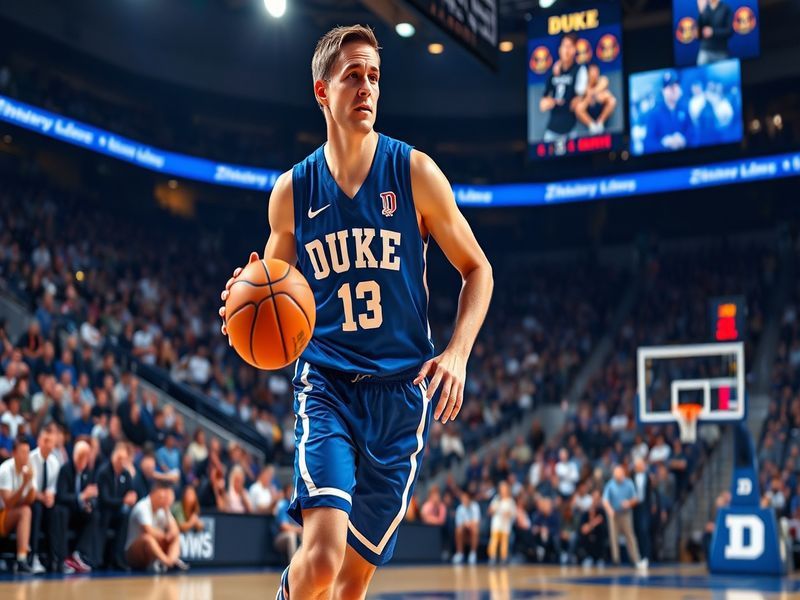
Bobby Hurley’s name isn’t just etched in the record books—it’s written in the DNA of college basketball. As one of the most electrifying point guards of the 1990s, Hurley didn’t just play the game; he rewrote the rules for what a floor general could be. His career at Duke University under Mike Krzyzewski set a new standard for leadership, precision, and clutch performance. More than three decades later, his influence still echoes through the sport, shaping how point guards are evaluated and developed.
The Making of a Legend at Duke
Hurley arrived at Duke in 1988 as a highly recruited freshman from Jersey City, New Jersey. He quickly established himself as a floor leader with an uncanny ability to control the tempo of a game. His partnership with Christian Laettner and Grant Hill formed the backbone of one of the most dominant teams in college basketball history. The Blue Devils won back-to-back national championships in 1991 and 1992, with Hurley orchestrating the offense with surgical precision.
His statistics speak for themselves: Hurley remains Duke’s all-time assists leader with 1,076, a record that stood for nearly three decades. His 1993 graduation marked the end of an era, but his legacy was far from over. The way he distributed the ball, protected it under pressure, and delivered in high-stakes moments redefined what it meant to be a point guard in college basketball.
Key Contributions During His Duke Career
- All-Time Assists Leader: Held the record for most career assists in NCAA history until 2021.
- Two-Time National Champion: Led Duke to back-to-back titles in 1991 and 1992.
- NCAA Tournament Heroics: Averaged 15.8 points and 7.7 assists in NCAA Tournament play.
- Model of Consistency: Shot over 40% from three-point range in multiple seasons, showcasing his all-around offensive skill.
From College Stardom to the NBA and Beyond
Hurley’s transition to the NBA wasn’t seamless. Drafted second overall by the Sacramento Kings in 1993, he faced early struggles with inconsistency and injuries. Despite flashes of brilliance—including a 20-point, 20-assist game in 1996—his NBA career never reached the heights of his college fame. He played for five teams over eight seasons, averaging 7.3 points and 5.1 assists per game. Yet, his impact extended beyond statistics. He embodied the relentless work ethic of a player who had mastered the craft at the highest amateur level.
After retiring as a player, Hurley turned his focus to coaching. He began as an assistant at the University of Rhode Island before joining his alma mater, Duke, in 2004. His coaching tenure under Coach K further solidified his reputation as a developer of talent, particularly at the point guard position. Players like Nolan Smith and Tyus Jones benefited from his mentorship, proving that Hurley’s basketball IQ was as sharp behind the bench as it was on the court.
Hurley’s Lasting Influence on the Game
Hurley’s legacy isn’t confined to trophies or records. It’s embedded in the way modern point guards approach the game. His emphasis on court vision, poise under pressure, and unselfish play has become a blueprint for young guards. Programs across the country now prioritize players who can distribute as effectively as they score—a philosophy Hurley embodied long before it became a trend.
The rise of analytics in basketball has further validated Hurley’s style. Metrics like assist-to-turnover ratio and offensive efficiency now highlight what he instinctively understood: the value of a point guard who maximizes every possession. Even in the era of three-point shooting and positionless basketball, Hurley’s principles remain relevant. His ability to control a game’s rhythm without dominating the ball is a skillset that modern coaches covet.
Off the court, Hurley’s story resonates as a testament to adaptability. He transitioned from a college icon to an NBA role player to a respected coach, proving that success isn’t linear. His journey challenges the notion that a player’s prime defines their entire legacy. Instead, Hurley’s career illustrates how impact can evolve across different phases of life.
The Next Generation of Floor Generals
Today, point guards like Caitlin Clark, Jalen Brunson, and Paige Bueckers are often compared to legends of the past. While the game has evolved, the fundamentals Hurley mastered—leadership, decision-making, and situational awareness—remain timeless. His influence is particularly evident in programs that emphasize player development over raw athleticism. Coaches like Ed Cooley and Jay Wright have cited Hurley as an inspiration for how they structure their offenses and mentor their guards.
For aspiring players, Hurley’s career offers a blueprint: greatness isn’t just about flashy plays or highlight-reel moments. It’s about the quiet, consistent execution of the fundamentals. Whether it’s threading a no-look pass or making the extra pass to a teammate, his legacy is a reminder that basketball is, at its core, a team sport.
Conclusion: A Legacy Built on Fundamentals
Bobby Hurley’s career is a study in contrasts. He was a high-volume scorer in college but a complementary player in the NBA. He was a winner in college basketball but faced the challenges of a pro career. Yet, through it all, he remained a student of the game. His ability to adapt while staying true to his principles is what makes his legacy enduring. For those who study the point guard position, Hurley’s career is a masterclass in how to play the game the right way.
As college basketball continues to evolve, Hurley’s influence persists in the players who prioritize the fundamentals he championed. His story isn’t just a chapter in Duke’s history—it’s a chapter in the broader narrative of basketball itself. For future generations of point guards, Bobby Hurley isn’t just a name to remember; it’s a standard to strive for.
For more insights into the evolution of the point guard position and its impact on modern basketball, explore our Sports and Analysis sections on Dave’s Locker.