Madelyn Burke has emerged as one of the most compelling voices in contemporary creative industries, blending traditional artistry with digital innovation. Her work spans visual design, digital content creation, and experiential storytelling, earning recognition from both niche audiences and mainstream platforms. At just 26 years old, Burke has already curated exhibitions, collaborated with global brands, and built a following of over 1.2 million across social media platforms.
What sets Burke apart is her ability to merge tactile, handcrafted elements with cutting-edge technology. Her signature style often features mixed-media installations where physical textures meet augmented reality overlays. This fusion creates immersive experiences that challenge conventional boundaries between mediums. Whether through interactive public art or limited-edition digital collectibles, Burke consistently pushes the envelope of what creative expression can achieve in the 21st century.
Early Influences and Artistic Evolution
Burke’s artistic journey began in her hometown of Portland, Oregon, where she grew up surrounded by the Pacific Northwest’s vibrant creative culture. Her mother, a textile artist, and father, a jazz musician, introduced her to the interplay between structure and improvisation at an early age. These dual influences—precision and spontaneity—became foundational to her creative approach.
After high school, Burke attended the Rhode Island School of Design (RISD), where she studied sculpture and digital media. It was there that she began experimenting with integrating physical materials and digital projections. A pivotal moment came during her senior thesis project, where she created an interactive installation titled Echo Chamber. The piece allowed viewers to manipulate sound waves through touch, translating their movements into real-time visual projections. The project won the RISD Critic’s Award and marked the first time Burke’s work was showcased outside academic circles.
Key Turning Points in Her Career
- 2019: Launched her first solo exhibition, Fragments of Light, in Brooklyn, featuring AR-enhanced paintings that responded to viewer proximity.
- 2021: Partnered with a major tech firm to develop a series of NFT-based artworks that sold out within hours.
- 2022: Curated Digital Tangibility, a group show exploring the intersection of physical and virtual art, which toured three major cities.
- 2023: Named to Forbes’ 30 Under 30 list in the Art & Style category, solidifying her status as a cultural innovator.
Signature Style and Creative Process
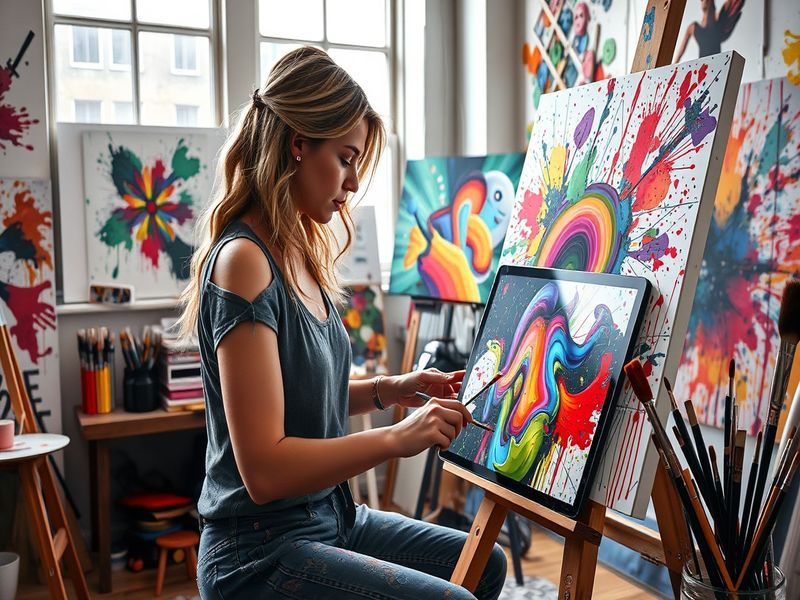
Burke’s work is characterized by its tactile yet ephemeral quality. She often starts with hand-sculpted elements—ceramic, metal, or organic materials—before layering digital elements on top. Her process is deeply iterative; she frequently revisits and reworks pieces based on audience interaction. This collaborative approach extends to her social media presence, where she shares behind-the-scenes footage of her creative process, inviting followers to contribute ideas.
One of her most acclaimed series, Liminal Spaces, explores the emotional resonance of transitional environments like stairwells, hallways, and doorways. Each piece in the series begins as a photograph Burke takes during her travels. She then transforms these images into three-dimensional sculptures, which are scanned and augmented with soundscapes that evolve based on the viewer’s movement. The result is an experience that feels both intimate and expansive, blurring the line between memory and reality.
Tools and Techniques
Burke’s toolkit reflects her hybrid approach. She relies on:
- 3D Scanning: Using photogrammetry to digitize her physical sculptures with millimeter precision.
- AR Development: Leveraging platforms like Unity and Spark AR to create interactive overlays.
- Handcrafted Materials: Prioritizing sustainable, locally sourced materials like reclaimed wood, hand-blown glass, and biodegradable resins.
- Collaborative Software: Tools like Procreate and Blender to prototype and refine digital components before finalizing them in physical form.
Cultural Impact and Industry Influence
Burke’s work has resonated beyond the art world, influencing sectors from fashion to gaming. Her collaboration with a luxury fashion house in 2023 resulted in a capsule collection where garments were embedded with NFC chips. When scanned, these chips unlocked AR filters that transformed the wearer’s appearance in real time. The collection sold out within days and sparked conversations about the future of wearable tech.
She has also made significant strides in democratizing access to digital art. In 2022, she launched Open Canvas, an online platform where emerging artists can upload their work and receive feedback from Burke and her team. The platform has since grown to over 20,000 users, many of whom credit it with helping them secure their first gallery representation or freelance opportunities.
Controversies and Criticisms
Despite her success, Burke’s fusion of physical and digital art hasn’t been without detractors. Some traditionalists argue that her reliance on technology dilutes the authenticity of her work. Others have questioned the environmental impact of her materials, particularly her use of plastics in early installations. In response, Burke has publicly committed to reducing her carbon footprint by sourcing 100% of her materials from certified sustainable suppliers by 2025.
Another point of contention arose when she auctioned a series of NFTs tied to her physical sculptures. Critics accused her of contributing to the speculative excesses of the crypto art market. Burke addressed these concerns in a 2023 interview, stating, “I see these pieces as bridges, not just commodities. The NFT isn’t the art; it’s the key to unlocking a deeper experience.”
Looking Ahead: The Future of Burke’s Vision
As Burke continues to evolve, her focus is shifting toward large-scale public installations that foster community engagement. Her upcoming project, Horizon Line, will transform an abandoned railway in Detroit into an interactive light and sound pathway. The installation will use motion sensors to trigger audio recordings of local residents sharing stories about their city’s past and future. Burke describes the project as “a love letter to forgotten spaces.”
She’s also venturing into filmmaking, with plans to direct a short documentary about artists who are redefining public art in urban environments. The project will premiere at the 2024 Tribeca Film Festival. “I want to show that art isn’t just something you hang on a wall,” she explains. “It’s a conversation, a movement, a living thing.”
With several high-profile commissions in the pipeline—including a permanent installation for a new cultural center in Singapore—Burke shows no signs of slowing down. Her ability to anticipate and adapt to cultural shifts while maintaining a distinct artistic voice positions her as a defining figure of her generation.
As the lines between disciplines continue to blur, Madelyn Burke stands at the forefront of a new creative paradigm—one where art is not just seen or touched, but experienced in ways that are as unique as the individuals who engage with it.